Winter Wellness Challenges That Support Holistic Employee Wellbeing
Last Updated Dec 15, 2025

Key Takeaways
- Cold weather causes a predictable drop in physical, emotional, and social wellbeing that shows up at work. Shorter days, colder temperatures, and disrupted routines reduce movement, energy, and connection at the same time. Because these areas are interconnected, winter wellness strategies help protect engagement, morale, and productivity.
- Winter wellness works best with clear, seasonal structure instead of generic motivation. Winter makes consistency harder without support. Time-bound challenges focused on movement, hydration, nutrition, mindfulness, and connection give employees practical ways to stay engaged through the season.
- Simple wellness challenges can improve energy, immunity, and connection without adding burden. Approachable activities like indoor movement, hydration tracking, mindfulness, nutrition support, and social connection encourage small, repeatable habits that support whole-person wellbeing.
- Inclusive design makes winter wellness effective for remote and hybrid teams. Location-agnostic, asynchronous, and accessible challenges allow employees across schedules, abilities, and environments to participate in ways that work for them.
- Sustained engagement comes from structure, visibility, and feedback. Clear timelines, light gamification, rotating themes, and recognition maintain momentum, while regular feedback reinforces participation and helps turn short-term challenges into lasting habits.
Last winter, Leila noticed her crew was fading. Cameras off. Energy low. Deadlines dragging. The same group that thrived in fall had hit a wall — and she knew the season was partly to blame.
Shorter days and colder temps don’t just change the weather. They change how people move, connect, and cope. Physical routines stall. Burnout spikes. Social energy disappears.
So she tried something simple: winter wellness challenges. Low-pressure, flexible, and fun.
The results? More connection. More movement. A boost in morale — without burnout.
Now it’s your turn. Harness the power of seasonal challenges that actually work — and help your people feel better, together.
How Cold Weather Affects Holistic Wellbeing
Winter has a way of slowing everything down — including your employees. Shorter days, colder temps, and fewer chances to move or connect all impact how people show up at work, whether they’re in the office or dialing in from home.
That seasonal dip? It’s real. And it affects every dimension of employee wellbeing.
Physical activity is often the first to go. Movement routines get disrupted by early sunsets and chilly mornings. And many employees are already struggling to find time to exercise — 51% say it’s their biggest barrier. When winter rolls in, momentum rolls out.
Emotional health takes a hit, too. Colder months bring higher stress and lower energy. And with 90% of employees reporting burnout symptoms in the last year, the need for consistent emotional support has never been more urgent.
Social connection shrinks as routines shift indoors. People see each other less and interact less. But connection matters: 62% of employees say community is essential for long-term wellness. And 53% are more likely to build healthy habits when they do it with others.
All three — physical, emotional, and social wellbeing — are deeply intertwined. When one drops, the others often follow. And in winter, they tend to drop together.
Here’s where HR can make a real difference.
You don’t need to wait for spring to build momentum. You can offer a seasonal wellness plan that helps employees feel better now — one that includes flexible options for movement, rest, nutrition, and connection, all grounded in their unique needs.
Because resolutions don’t drive behavior change — plans do.
Winter Wellness Challenge Ideas to Boost Energy, Immunity, and Team Connection
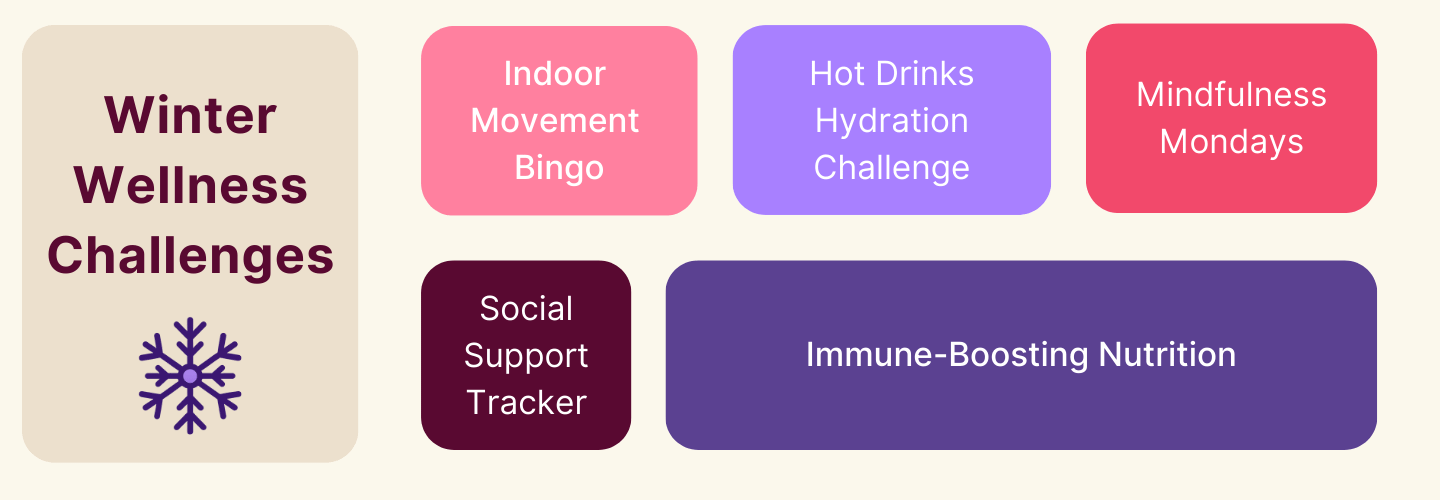
Want to help employees beat the seasonal slump and build healthier habits? The right challenges can do both. Below are five plug-and-play wellness challenge ideas designed for winter — each one easy to launch, flexible for remote teams, and rooted in whole-person wellbeing.
- Indoor Movement Bingo Challenge
What it supports: Physical wellness, stress relief, daily movement
Why it works: It’s simple, self-paced, and surprisingly fun. Plus, it builds momentum — one square at a time.
How to run it:
- Create a digital bingo board with 25 activities. Each square should be a movement that can be done indoors, like:
- Take a CorePower Yoga class
- Try a DanceBody or Zumba session
- Do 20 squats between meetings
- Walk up and down the stairs for 5 minutes
- Complete a 10-minute stretch video
- Take a CorePower Yoga class
- Use tools like Google Sheets, Notion, or a custom PDF for tracking. Bonus points if you use a platform like Slack or Teams to share progress screenshots.
- Run the challenge for 2–4 weeks.
- Offer prizes for:
- A full row or column
- A full blackout
- The most creative workout selfie
- A full row or column
Inclusivity Tip: Include low-impact and desk-friendly options so everyone can participate, regardless of ability or fitness level.
- Hydration Challenge: Hot Drinks Edition
What it supports: Physical health, energy levels, immune support
Why it works: Hydration is often forgotten in winter. This gives employees a warm reason to remember.
How to run it:
- Set a hydration goal (e.g., 8 cups/day for 14 days).
- Encourage employees to log water + warm drinks like:
- Herbal teas
- Hot lemon water
- Bone broth or veggie broth
- Herbal teas
- Use a shared spreadsheet, hydration tracking app, or even a Slack thread.
- Tie the challenge to Sleep Cycle insights by prompting participants to track how hydration affects their sleep.
- Weekly reminder emails or Slack nudges can keep people engaged.
- Recognize small wins, like “Hydration Hero of the Week.”
Bonus: Provide branded mugs or send out tea sampler kits to get people excited.
- Mindfulness Mondays
What it supports: Mental health, emotional regulation, focus
Why it works: Employees start the week with intention — and stress management skills that carry through Friday.
How to run it:
- Pick a mindfulness app (like Meditopia or Headspace) and choose a 5–10 minute practice each Monday.
- Send a calendar invite for the same time every Monday morning (or allow people to complete it any time that day).
- Share a weekly theme, like:
- Week 1: Grounding breathwork
- Week 2: Body scan
- Week 3: Visualization for energy
- Week 4: Gratitude journaling
- Week 1: Grounding breathwork
- Encourage reflection: Add a Slack thread or Teams chat where employees can share what resonated.
- Incentivize consistency — those who complete all four weeks get a reward or shoutout.
Optional: Offer a live guided session the first Monday to kick off the series and build community.
- Immune-Boosting Nutrition Challenge
What it supports: Immune health, energy levels, and mindful eating habits
Why it works: Winter is the perfect time to spotlight foods that fuel — and give employees a plan, not pressure.
How to run it:
- Create a 10-day “Winter Fuel” challenge using Lifesum or BodyFast.
- Daily goals might include:
- Eat a serving of citrus or dark leafy greens
- Add garlic, turmeric, or ginger to a meal
- Prep one batch-cooked meal with immunity-boosting ingredients
- Drink a smoothie with berries and Greek yogurt
- Eat mindfully with no screens for 10 minutes
- Eat a serving of citrus or dark leafy greens
- Provide a downloadable tracker or app-based journal.
- Share a list of warm, easy-to-make recipes employees can try.
- Wrap up the challenge with a virtual “recipe swap” or potluck-style photo contest.
Tip: Keep nutrition language positive and inclusive. The focus is nourishment, not restriction.
- Social Support Tracker
What it supports: Social wellbeing, accountability, team morale
Why it works: People are more likely to follow through when they don’t do it alone. And in winter, connection keeps us going.
How to run it:
- Invite employees to track small acts of connection:
- Joined a group workout (online or in person)
- Checked in on a colleague
- Participated in a Slack thread or challenge chat
- Shared a wellness tip or recipe
- Walked or called a friend instead of scrolling
- Joined a group workout (online or in person)
- Use a point-based tracker. For example:
- 1 point per act of connection
- 10 points = prize entry or badge
- 1 point per act of connection
- You can also create weekly mini-challenges like:
- “Invite a coworker to stretch with you”
- “Post your favorite winter meal in the team chat”
- “Invite a coworker to stretch with you”
Data to know: 83% of employees say they’re more likely to join a workplace wellness initiative if it includes a social or team component.
When winter brings a slowdown, you can offer a plan that brings people together, keeps them energized, and reminds them that wellbeing isn’t one-size-fits-all. It’s flexible. It’s seasonal. And it can start with just one small challenge.
How to Make Winter Wellness Challenges Inclusive for Remote and Hybrid Teams
When your team is spread across time zones, work styles, and home setups, it’s not enough to just launch a challenge. You have to build in accessibility from the start.
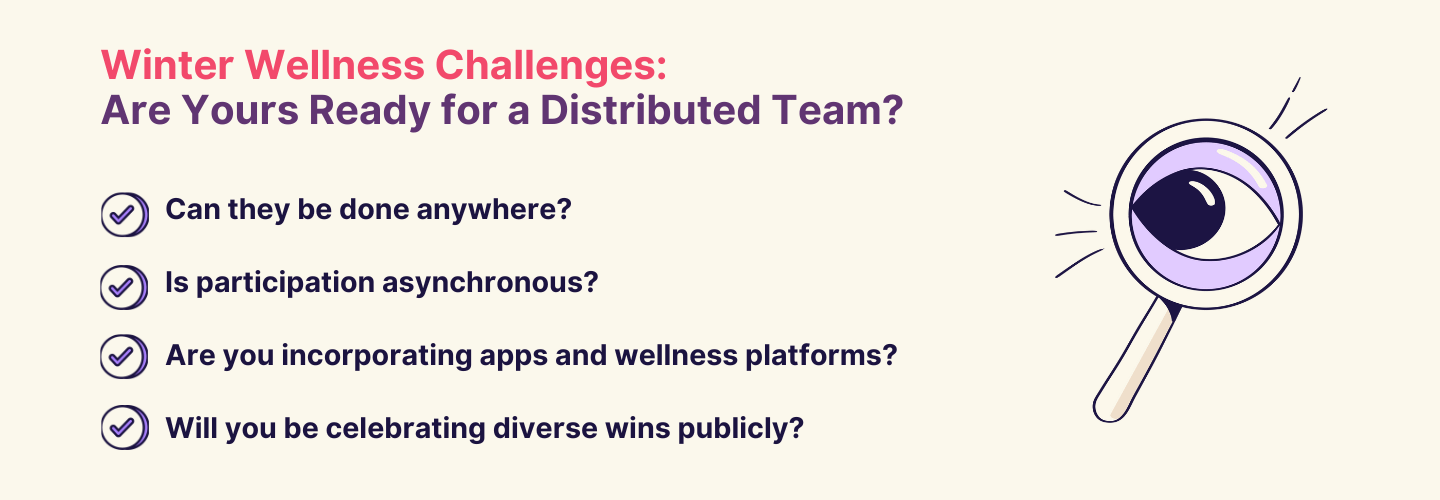
Here’s how to design winter wellness initiatives that reach everyone. Because inclusivity isn’t an add-on—it’s how you make wellbeing stick.
- Choose Activities That Can Be Done Anywhere
Many employees don’t have access to gyms or even a dedicated space for workouts at home. So choose challenges that don’t rely on location, fancy equipment, or a 90-minute time block.
Try this:
- Include desk-friendly movement (like 10-minute stretch breaks or walking meetings)
- Offer both app-based and no-tech options (e.g., printable bingo cards, Google Sheets logs)
- Use universally available tools like Zoom, Slack, or WhatsApp to keep communication open
Inclusive Example: A hybrid employee might take a Zumba class at home, while their in-office teammate does a stairwell walk challenge — and both can still earn challenge points.
- Make Participation Asynchronous by Default
The best way to include everyone? Ditch rigid schedules.
Instead of saying “Join the group stretch at 9 a.m.”, let employees complete activities when it works for them — and still feel like they’re part of the team.
Try this:
- Send Monday reminders with the full week's challenge activities
- Let employees log progress daily or weekly, on their own time
- Create a shared leaderboard that updates automatically (via Google Forms or Typeform)
Inclusive Example: A parent working flex hours can do the Mindfulness Monday practice at night — and still check in with the team the next morning.
- Use Apps and Platforms That Bridge the Distance
Whether your employees are in the office, at home, or on the road, your challenge should meet them where they are. That’s where Wellhub’s wellness partners shine.
Apps like Headspac and AppleFitness+ give everyone access to the same high-quality experience — even if they never step foot in a company building.
Try this:
- Offer a “Winter Wellness Stack” with your top 3–5 recommended apps
- Let employees choose their own path (movement, mindfulness, nutrition, or connection)
- Highlight which apps have mobile, desktop, and on-demand formats
Inclusive Example: A field-based employee can listen to a guided meditation from Headspace in their car before a shift — while a desk-based employee takes the same session on their lunch break.
- Celebrate Wins Equally — and Publicly
Remote workers often miss out on the informal high-fives and hallway shoutouts. So build recognition into your challenge — and make it visible for all.
Try this:
- Use a Slack channel or Teams thread to share daily wins or fun photos
- Highlight participants from all work environments (home, hybrid, field, office)
- Offer non-location-based incentives (gift cards, app upgrades, water bottles)
Inclusive Example: At the end of the Hydration Challenge, you spotlight one remote, one hybrid, and one in-office “Hydration Hero” — and send them each a personalized mug.
When your wellness challenges work for every employee — not just the ones in the room — they have the power to transform culture.
How to Promote Consistency and Energy with Winter Wellness Challenges
A challenge is only as valuable as the habits it creates. The first week of a wellness initiative often comes with excitement and high participation — but winter can quickly drain momentum. Darker days. Packed calendars. Low energy.
So how do you help your people keep going?
The answer isn’t just more reminders. It’s building structure, visibility, and motivation into the challenge from day one. Here’s how to make winter wellness stick — without burning your team out.
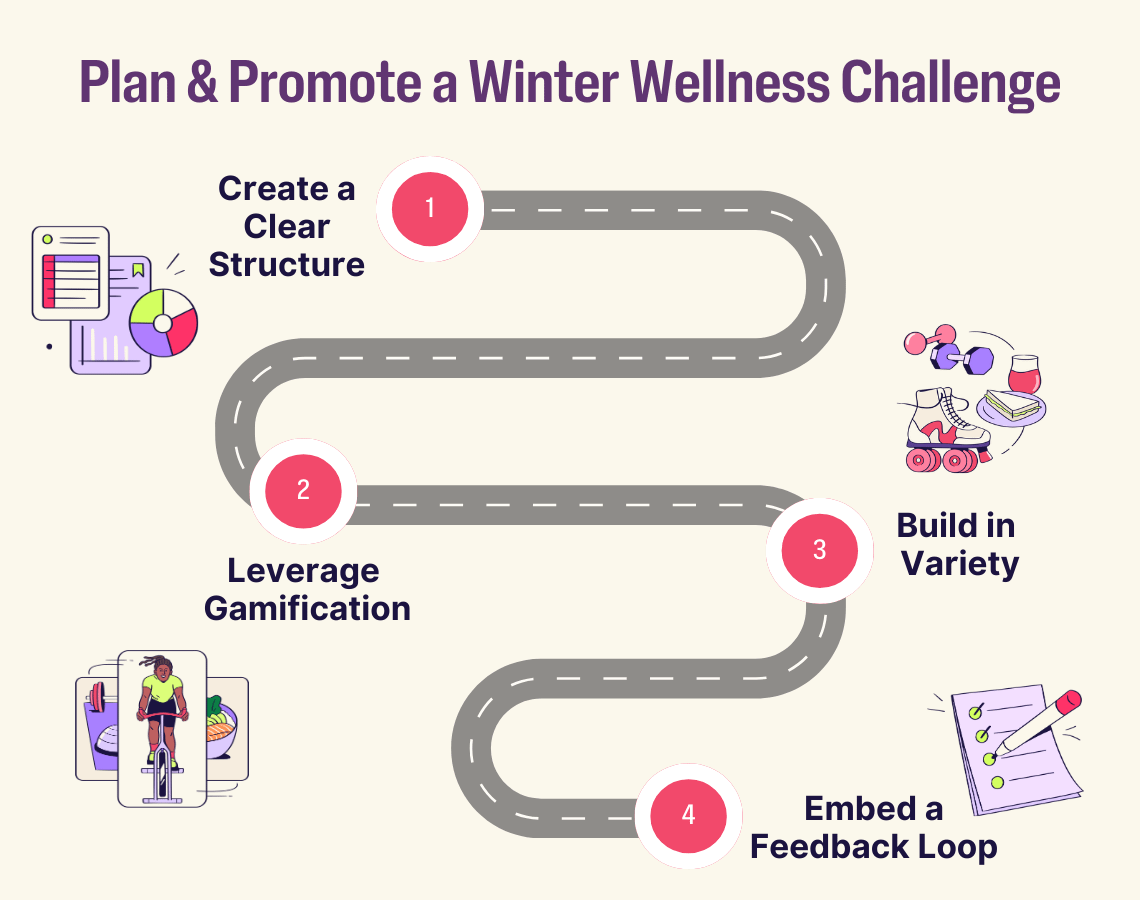
- Set a Clear, Time-Bound Structure
People are more likely to commit when they know exactly what’s expected — and for how long. Vague goals like “stay active this winter” don’t inspire action. Specific, short-term goals do.
Try this:
- Limit each challenge to 2–4 weeks with a clear kickoff and wrap-up
- Use simple weekly formats (e.g., Movement Mondays, Wellness Wednesdays)
- Create a challenge calendar so employees can see what’s coming next
Why it works: Clarity reduces decision fatigue — and gives employees a clear finish line to work toward.
- Use Gamification to Encourage Momentum
Progress tracking, milestones, and light competition all keep people engaged — even when motivation dips. When employees see their progress and feel part of a bigger movement, they’re more likely to stick with it.
Try this:
- Add badges for streaks (3-day, 7-day, 14-day)
- Share weekly team progress updates via email or Slack
- Offer tiered rewards: one for participation, another for consistency
Why it works: People don’t need to win to feel good. They need to feel seen.
- Build in Variety to Prevent Drop-Off
Winter routines can feel repetitive. That’s why variety matters — not just in activities, but in challenge types. Rotate the wellness focus from week to week to keep things interesting and engage different wellbeing needs.
Try this:
- Week 1: Movement
- Week 2: Sleep or hydration
- Week 3: Nutrition
- Week 4: Mindfulness or social connection
Pair each focus with a featured app from your wellbeing program so employees can explore new tools and routines.
Why it works: Variety reduces boredom — and makes the challenge feel fresh, even in week four.
- Keep the Feedback Loop Open
The easiest way to lose energy? Let employees feel like no one’s listening. Ongoing feedback builds trust and helps you adapt in real time.
Try this:
- Run a 1-minute pulse survey halfway through the challenge
- Ask weekly check-in questions in a Slack thread or virtual huddle
- Use insights to adjust the next challenge (and let employees know their input shaped it)
Why it works: Employees are more engaged in programs they help shape — and more likely to rejoin the next one.
Keep Wellbeing Hot Through Winter
Winter slows everything down—including your team’s energy, connection, and routines. When movement drops, stress rises. And isolation makes it harder to stay motivated.
A wellbeing program keeps momentum going with flexible tools for fitness, mindfulness, nutrition, and connection.
Wellhub members are 58% more likely than non-members to say their wellbeing improved over the past year. Speak with a Wellhub team member to keep your team active and energized this winter.

Company healthcare costs drop by up to 35% with Wellhub*
See how we can help you reduce your healthcare spending.
[*] Based on proprietary research comparing healthcare costs of active Wellhub users to non-users.
Category
Share

The Wellhub Editorial Team empowers HR leaders to support worker wellbeing. Our original research, trend analyses, and helpful how-tos provide the tools they need to improve workforce wellness in today's fast-shifting professional landscape.
Subscribe
Our weekly newsletter is your source of education and inspiration to help you create a corporate wellness program that actually matters.
Subscribe
Our weekly newsletter is your source of education and inspiration to help you create a corporate wellness program that actually matters.
You May Also Like

FSA vs. HSA Strategy for HR Leaders | Wellhub
Compare FSA vs HSA rules, tax advantages, eligibility, and rollover differences to help employees choose the right account and avoid costly compliance issues.

Employee Wellness Programs: Key Components for Success | Wellhub
Transform your workplace wellness strategy by integrating physical, mental, financial, and social wellbeing into a comprehensive wellness program that works

Benefits Strategy Roadmap: Pull and Retain Top Talent | Wellhub
Support wellbeing, reduce turnover, and maximize ROI with a benefits strategy built for today’s workforce—not yesterday’s spreadsheet.