Wellness Solutions for International and Distributed Workforces: A Global HR Playbook
Last Updated Dec 3, 2025

Key Takeaways
- Global wellness is a strategic necessity. Employee wellbeing is now a core driver of performance, retention, and engagement. Wellness is a business imperative that directly impacts productivity, loyalty, and company culture across borders.
- Equitable and localized wellness access is critical. Global teams require wellness programs that account for cultural, linguistic, and infrastructural differences. Localization and digital-first access ensure all employees—regardless of location—experience the same standard of care and inclusion.
- Community and connection power engagement. Wellness thrives in shared experiences. Building global challenges, social features, and peer recognition into programs creates belonging and consistency across distributed teams, reducing isolation and strengthening culture.
- Measurement and adaptability sustain long-term success. HR leaders must track participation, engagement depth, satisfaction, and retention to prove ROI and refine wellness strategies. Data-informed iteration turns wellness from an initiative into an evolving, high-impact business strategy.
Your workforce is growing borders, time zones, and cultures.
Work has gone global so rapidly that many wellness strategies haven’t kept pace.
Disconnected programs. Inconsistent access. One-size-fits-all benefits that don’t resonate beyond headquarters. These gaps don’t just frustrate employees—they cost real money in burnout, turnover, and lost productivity.
Employees now expect wellness to be as flexible, personal, and global as their work lives. And HR leaders who deliver on that expectation aren’t just improving morale—they’re protecting business performance.
Uncover the benefits of global workforce wellness. Learn how the right strategy can boost retention, fuel performance, and build a culture that travels as well as your team does.
The Business Case for Global Workforce Wellness
Employee wellbeing is now one of the most reliable predictors of business success. The data from Wellhub’s 2026 State of Work-Life Wellness Report makes that connection unmistakable: when employees feel well, they work well.
Across continents, job functions, and industries, employees are saying the same thing — wellness drives their performance, focus, and loyalty. For HR leaders, that’s not a trend. It’s a strategic imperative.
Wellbeing and Work Performance
Healthy employees perform better. It’s that simple.
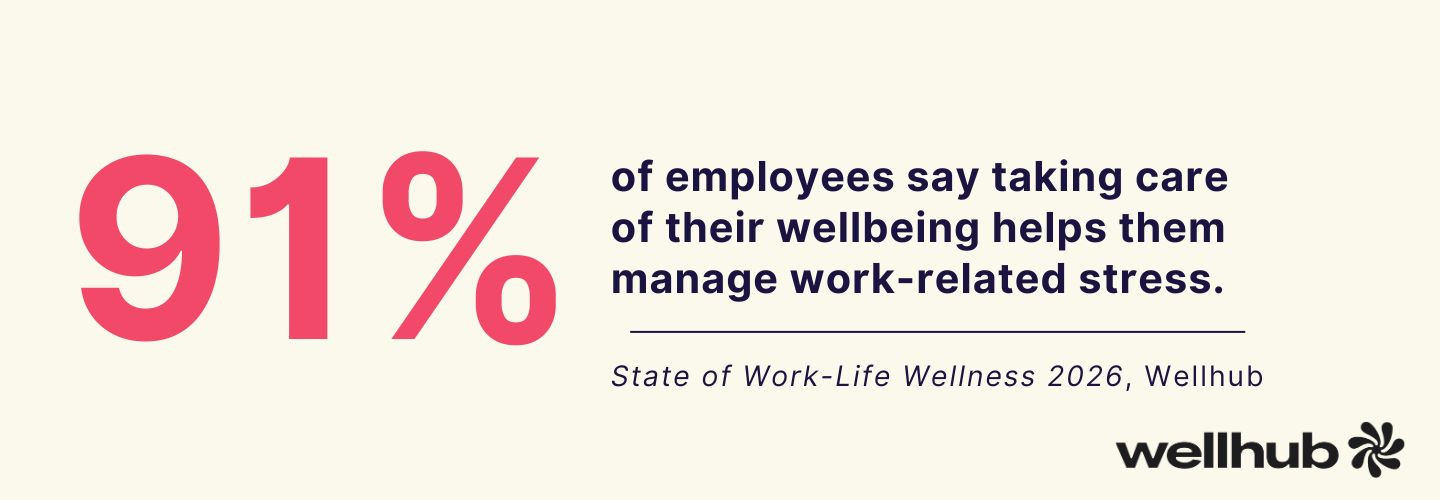
Ninety-one percent of employees say spending time in wellness spaces — gyms, yoga studios, or fitness classes — helps them manage work-related stress. Eighty-nine percent say that when they prioritize their wellbeing, their performance improves.
These numbers highlight what HR professionals have long known: wellness is not time away from work; it’s what makes great work possible. Regular movement, social connection, and recovery fuel energy, focus, and creativity.
The report also shows that 95% of employees see physical, mental, emotional, and social wellbeing as interconnected, with nearly half strongly agreeing. Effective wellness programs now reflect this reality. They don’t just focus on gym access or mental health alone — they weave together every dimension of wellbeing to support the whole person.
Culture and Infrastructure
Embedding wellness in company culture remains a major challenge. Only 17% of employees strongly agree that wellness is part of their organization’s DNA. That number represents a gap between belief and practice.
Workload plays a central role in that gap. Forty-three percent of employees identify excessive workload as the top cause of burnout. No wellness app can offset chronic overwork. Sustainable productivity depends on systems that give people time and permission to recover.
The quality of wellness offerings also matters. Only 29% of employees rate their company’s programs as good — down from 41% last year. As expectations rise, employees want wellness resources that are flexible, personalized, and relevant to their day-to-day lives. Programs that stop at access miss the point. Employees want to see wellbeing reflected in how work actually happens.
Retention and Talent Risk
Wellbeing now influences whether people stay. Eighty-five percent of employees say they would consider leaving a company that doesn’t prioritize wellness — up from 68% in 2022.
That shift is significant. It means wellness has become a core factor in employment decisions, right alongside pay and flexibility. Organizations that fail to invest in wellbeing risk higher turnover, steeper hiring costs, and weakened engagement.
Retention is one of the clearest returns on wellness investment. When employees feel supported, they stay longer, contribute more, and advocate for their workplace.
Community as a Force Multiplier
Wellbeing is social by nature. Sixty-two percent of employees say community and social support are essential to maintaining long-term wellness habits. That insight has major implications for program design.
When companies build opportunities for connection — group fitness, shared challenges, mentorship, or peer recognition — employees are more likely to sustain healthy habits. Social accountability reinforces consistency, and consistency drives impact.
Wellbeing programs work best when they help employees feel like part of something larger than themselves.
Challenges of Wellness in Distributed and International Teams
Leading wellness in a distributed, international organization is like conducting an orchestra across time zones — every section is playing the same song, but not always at the same tempo. When your people are everywhere, their wellbeing experiences are too. These challenges aren’t signs of failure; they’re simply the natural complexities that come with global scale.
Here are seven that every HR leader should understand — because recognizing them is the first step to addressing them strategically.
- Time Zones and Distance
Global teams operate on a 24-hour clock, and that rhythm makes shared experiences difficult to synchronize. A meditation class that feels energizing at 11 a.m. in New York might take place at midnight in Singapore or dawn in London.
Beyond scheduling, time zones also shape how employees experience work-life balance. For some, “after hours” no longer exist. Late-night meetings or early morning calls can slowly erode recovery time and sleep quality. Over time, this fatigue can compound into burnout.
Distributed teams also lose the micro-moments that bond in-person teams — casual chats, spontaneous walks, shared lunches. Without those informal touchpoints, maintaining a rhythm of connection requires deliberate effort.
- Cultural and Language Diversity
Wellbeing doesn’t look the same everywhere. In Japan, mental health support may still carry stigma. In Brazil, wellness might center on movement and community. In Germany, it’s often about balance and time off.
Cultural context influences how employees understand and engage with wellness. Even the word “wellness” may translate differently—or not at all. Programs built on a single cultural assumption can unintentionally alienate or exclude.
Language barriers add another layer. A beautifully designed mindfulness video or nutrition guide loses its impact if it’s only available in one language. And idioms or imagery that resonate in one country can confuse or offend in another.
In short: what feels universal from headquarters may not feel accessible—or relevant—elsewhere.
- Access and Equity
Not every employee has equal access to wellness resources. Office-based workers might enjoy on-site gyms or catered lunches, while remote employees rely on what’s available in their local community—or their apartment living room.
Infrastructure varies, too. Reliable internet, safe outdoor spaces, or even local availability of healthy food options can differ widely across regions. A wellness challenge that assumes a shared baseline—like tracking daily steps or joining live fitness sessions—can unintentionally exclude those without equal conditions.
Equity issues also emerge when benefits are tied to physical location. A U.S. employee might have mental health coverage under company insurance, while a contractor in Argentina or Poland may not. For distributed organizations, this disparity can feel personal—and it erodes trust.
- Engagement and Belonging
Wellness thrives on connection, but distance often undermines it. Remote workers report higher rates of loneliness and disengagement than their office-based peers. When people work in isolation, even well-intentioned programs can feel transactional or optional.
Without shared physical spaces, distributed employees miss the subtle reinforcement of wellness culture—the colleague who invites them for a lunchtime walk, the yoga mat in the corner of the breakroom, the collective pause when someone grabs a healthy snack.
The result? Wellness can start to feel like an individual responsibility rather than a shared value. And when belonging weakens, so does participation.
- Compliance and Consistency
HR teams leading wellness globally walk a tightrope between local compliance and global cohesion. Every country has its own labor laws, healthcare systems, and tax frameworks. A benefit that’s compliant in Spain might violate regulations in Singapore or the U.S.
Even within multinational companies, benefit structures can differ dramatically. Some locations may have mandatory health stipends; others rely on voluntary programs. Ensuring consistency while respecting local laws is a balancing act that requires constant recalibration.
This complexity makes it hard to promise a unified employee experience. It’s not just about equity—it’s about credibility. Employees expect the same care, no matter where they log in from.
- Measuring Impact Across Borders
Wellness success looks different depending on who—and where—you ask. Participation rates might vary because of cultural attitudes toward self-reporting, privacy norms, or even workweek structure.
Data collection also raises challenges. Privacy regulations like GDPR in Europe or LGPD in Brazil can limit how organizations measure health-related outcomes. And beyond legality, there’s the cultural lens: in some regions, discussing wellbeing metrics may feel intrusive.
The result is a patchwork of insights that makes it difficult to evaluate what’s working globally. HR leaders must often interpret fragmented data and still find ways to tell a cohesive story about wellness impact.
- Losing Access During Business Travel
When employees travel internationally for work, wellness routines are often the first casualty. Jet lag, disrupted sleep, and unfamiliar food options make it hard to maintain healthy habits. Add long flights, packed itineraries, and changing time zones—and even the most committed employees can lose access to wellness support.
Corporate wellness benefits rarely travel as smoothly as the employees do. Gym partnerships may be location-specific. Mental health platforms may not be licensed in the destination country. Even company-provided wellness apps can face regional access restrictions.
For global workforces, this means wellness can literally stop at the border. And that sends a subtle message: wellbeing is conditional, not continuous.
Each of these challenges is inherent to global, distributed work. They aren’t signs that wellness programs are doomed to falter—they’re reminders that the world of work has changed faster than most benefit systems have. Recognizing these patterns helps HR leaders design solutions that are as flexible and borderless as their teams.
Wellness Solutions for Global and Distributed Workforces
Global wellness can feel complex—but it doesn’t have to be. Wellhub makes it simple, scalable, and human. With one platform supporting physical, mental, and social wellbeing across the U.S., Brazil, Mexico, Argentina, Chile, Spain, Germany, the U.K., Ireland, Romania, Italy, Portugal, and Canada, HR leaders can deliver a unified experience that adapts to every culture and time zone.
Here’s how to make global wellness work everywhere your people are.
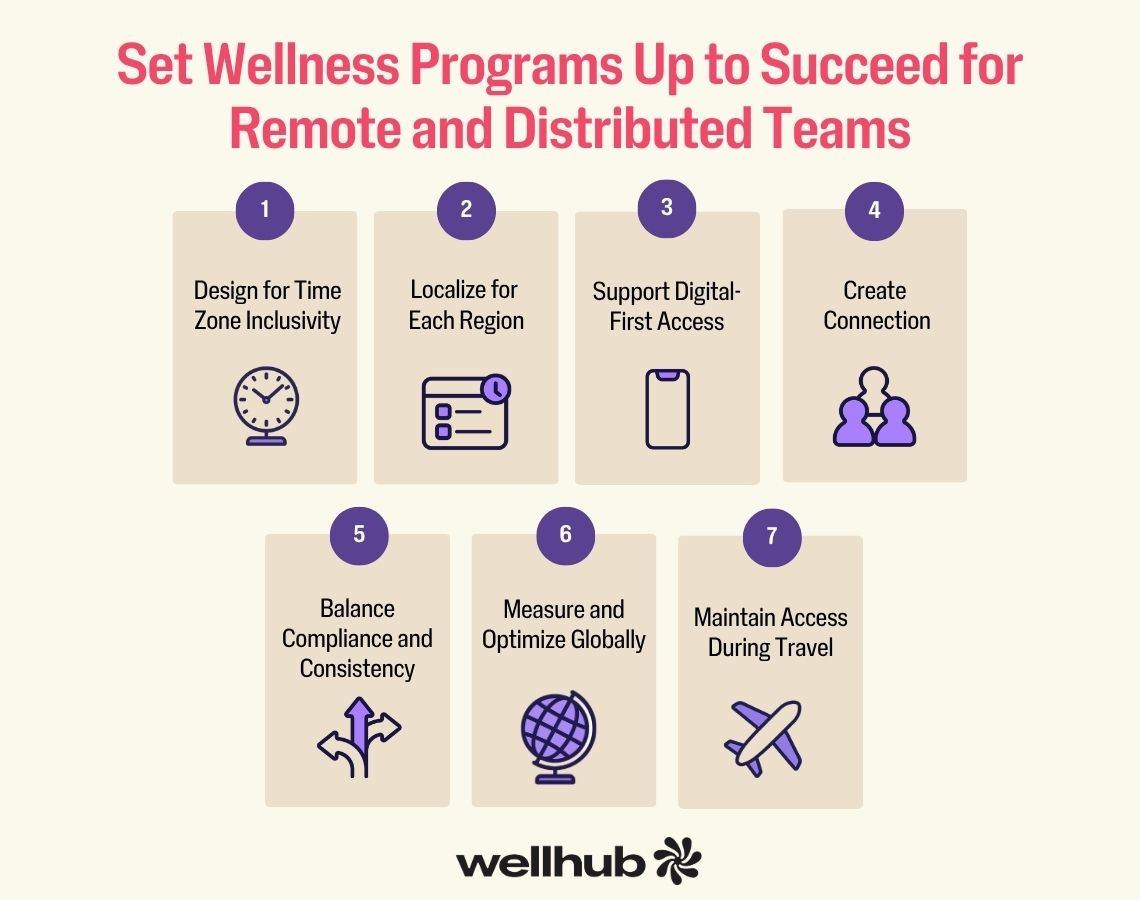
- Design for Time Zone Inclusivity
Wellness only works when everyone can join. For global teams, that means designing programs that are time-zone neutral and universally accessible.
What this looks like in practice:
- Offer on-demand, asynchronous wellness content through Wellhub—recorded yoga sessions, guided meditations, and digital fitness classes employees can access anytime, from Toronto to São Paulo to Dublin.
- Rotate live events quarterly so every region gets its “prime-time” moment, whether it’s a lunchtime mindfulness session in London or an afternoon mobility break in Los Angeles.
- Use Wellhub’s global challenges feature to run asynchronous step, sleep, or hydration activities where participation—not timing—drives success.
Treat wellness like communication: asynchronous by default, live by exception.
- Localize Wellness for Culture and Language
Culture shapes how people experience wellbeing. What’s restorative in Berlin might look different in Santiago or Dallas. Localization ensures that wellness feels familiar, not foreign.
What this looks like in practice:
- Use Wellhub’s network of local partners to offer wellness experiences tailored to each country—think Pilates in Madrid, functional training in São Paulo, or mindfulness sessions in Vancouver.
- Provide content in multiple languages (English, Spanish, Portuguese, German, Romanian, Italian) so employees everywhere feel included.
- Align wellness campaigns with local holidays or cultural rhythms—such as mental-health initiatives during World Wellbeing Week in the U.K. or movement challenges in Brazil’s spring season.
When wellness speaks everyone’s language, participation becomes personal.
- Build Equity Through Digital-First Access
In global organizations, wellness shouldn’t depend on where an employee works. A digital-first approach makes wellbeing fair and accessible for everyone—whether they’re in an office in Chicago or working remotely in Lisbon.
What this looks like in practice:
- Give all employees equal access to Wellhub’s all-in-one digital platform, which integrates fitness, mindfulness, nutrition, and therapy support—available in every operating country.
- Track engagement data within Wellhub to ensure every team, location, and region participates equitably.
Equity starts with access. When everyone logs in through the same platform, they get the same experience of care.
- Create Connection to Strengthen Engagement and Belonging
Wellness thrives in community: 56% of employees feel extremely or very connected to others during shared wellness activities, and a third say wellness challenges are their favorite form of workplace wellbeing initiative. For distributed teams, intentional connection transforms isolated participation into a shared culture of wellbeing.
What this looks like in practice:
- Launch Wellhub-powered challenges that bring together employees from Buenos Aires to Berlin. Global step counts, mindfulness streaks, or hydration goals unite teams across borders.
- Use Wellhub’s community and leaderboard features to encourage friendly competition and celebrate wins.
- Spotlight regional champions and success stories in company communications to reinforce belonging.
- Balance Compliance with Consistency
Each country has its own benefits rules and tax laws—but employees still expect a cohesive wellness experience. Balancing local compliance with global consistency builds trust and transparency.
What this looks like in practice:
- Deploy Wellhub’s global wellness framework, which standardizes benefits while adapting seamlessly to local regulations in the U.S., E.U., and Latin America.
- Give local HR teams flexibility to tailor offerings—like expanding mental-health resources in Ireland or adding fitness options in Chile—without losing brand alignment.
- Maintain clear documentation outlining country-specific benefits, eligibility, and tax guidance.
Think globally, act locally. When structure and flexibility coexist, compliance becomes simple.
- Measure and Optimize Globally
You can’t improve what you don’t measure—and in distributed teams, consistent data collection is key. The challenge is doing it responsibly across borders.
What this looks like in practice:
- Use Wellhub’s analytics dashboard to track engagement, participation, and wellbeing outcomes.
- Analyze usage patterns to identify trends: perhaps meditation uptake is highest in Spain, while nutrition engagement peaks in Canada.
- Share insights across leadership teams to demonstrate the ROI of global wellbeing initiatives.
Turn data into dialogue. When employees and leaders see wellness impact, they invest even more in sustaining it.
- Keep Wellness Continuous During International Travel
In traditional programs, employee wellness stops at the airport. Not with Wellhub. Through International Check-ins, employees can access their same wellness benefits while traveling within Wellhub’s operating network.
What this looks like in practice:
- Employees traveling from Mexico to Spain—or from the U.S. to Germany—can check into thousands of gyms, studios, and wellness centers using their same Wellhub account.
- Travelers keep digital access to their favorite workouts, mindfulness content, and nutrition tools with zero disruption.
- HR leaders can include Wellhub in travel policies, ensuring wellbeing support follows employees on every trip.
When wellness travels with your employees, it tells them their wellbeing is never out of office.
Wellhub empowers HR leaders to deliver one consistent, culturally aware, and continuously accessible wellness experience—across 13 countries, countless time zones, and every way of working. Wherever your people go, Wellhub goes with them.
Implementation Roadmap: How to Roll Workforce Wellness Out Globally
A global wellness strategy only works when every employee knows about it, understands it, and feels invited to participate. Launching across countries, languages, and time zones takes more than good intentions — it takes structure.
Wellhub partners with HR teams to take the guesswork out of that process. From planning to communication to ongoing engagement, every step is supported with proven resources, data insights, and tools that make activation simple and repeatable.
Here’s how global rollout works in practice.
Phase 1: Align and Assess
The first step is clarity. Before you introduce any new program, it’s essential to understand where wellness currently stands in your organization.
What this looks like in practice:
- Work with your Wellhub Customer Success Manager to map existing benefits, participation levels, and regional differences.
- Assess employee wellbeing needs to capture needs across countries and work arrangements.
- Align on goals — whether that’s reducing burnout, improving retention, or boosting engagement.
Pro tip: Start by listening. When employees feel heard before rollout, participation follows naturally.
Phase 2: Design Your Global Framework
Once you understand your baseline, it’s time to build your blueprint. A strong global framework balances company-wide consistency with regional flexibility.
What this looks like in practice:
- Use Wellhub’s platform to define core wellness pillars (physical, mental, social, and emotional) that translate across all your operating countries.
- Customize local options — gym access in Brazil, mindfulness programs in Ireland, or nutrition support in Canada — within the same global structure.
- Identify regional ambassadors or HR leads to serve as wellness champions.
Pro tip: Think globally, deliver locally. The most successful wellness programs feel both familiar and personal.
Phase 3: Prepare for Launch
Communication determines success. Employees need to know what’s changing, why it matters, and how to get started.
What this looks like in practice:
- Wellhub’s Launch Toolkit includes banners, flyers, and internal posts that build awareness before launch day.
- Use Wellhub’s channel framework to reach employees where they already are — through the company intranet, Slack or Teams, internal emails, and digital signage.
- Equip managers and wellness ambassadors with talking points so messages feel personal, not corporate.
Pro tip: Consistency beats volume. The best campaigns repeat one clear message across multiple touchpoints: “Wellness is for everyone — and it starts now.”
Phase 4: Launch and Engage
Launch day is about excitement and accessibility. The goal is to make it easy for employees to explore and participate right away.
What this looks like in practice:
- Use the toolkit’s Launch Communications Calendar to time posts, videos, and emails that highlight key benefits.
- Host a virtual or hybrid kickoff event so employees in every region can participate live or asynchronously.
- Encourage teams to join their first Wellhub activity — a local studio class, mindfulness session, or team challenge — within the first week.
Pro tip: Wellness adoption follows awareness. The more visible your program is in its first month, the faster it becomes part of the culture.
Phase 5: Measure and Optimize
Sustained success requires feedback and iteration. Measurement transforms a wellness program from an initiative into an ongoing strategy.
What this looks like in practice:
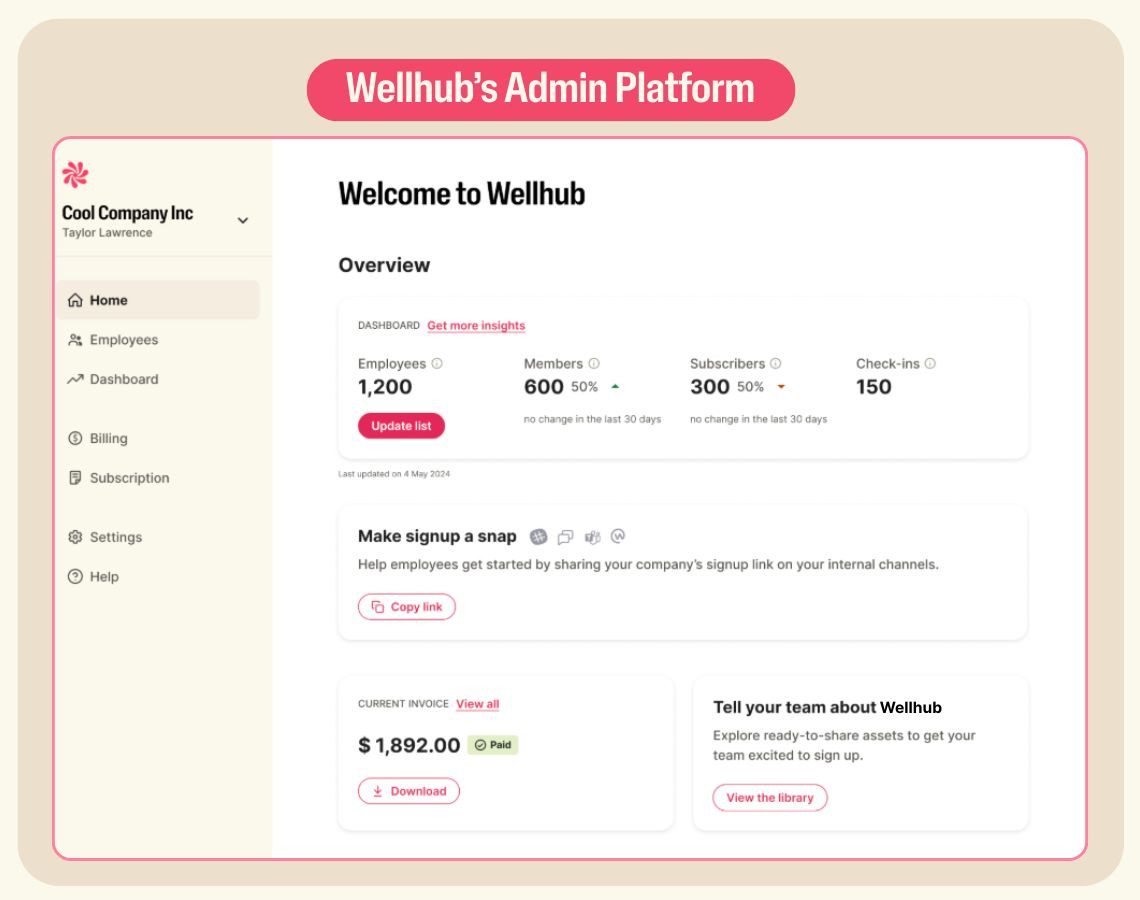
- Use Wellhub’s HR admin platform to track participation rates, engagement depth, and feedback by region.
- Run quarterly pulse surveys to capture employee sentiment and identify emerging needs.
- Adjust programming seasonally — promoting outdoor activities in summer months or mindfulness during peak work cycles.
Pro tip: Data is only valuable if it drives action. Share results with employees to show that their feedback shapes what comes next.
Phase 6: Sustain and Evolve
Wellness is most powerful when it becomes part of everyday culture. That requires momentum, recognition, and continuous storytelling.
What this looks like in practice:
- Celebrate participation milestones and spotlight local success stories.
- Refresh your communications quarterly with updated Wellhub toolkits and new creative assets to keep messaging fresh.
- Expand engagement with region-specific challenges or seasonal wellness campaigns.
- Build wellness into onboarding so new hires join a culture that already values wellbeing.
Pro tip: Consistently is key to building a wellness culture. Every message, event, and metric reinforces that wellbeing is part of how your company works.
Rolling out global wellness doesn’t have to be complicated. With Wellhub’s structured roadmap, ready-to-use communication toolkits, and country-by-country support, HR leaders can focus on what matters most: helping people feel their best wherever they work.
Global wellness starts with one connected plan — and grows through every moment of engagement that follows.
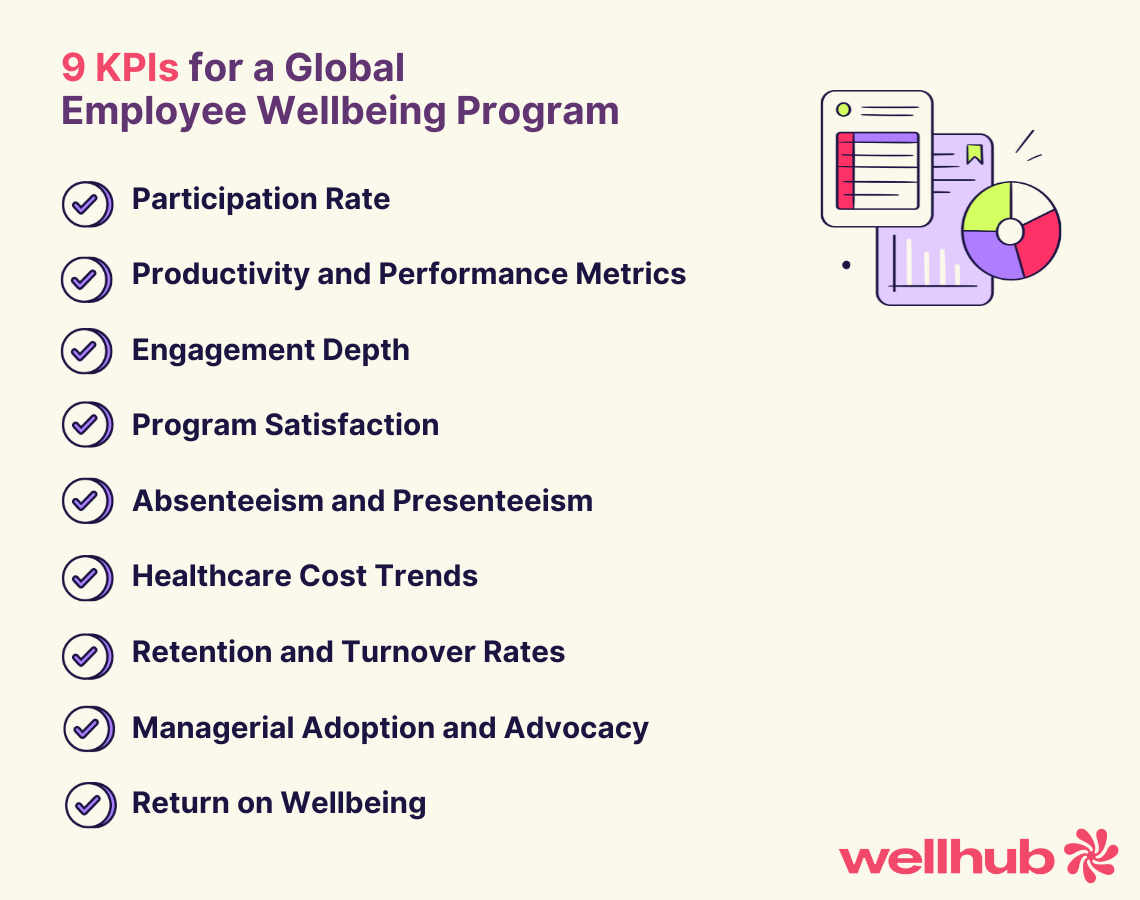
How to Measure Success: 9 Employee Wellbeing Program KPIs
Once your global wellness program is up and running, the real work begins: measuring what’s working, where it’s working, and how it’s moving the needle for your people and your business.
These are the KPIs that matter most for any global wellness program.
- Participation Rate
What it tells you: This is your baseline indicator of engagement—how many employees are actively using your wellness program. Participation shows awareness, relevance, and accessibility.
Why it’s valuable: A high participation rate signals strong communication, cultural alignment, and program appeal. Low participation often highlights structural barriers (like time-zone conflicts or lack of awareness) that can be fixed with better promotion or accessibility.
How to collect it: Track the percentage of employees engaging with at least one wellness activity each month. Use your HR platform to break it down by region, department, or work type (remote, hybrid, on-site).
- Productivity and Performance Metrics
What it tells you: Wellbeing directly influences focus, creativity, and output. Tracking productivity changes offers a clear link between wellness and business performance.
Why it’s valuable: Demonstrating that wellness boosts performance reframes it as a strategic investment—not a “perk.” It also helps align HR goals with CFO and COO priorities.
How to collect it: Combine self-assessments (“I feel energized and focused at work”) with business metrics like project completion rates, quality scores, or revenue per employee.
- Engagement Depth
What it tells you: Beyond participation, engagement depth measures how frequently and meaningfully employees interact with wellness offerings. Are they attending one yoga class—or returning weekly?
Why it’s valuable: Deep engagement predicts habit formation, which drives sustained wellbeing outcomes. It’s a stronger indicator of cultural adoption than one-time participation.
How to collect it: Monitor attendance frequency, app logins, or the number of unique activities per user over time. Pair quantitative data with pulse surveys to understand why employees keep returning.
- Program Satisfaction
What it tells you: Program satisfaction reflects how well your offerings align with employee expectations and needs. It’s the emotional counterpart to participation metrics.
Why it’s valuable: High satisfaction correlates with retention, advocacy, and employer brand strength. When employees feel seen and supported, they become wellness ambassadors—spreading adoption organically.
How to collect it: Run quarterly wellness satisfaction surveys. Use both numeric ratings (e.g., Net Wellness Score) and open-text responses to capture qualitative feedback.
- Absenteeism and Presenteeism
What it tells you: Absenteeism measures lost workdays due to illness or stress. Presenteeism measures employees who show up but operate below capacity due to poor wellbeing.
Why it’s valuable: Both are leading indicators of burnout and disengagement. Reductions in absenteeism and presenteeism directly reflect improved health and productivity.
How to collect it: Work with HR and payroll data to track sick days per full-time employee. Pair with manager feedback or self-assessments about productivity and focus levels.
- Healthcare Cost Trends
What it tells you: Over time, wellness programs can reduce healthcare utilization, chronic illness rates, and medical claims. Wellhub clients, for example, have seen an up to 35% drop in healthcare costs.
Why it’s valuable: This KPI translates wellness impact into financial terms—demonstrating cost avoidance and improved organizational health.
How to collect it: Analyze annual healthcare claims data, employee assistance program usage, or insurance renewal rates. Track correlations with wellbeing participation and engagement depth.
- Retention and Turnover Rates
What it tells you: Wellness and retention are deeply connected. Employees who feel cared for are less likely to leave—and more likely to refer others.
Why it’s valuable: Improved retention demonstrates that your wellness program is strengthening organizational loyalty. This KPI also translates directly into cost savings for talent acquisition and onboarding.
How to collect it: Compare turnover rates before and after your wellness program launch. Segment by engagement level—employees who participate in wellness programs often show lower attrition rates than those who don’t.
- Managerial Adoption and Advocacy
What it tells you: Manager engagement is the multiplier effect of wellness. When managers participate and encourage teams, programs scale faster and sustain longer.
Why it’s valuable: A manager’s behavior signals organizational priorities. Their participation normalizes wellbeing and integrates it into the employee experience.
How to collect it: Track manager participation rates and their frequency of wellbeing communications (such as promoting challenges or sharing results in team meetings).
- Return on Wellbeing
What it tells you: ROW calculates the tangible and intangible business impact of your wellbeing program—combining engagement, retention, healthcare cost, and productivity data.
Why it’s valuable: This is your boardroom KPI. It quantifies the link between wellbeing and bottom-line outcomes, making it easier to sustain executive support and funding.
How to collect it: Compare the cost of your wellness investment against measurable returns—such as reduced absenteeism, higher retention, or healthcare savings. Track trends over time to establish a clear narrative of impact.
Future Trends in Global and Distributed Workforce Wellness
The future of global workforce wellness is flexible, tech-powered, and deeply human.
In 2026 and beyond, leading organizations are designing wellness programs that treat employees as whole people, not just workers. They’re blending neuroscience, technology, and empathy to create cultures of wellbeing that thrive anywhere on the planet.
Key Global Workforce Wellness Trends
Global workforce wellness in 2025 is evolving into a holistic, science-backed business strategy. Organizations are embedding wellness into leadership, policy, and everyday work habits to strengthen both performance and employee experience.
- Integrated wellness as business strategy: Leading companies no longer treat wellness as a perk. They integrate it into operations, aligning wellbeing with performance, retention, and engagement goals.
- Cognitive wellness at work: Employers are focusing on brain health, emotional regulation, and focus through neuroscience-based programs. Sleep education, mental recharge time, and aligning work schedules with natural cognitive rhythms are becoming standard.
- Holistic wellbeing models: Physical, mental, and social health are now interconnected. Nutrition for brain health, movement for mood, and human connection for belonging form a complete wellbeing ecosystem.
- Flexibility as a wellness driver: Flexible work hours and autonomy reduce stress and strengthen work-life balance across distributed teams and time zones. Flexibility is emerging as a top predictor of long-term employee wellbeing.
Summary insight: Organizations that operationalize wellbeing as a cultural pillar see stronger performance outcomes, lower burnout rates, and higher employee engagement.
Distributed and Hybrid Workforce Wellbeing
As distributed and hybrid work become the global standard, companies are designing wellness programs that reach employees wherever they are.
- Borderless wellness access: Programs now serve employees both onsite and remotely, from Toronto to Buenos Aires, ensuring equitable access to resources and community.
- Omnichannel delivery: Wellness offerings combine virtual fitness classes, on-demand mindfulness sessions, and stipends for home office ergonomics. This hybrid model meets employees where they work.
- Flexible scheduling for wellbeing: Practices such as summer hours, no-meeting Fridays, and locally adjusted workdays support energy management and mental restoration.
- Localized best practices: Global firms are learning from regional wellness norms—European summer slowdown policies and Latin American mid-afternoon rest practices—proving that cultural adaptation sustains participation.
Summary insight: Global wellness succeeds when it’s accessible, flexible, and culturally responsive—meeting distributed employees where they live and work.
Technology and Personalization in Employee Wellbeing
Technology is transforming workforce wellness from one-size-fits-all into personalized, data-informed experiences that improve participation and outcomes.
- AI-driven personalization: Wellness platforms now use wearable data, employee feedback, and health analytics to tailor programs to each individual’s needs.
- Connected digital ecosystems: From mindfulness apps and wearable integrations to wellbeing dashboards, technology empowers employees to self-manage their health while giving HR visibility into engagement trends.
- Employee choice: Workers want control over how they stay well—choosing from fitness stipends, ergonomic resources, meditation, sleep tracking, and financial coaching.
- Real-time optimization: Data-driven insights allow companies to continuously refine offerings and improve ROI on wellness initiatives.
Summary insight: Personalized wellness technology increases engagement, enables measurable results, and aligns wellbeing programs with both employee expectations and organizational goals.
Mental Health and Psychological Safety
Mental health has become the cornerstone of global wellness strategies. Companies are embedding psychological safety and proactive mental health support into their cultures.
- Psychological safety in distributed teams: Remote and hybrid employees need trust and open communication to thrive. Clear norms and visible support build that foundation.
- Normalized conversations: Forward-looking organizations encourage open dialogue about mental wellbeing. Mental health days, virtual counseling, and resilience training are now baseline offerings.
- Preventing burnout through proactive care: Employers are adding sabbaticals, guided mindfulness for distributed teams, and continuous access to mental health resources to protect creativity and focus.
- Leadership modeling: Leaders who prioritize their own mental wellbeing set the tone for organizational culture and retention.
Summary insight: Psychological safety and mental health access are now fundamental to productivity and retention, not supplemental benefits.
Workplace Design for Wellbeing
Workplace design—both physical and digital—is now part of the wellness strategy for global workforces.
- Healthy physical environments: Offices are being redesigned with biophilic elements, ergonomic furniture, quiet zones, and improved air quality to reduce stress and boost concentration.
- Equitable remote environments: Remote employees receive stipends for home office upgrades, ensuring consistent wellbeing standards across all work arrangements.
- Wellbeing architecture: Whether in a corporate office in Madrid or a home workspace in Montreal, the goal is the same—design spaces that support focus, creativity, and mental clarity.
- Sustainable design for health: Employers are integrating environmental wellness into facilities planning, connecting workspace health to broader ESG initiatives.
Summary insight: Workplace design directly shapes wellness outcomes. Healthy environments—physical or virtual—enable healthier, more productive people.
In Summary: The Future of Global Workforce Wellness
Global workforce wellness is entering a new era defined by personalization, data insight, and human connection. Organizations are shifting from one-size-fits-all benefits to integrated wellness ecosystems that support physical, mental, social, and emotional health.
This next generation of workplace wellbeing is:
- Personalized: Every employee can access tailored wellness experiences that match their location, schedule, and preferences.
- Data-informed: Employers use wellbeing analytics to understand engagement, measure impact, and continuously improve global programs.
- Compassionate: Wellbeing is now viewed as a shared responsibility—built into company culture, leadership practices, and the employee experience.
Tap Accessible Wellness to Build Stronger Teams
Distributed and international teams face unique stressors—disconnection, inconsistent access, and cultural barriers. These challenges make global wellness solutions more than a benefit—they’re a business advantage.
When employees feel supported, they perform better. Wellhub’s research shows that 97% of CEOs say wellness programs improve productivity, and 80% say they strengthen talent attraction.
A wellbeing program tailored to your global workforce bridges time zones, cultures, and expectations. It builds connection, boosts engagement, and fuels long-term performance.
Speak with a member of Wellhub’s sales team to create a wellness program that unites your global team and drives measurable results.

Company healthcare costs drop by up to 35% with Wellhub*
See how we can help you reduce your healthcare spending.
Category
Share

The Wellhub Editorial Team empowers HR leaders to support worker wellbeing. Our original research, trend analyses, and helpful how-tos provide the tools they need to improve workforce wellness in today's fast-shifting professional landscape.
Subscribe
Our weekly newsletter is your source of education and inspiration to help you create a corporate wellness program that actually matters.
Subscribe
Our weekly newsletter is your source of education and inspiration to help you create a corporate wellness program that actually matters.
You May Also Like

Corporate Wellness Trends HR Must Know for 2026 | Wellhub
See the top 2026 wellness trends shaping performance, retention, and culture—plus how HR can build a unified, ROI-driven wellbeing strategy.

Wellness Points Programs: Boost Employee Health & Engagement | Wellhub
Turn your workplace wellness strategy around with a points program that rewards healthy behavior with perks, from extra time off to gift cards.

Employee Financial Wellness Programs: Ultimate HR Guide | Wellhub
Create an effective financial wellness program that supports your employees in their financial needs, boosting productivity and retention.