Corporate New Year's Resolutions: Measurable Wellness Goals That Boost Business Performance
Last Updated Dec 12, 2025

Key Takeaways
- Burnout is a measurable business risk that directly impacts productivity, retention, and performance. With 90% of employees experiencing burnout symptoms and burned-out workers far more likely to disengage or leave, burnout is no longer a “soft” issue. Organizations that track pulse survey data, absenteeism, PTO patterns, and turnover can identify where burnout is happening and intervene before it escalates into lost productivity and attrition.
- Wellbeing is one of the strongest and most underutilized drivers of sustainable productivity. Nearly 9 in 10 employees say they perform better when they prioritize their wellbeing, yet many companies still focus productivity efforts on tools and processes alone. Supporting flexible schedules, movement, focus-friendly environments, and recovery from stress enables employees to manage energy—not just time—which leads to more consistent, higher-quality output.
- Improving wellbeing scores requires treating wellbeing as a core organizational metric, not a perk. Employees with access to wellness programs report significantly higher wellbeing than those without, creating a clear opportunity gap. Measuring wellbeing consistently through surveys, usage data, and downstream indicators like absenteeism allows leaders to track progress and hold themselves accountable for cultural change.
- Employee engagement increases when wellness is embedded into everyday team experiences. Engagement improves when wellness shifts from an individual responsibility to a shared, visible part of work life. Team challenges, recognition tied to healthy behaviors, and managers trained to discuss energy and stress help employees feel connected, supported, and motivated rather than pressured.
- Retention is increasingly tied to whether employees feel their wellbeing is genuinely supported. A majority of employees would consider leaving organizations that don’t prioritize wellbeing, making wellness a financial as well as cultural imperative. Flexible work, manager-led wellbeing support, equitable access to benefits, and clear communication of wellness offerings all reduce wellbeing-related turnover and strengthen long-term trust.
Forget vague wellness promises—this year, make goals that actually move the needle.
Wellness isn't a perk anymore. It's a performance driver, a retention tool, and a competitive advantage.
Yet most companies still treat it like a side project. That’s a missed opportunity—because when employees feel supported in their wellbeing, they don’t just feel better. They work smarter, stay longer, and show up stronger.
Meanwhile, turnout, low engagement, and wellbeing-related turnover are costing businesses more than ever.
But HR leaders can flip the script by setting bold, measurable wellness resolutions that connect employee health to business outcomes.
This year, skip the fluff. Set goals you can track, scale, and celebrate.
Unlock the strategies that help you reduce burnout, increase productivity, and turn wellbeing into a bottom-line win.
Resolution 1: Reduce Burnout Rates by 20%
Burnout is everywhere. In fact, 90% of employees say they’ve experienced burnout symptoms in the past year. Nearly 4 in 10 experience those symptoms at least weekly, and almost 1 in 5 feel them every day. And that’s not just a people problem—it’s a performance crisis.
Burned-out workers are:
- 2.6 times more likely to be actively looking for another job
- 13% less confident in their job performance
- Significantly more likely to call out sick or mentally check out at work
All told, burnout costs companies $322 billion globally in lost productivity and turnover.
How to Measure Burnout
Burnout can feel squishy, but it’s measurable when you ask the right questions. Start with:
- Quarterly employee pulse surveys focused on emotional exhaustion, workload, and stress recovery.
- Self-reported frequency of feeling drained, disengaged, or overwhelmed.
- HR metrics like absenteeism spikes, PTO carryover, and turnover rates.
Tracking these indicators over time helps you see both where burnout is happening—and if your efforts are working.
How to Reduce Burnout in Your Organization
A resolution is only as good as the plan behind it. Here’s how to bring this one to life:
- Prioritize workload management
Overwork is the #1 reported cause of burnout—43% of employees cite excessive workload as a primary driver. Balance assignments, set clearer expectations, and train managers to help teams prioritize.
- Build recharge into the rhythm of the workday
Encourage micro-breaks, no-meeting blocks, and time away from screens. Even short mental resets make a difference.
- Normalize and support emotional recovery
Offer access to therapy, mindfulness, and wellbeing apps. Start meetings with a quick check-in. When employees feel seen, they’re more likely to speak up early—before burnout takes root.
- Train managers to spot and respond to early signs
A proactive manager can redirect work, encourage recovery, or get HR involved before someone hits a breaking point.
- Make wellbeing non-negotiable
Less than 1 in 5 employees say wellness is truly ingrained in their culture. Start changing that by applauding PTO usage and adding wellbeing goals to leadership OKRs.
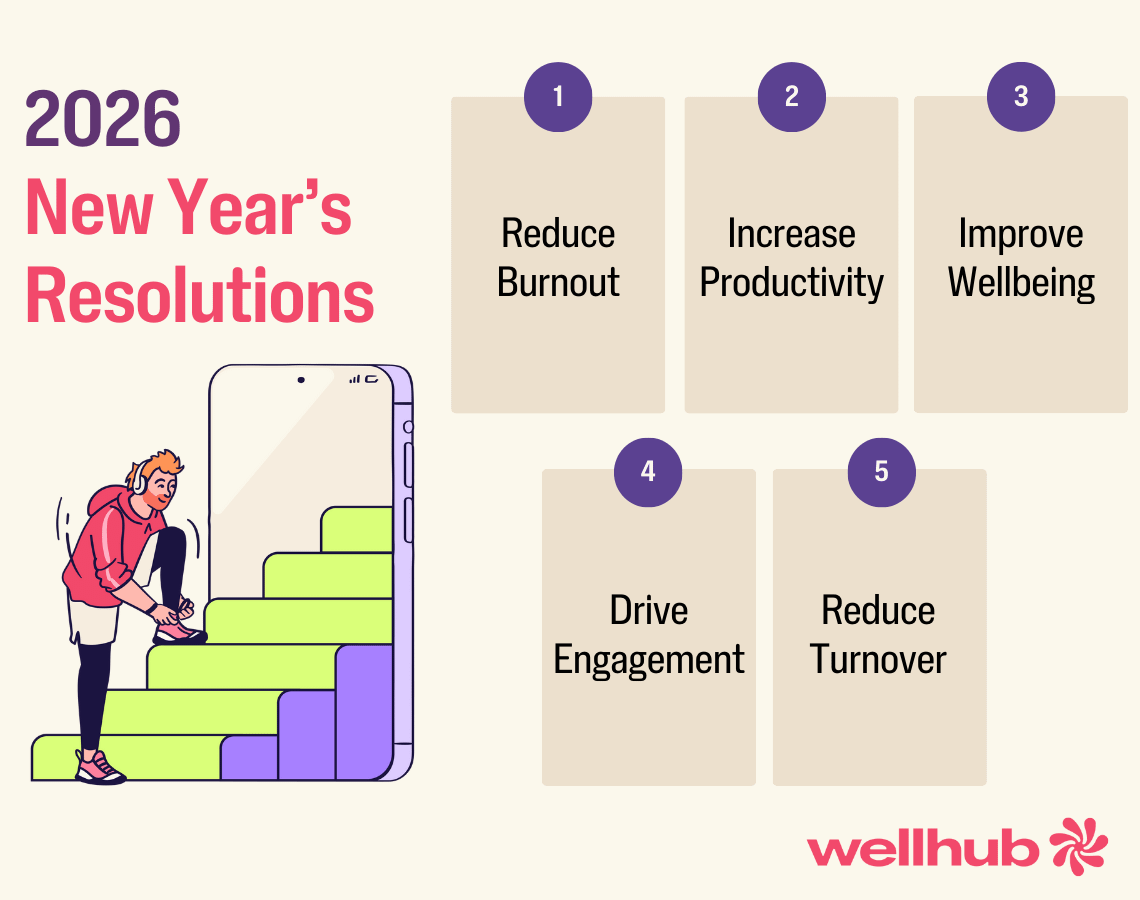
Resolution 2: Increase employee productivity by 15%
It’s no secret: when your team feels better, they work better. That’s not just a hunch — it’s a measurable business lever.
According to Wellhub’s State of Work-Life Wellness 2026 report, 89% of employees say they perform better at work when they prioritize their wellbeing. Another 91% say that time spent in wellness spaces like gyms or yoga studios helps them manage work-related stress — a leading productivity killer.
Despite that, most companies still approach productivity from the top down: through processes, technology, or performance reviews. But a bottom-up strategy—investing in the wellbeing of your people—can drive consistent, sustainable gains.
That’s why this year’s resolution is simple: Increase employee productivity by 15% by supporting personal wellbeing.
How to Measure Productivity
- Self-reported productivity. Include questions in your quarterly engagement surveys like: “On a scale of 1–10, how productive do you feel during your workday?”
- Output per employee. Measure completed tasks, closed tickets, or delivered projects by headcount or FTE hours.
- Engagement metrics. Use tools like Gallup Q12 or your HRIS to track whether employees feel focused and energized at work.
Benchmark where you are now — then check in quarterly to track improvement.
How to Improve Productivity
- Start with flexible schedules
Rigid 9-to-5s don’t reflect how people do their best work. Where possible, flexible start and end times, asynchronous hours, or a results-only work environment. These changes help employees manage energy instead of time—and that leads to better output.
- Design workspaces for focus and recovery
If your team works on-site, create dedicated quiet zones and relaxation areas. If remote, offer stipends for ergonomic equipment or coworking access. According to the same Wellhub report, 39% of employees say they aren’t working in their preferred environment, which can directly impact their ability to concentrate.
- Support movement throughout the day
Physical activity improves cognitive performance, mood, and energy. But employees often feel stuck at their desks. Encourage “movement meetings,” walking 1:1s, or standing breaks. Even five-minute walk breaks improve focus.
You can go further by giving employees access to a network of gyms, fitness classes, and yoga studios. Nearly three-quarters of employees already visit wellness spaces at least once per week — and 91% say it helps them manage work stress.
- Tackle the real productivity blockers
Wellness isn’t just about workouts. It’s about addressing the root causes of presenteeism and performance decline—like poor sleep, stress, and burnout.
Some ways to target these blockers:
- Add education around sleep hygiene and offer digital tools that support better rest.
- Provide access to mindfulness apps or breathing exercises—especially during high-stress periods like end-of-quarter.
- Make therapy or coaching accessible through EAPs or wellness platforms.
- Normalize sustainable performance
Too often, productivity is rewarded when it looks like overwork. But long hours come at a cost. Model healthy boundaries by setting team norms around email response times, deep work blocks, and PTO usage.
Managers should proactively check in on energy levels—not just KPIs. And company leaders should celebrate efficiency and outcomes, not always effort.
Resolution 3: Improve employee wellbeing scores by 25%
Burnout, absenteeism, disengagement—these are just symptoms. The underlying issue? Wellbeing. And the good news is that it’s measurable.
According to Wellhub’s State of Work-Life Wellness 2026 report, only 54% of employees currently rate their wellbeing as “good” or “thriving”—down nearly 10 percentage points from the year prior.
But here’s what’s powerful: that number jumps to 61% for employees with access to a wellness program, and drops to just 40% for those without.
That’s a 21-point gap—and a huge opportunity.
This year, set a clear goal: Improve employee wellbeing scores by 25%.
You’ll boost satisfaction, reduce turnover, and create the kind of culture people want to stay in.
How to Measure Employee Wellbeing
Wellbeing is subjective—but that doesn’t mean it’s vague. Build it into your quarterly engagement or experience surveys using a consistent scale.
Ask:
- “Overall, how would you rate your wellbeing at work?”
- “Do you feel you have time during the workday to care for your personal wellbeing?”
- “Do you feel physically, mentally, and emotionally supported at work?”
You can also:
- Track usage of wellness benefits and resources.
- Measure absenteeism, PTO usage, and sick leave patterns as downstream indicators.
Establish your baseline now, then track change every quarter.
How to Improve Employee Wellbeing
- Treat wellbeing as a core metric, not an HR initiative
That means reporting it to the C-suite, tracking it like you would retention or DEIB progress, and budgeting accordingly. This often leads to a virtuous cycle of increased investment: Over half of CEOs who receive impact updates at least once a month significantly increased funding for their wellness program last year.
- Expand access to holistic wellness benefits
Most employers still offer limited wellness support. In fact, only one in 10 offer nutrition, fitness, therapy, or flexible work options—the very things employees say make the biggest difference to how they feel at work.
Offer tools that support multiple dimensions of wellbeing—physical, mental, emotional, and social. Make sure your benefits include:
- Access to gyms, fitness classes, and movement resources.
- Therapy, coaching, and mindfulness tools.
- Nutrition support or counseling.
- Flexible hours and location options.
- Create space during the workday
One of the biggest barriers to wellbeing? Time. Wellhub research found that 50% of employees say they don’t have enough time in the workday to care for their wellbeing .
What you can do:
- Block out “wellness windows” on team calendars.
- Encourage employees to schedule movement, meals, or meditation like they would meetings.
- Model this behavior at the leadership level.
- Make wellbeing visible in team culture
Just 17% of employees strongly agree that wellness is ingrained in their company culture.
To change that:
- Start meetings with a quick energy check or “wellness win.”
- Celebrate healthy habits (like consistent gym visits or mental health PTO).
- Host team-based wellness challenges and reward participation, not just performance.
- Give employees control
Autonomy is essential to wellbeing. That includes control over when, where, and how work gets done. It also includes access to personalized wellness support.
If you offer a wellness platform, choose one that lets employees customize their routines—whether that means yoga, walking clubs, boxing, sleep apps, or digital therapy.
The more people can shape their experience, the more likely they are to engage.
Resolution 4: Increase employee engagement through wellness
Productivity. Retention. Innovation. Engagement is the thread that connects them all. But here’s the twist: the most powerful way to improve engagement might not be another manager training or performance framework.
It might be wellness.
According to Gallup, 62% of employees are not engaged at work—and 15% are actively disengaged. That lack of engagement costs the global economy an estimated $8.9 trillion a year. Meanwhile, Wellhub data shows that employees who prioritize their wellbeing perform better, are more productive, and are more likely to stay.
When you improve wellbeing, you energize your workforce. When you ignore it, you drain it.
That’s why your next resolution should be: Increase employee engagement by making wellness a core engagement driver.
How to Measure Employee Engagement
Start with:
- Quarterly engagement surveys. Use consistent, validated items (like Gallup Q12) and include wellbeing-specific questions.
- Wellness program participation rates. Look for correlations between usage and engagement scores.
- Turnover intent metrics. Track how many employees say they are considering leaving in the next 6–12 months—and whether they feel connected to the company.
Look for signals of progress in both your people data and your wellbeing data.

How to Improve Employee Engagement
- Make wellness a team experience, not a solo activity
Shared wellbeing experiences build connection. In fact, 56% of employees say they feel highly connected to coworkers during group wellness activities, and 52% say participating in group wellness challenges is motivating (source).
What to do:
- Host team wellness challenges each quarter—steps, hydration, mindfulness, sleep.
- Offer points or perks for participation, not perfection.
- Create shared goals across departments and reward collective progress.
- Tie wellness to your recognition strategy
Recognition improves engagement—but what you recognize matters. Highlight and reward behavior that aligns with a culture of balance, health, and sustainability.
Try this:
- Shout out employees who take time off and return recharged.
- Recognize managers who build psychologically safe teams.
- Celebrate team wins like highest participation in a wellness challenge or best energy check-in streak.
- Give managers the tools to talk about wellbeing
Wellness should be a standing agenda item—not an awkward afterthought. But that won’t happen unless managers are equipped.
Offer microtrainings on:
- How to ask about energy levels and stress without crossing boundaries.
- How to spot burnout or disengagement early.
- How to model wellness behaviors themselves (like logging off on time or taking recharge days).
- Embed wellness into the employee experience
Right now, only 44% of employees say wellness is ingrained in their company culture. But the most engaged teams feel that support in every interaction.
To embed it:
- Make wellness a standing section in onboarding.
- Offer wellness stipends that employees can personalize.
- Make it easy to find and use wellness resources in your HR tech stack.
- Ask your employees what they want—and use it
Engagement is about agency. That means involving employees in wellness programming design.
Use surveys, listening sessions, or focus groups to ask:
- What wellness tools would you actually use?
- What’s getting in the way of engaging?
- What could we do tomorrow that would help you feel more supported?
Then act on that feedback—and close the loop.
When engagement feels like something being done for employees, not to them, everything changes. Wellness creates that dynamic. It shifts the conversation from performance pressure to shared energy and growth.
Resolution 5: Reduce turnover attributed to lack of wellbeing support by 15%
Retention doesn’t just hinge on compensation or career ladders. Increasingly, employees are making decisions based on something more personal: their wellbeing.
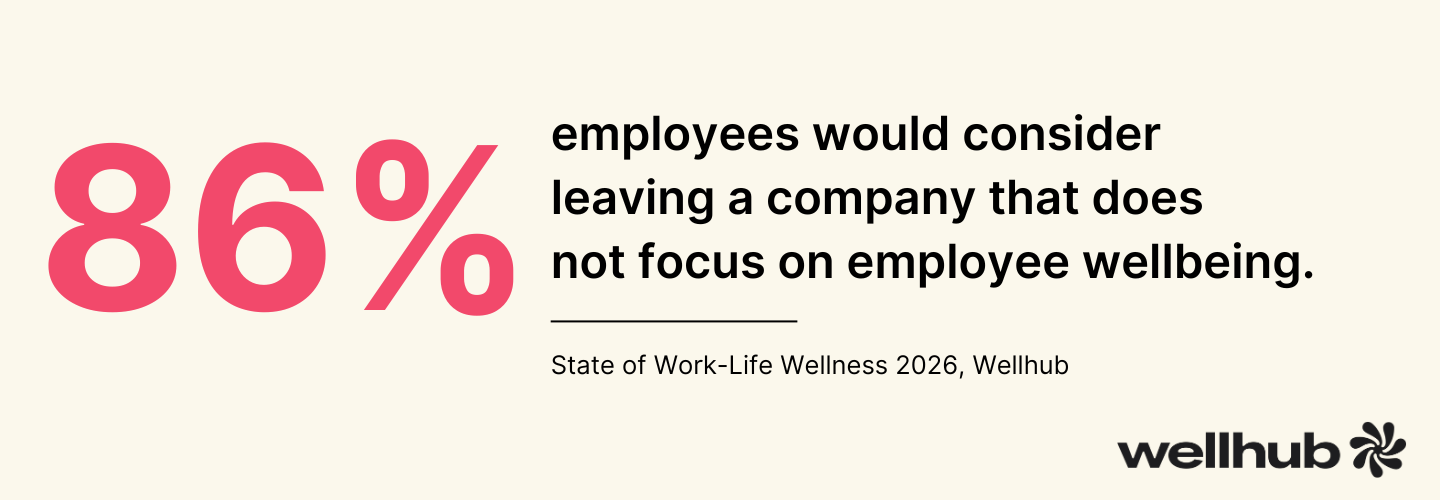
According to Wellhub’s 2026 report, 85% of employees say they would consider leaving a company that doesn’t prioritize wellbeing. And they’re not just bluffing — turnover driven by burnout alone is estimated to cost organizations 15% to 20% of their annual payroll budget.
That makes wellness not just a cultural priority, but a financial one.
This year, make retention a wellness metric by setting the goal: Reduce wellbeing-related turnover by 15%.
How to Measure Turnover Driven by Poor Wellbeing
This one’s trickier to quantify, but absolutely possible with the right mix of data and dialogue.
- Exit surveys: Include specific questions around wellbeing — Did lack of wellness support factor into your decision to leave?
- Stay interviews: Proactively ask current employees what’s keeping them here, and what would make them consider leaving.
- Turnover trends: Look at turnover rates by role, manager, and tenure. Cross-reference with wellness program usage and burnout survey data.
You can also ask employees directly: “Do you feel supported in your wellbeing here?” Tracking that response over time is one of the clearest leading indicators of retention risk.
How to Improve Retention with Wellbeing
- Offer flexibility that actually meets employee needs
Wellbeing isn’t one-size-fits-all — and neither is flexibility. Some employees want hybrid options, others need compressed workweeks, and many just need more autonomy in how they work.
Start by surveying employees on their preferred work environment. According to Wellhub’s research, 39% say they aren’t currently working in their preferred setup. That mismatch can lead to disengagement and eventual exits.
- Make managers retention partners
Train managers to recognize the early signs of wellbeing erosion — like a drop in engagement, increased time off, or withdrawal in meetings. Then equip them to respond with empathy, not just accountability.
Best practices include:
- Regular 1:1s with wellbeing check-ins.
- Customizable recovery plans after high-stress projects.
- “Time-off normalization” campaigns from leadership.
- Communicate your wellness benefits like your top benefits — because they are
If employees don’t know what’s available, they won’t use it — and they certainly won’t stay for it. Yet many employees report being unaware of what their company offers, especially outside of healthcare.
To fix that:
- Promote wellness benefits quarterly via email, Slack, and team meetings.
- Include wellness benefits as part of internal promotion or milestone celebration packages.
- Ensure wellness offerings are easy to access through your HRIS or intranet.
- Track access equity
Are your wellbeing programs accessible to every shift, location, and level of employee? Do hourly workers have the same access as salaried team members? If not, start there. Uneven access creates resentment — and attrition.
- Embed wellness into your EVP
Retention starts with recruitment. When you present wellness as a core part of your employee value proposition, you attract talent who will stay longer — because they chose you for it.
Update your careers page, social channels, and offer letters to reflect this focus. Include testimonials or stats about how wellness programs have impacted employees, and call out participation rates as proof that the culture matches the copy.
Retention is a reflection of trust. When employees trust that your organization supports their wellbeing, they’re more likely to stay — not just out of loyalty, but because they know they can thrive here.
Prioritize Wellbeing to Meet Your 2026 Goals
Burnout, low productivity, and disengagement aren’t just employee concerns—they’re business risks. These challenges hurt performance, drive up turnover, and drain company resources.
Supporting employee wellbeing is one of the most powerful ways to reverse those trends. A comprehensive wellbeing program helps employees manage stress, recharge during the day, and feel more supported overall.
These benefits translate into real results: companies that invest in Wellhub haveseen up to 40% lower turnover and save up to 35% on healthcare costs.
Speak with a Wellhub Wellbeing Specialist to reduce burnout, boost productivity, and build a culture where your people—and your business—can thrive.

Company healthcare costs drop by up to 35% with Wellhub*
See how we can help you reduce your healthcare spending.
[*] Based on proprietary research comparing healthcare costs of active Wellhub users to non-users.
Category
Share

The Wellhub Editorial Team empowers HR leaders to support worker wellbeing. Our original research, trend analyses, and helpful how-tos provide the tools they need to improve workforce wellness in today's fast-shifting professional landscape.
Subscribe
Our weekly newsletter is your source of education and inspiration to help you create a corporate wellness program that actually matters.
Subscribe
Our weekly newsletter is your source of education and inspiration to help you create a corporate wellness program that actually matters.
You May Also Like

FSA vs. HSA Strategy for HR Leaders | Wellhub
Compare FSA vs HSA rules, tax advantages, eligibility, and rollover differences to help employees choose the right account and avoid costly compliance issues.

Employee Wellness Programs: Key Components for Success | Wellhub
Transform your workplace wellness strategy by integrating physical, mental, financial, and social wellbeing into a comprehensive wellness program that works

Benefits Strategy Roadmap: Pull and Retain Top Talent | Wellhub
Support wellbeing, reduce turnover, and maximize ROI with a benefits strategy built for today’s workforce—not yesterday’s spreadsheet.