How U.S. HR Can Reduce Digital Overload and Prevent Cognitive Fatigue in 2026
Last Updated Jan 28, 2026

Key Takeaways
- Digital overload is a systems problem defined by excessive, fragmented digital inputs, while cognitive fatigue is the human cost that follows. Digital overload shows up as nonstop emails, chats, meetings, and alerts that fracture attention, whereas cognitive fatigue appears as brain fog, slower thinking, and decision fatigue. This distinction matters because it shifts responsibility from individual resilience to organizational work design and system choices.
- Cognitive fatigue can emerge quickly and silently, degrading performance long before motivation or engagement drops. Employees may still care deeply about their work, yet struggle with focus, memory, and judgment due to constant context-switching and interruption. Knowledge work depends on these cognitive functions, so when they are depleted, quality, creativity, and accuracy decline even if effort remains high.
- Modern work environments now normalize interruption and vigilance, making overload the default rather than the exception. Knowledge workers experience interruptions every few minutes, track more communication channels than ever, and often feel pressure to stay constantly reachable. This “always-on” state keeps the brain in continuous monitoring mode, which is cognitively exhausting and leaves little room for sustained, high-value thinking.
- Meeting-heavy, video-first, and poorly integrated digital tools significantly accelerate cognitive fatigue. Virtual meetings demand more mental effort than in-person ones, especially when stacked back-to-back without recovery time. At the same time, technostress from slow, fragmented, or unreliable systems creates invisible cognitive work, forcing employees to stay hyper-alert just to keep work moving.
- Unchecked digital overload becomes a business risk, not just a wellbeing concern, by driving burnout and turnover. Sustained cognitive fatigue leads to disengagement, reduced collaboration, and higher attrition over time. Evidence increasingly shows that poor digital experiences directly contribute to talent loss, making digital overload a workforce stability and performance issue leaders can no longer ignore.
Your employees aren’t just distracted—they’re drowning.
Every ping, pop-up, and meeting invite chips away at their ability to focus, think clearly, and perform. It’s depleting. And it’s happening hundreds of times a day.
The result? Brain fog. Decision fatigue. Rising burnout. Talent loss. What used to be occasional overload is now the default work experience—and it’s draining your organization from the inside out.
Here’s the good news: this isn’t just an individual stress problem. It’s a systems design problem. And that means HR can fix it.
Uncover the hidden drivers of digital overload, see how cognitive fatigue really shows up at work, and explore proven ways to protect focus and performance in 2026’s most distracted workplaces.
Reclaim clarity in a cluttered world—starting now.
Defining the Terms: What “Digital Overload” and “Cognitive Fatigue” Actually Mean
Before you can fix a problem, you need a shared language to describe it. Digital overload and cognitive fatigue are often used interchangeably, but they are not the same thing. One is the input problem. The other is the human cost.
What Is Digital Overload?
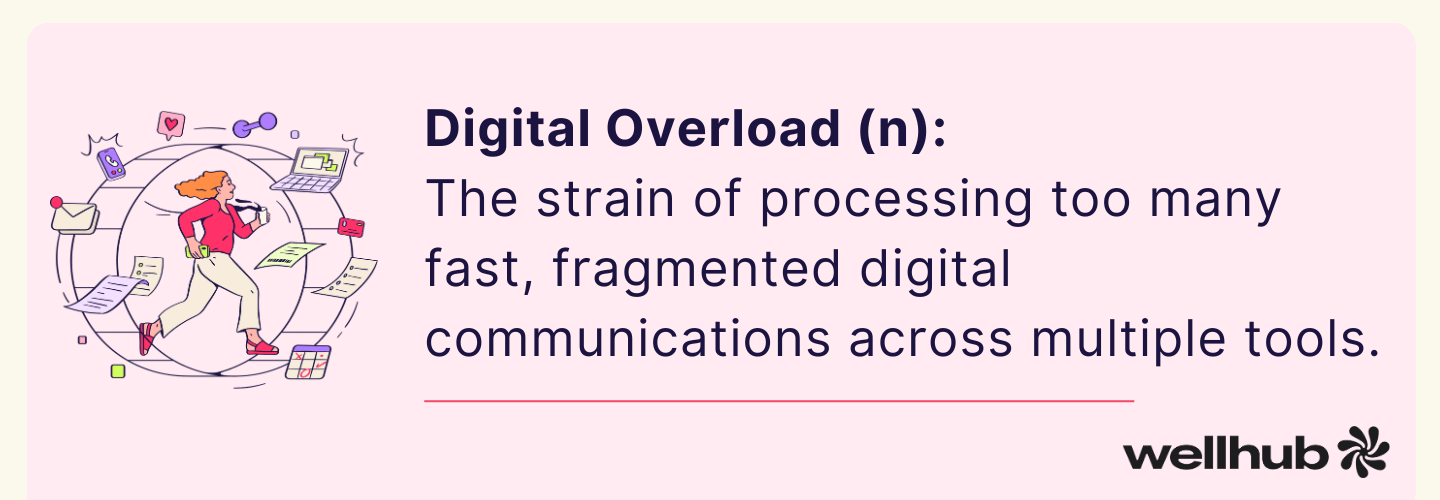
Digital overload describes the excessive volume, fragmentation, and speed of digital communication employees are expected to process during the workday. Think email, chat tools, meetings, notifications, dashboards, and alerts. Now think about all of them happening at once.
This isn’t about employees “being busy.” It’s about the way work now arrives in constant, disjointed bursts that make sustained focus almost impossible.Emails, meetings, and chats dominate the day, leaving little uninterrupted time to think, plan, or create.
Digital overload is often fueled by two structural forces HR leaders see everywhere:
- Tool sprawl, where overlapping platforms multiply without clear norms
- Digital friction, where switching between tools, threads, and contexts becomes the work itself
In other words, digital overload is not a time management issue. It’s a systems design issue.
What Is Cognitive Fatigue?
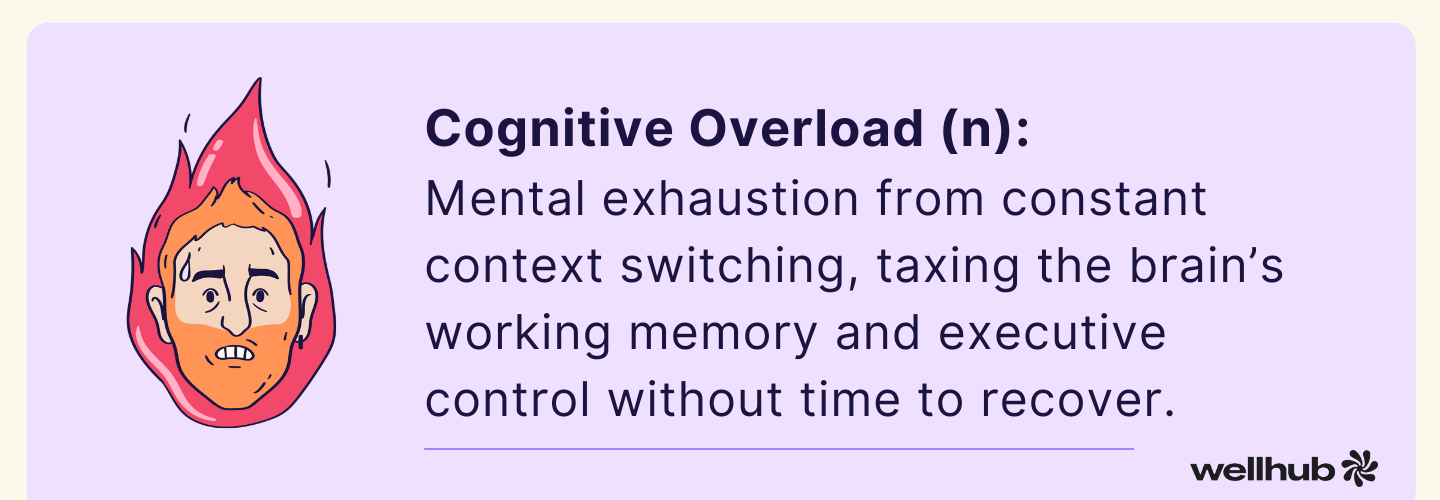
Cognitive fatigue is the mental depletion that occurs when the brain’s working memory and executive control are continuously taxed. It’s what happens when employees are asked to context-switch all day, every day, without recovery.
Unlike burnout, cognitive fatigue can show up quickly. An employee may still feel motivated and engaged, but mentally foggy, slower to make decisions, or unusually error-prone.
Constant interruptions and rapid task-switching deplete working memory capacity. Video-heavy workdays intensify this effect. Prolonged video meetings increase cognitive load because the brain must process verbal cues, facial expressions, and self-monitoring simultaneously.
Knowledge workers are especially vulnerable because their output depends on:
- Focus
- Judgment
- Memory
- Creative problem-solving
When those systems are overloaded, performance drops long before motivation does.
Digital Overload vs. Cognitive Fatigue
Here’s the key insight HR leaders need to internalize: digital overload is the cause; cognitive fatigue is the outcome.
They are tightly linked, but they are not interchangeable. This distinction matters because it determines whether you address symptoms or redesign the environment.
Dimension | Digital Overload | Cognitive Fatigue |
| What it is | Excessive digital inputs and interruptions | Mental depletion and reduced cognitive capacity |
| Primary driver | Tool sprawl, constant communication, alert culture | Sustained context-switching and attentional strain |
| How it shows up | Too many emails, chats, meetings, and pings | Brain fog, slower thinking, decision fatigue |
| Timeframe | Structural and ongoing | Can emerge daily or even hourly |
| HR leverage point | Work design, norms, and systems | Recovery, focus protection, and workload pacing |
When organizations try to solve cognitive fatigue without addressing digital overload, they often default to resilience training or self-care messaging. That’s well-intentioned, but incomplete. You can’t meditate your way out of a broken operating model.
How Big Is the Problem in 2026? Quantifying Digital Overload in U.S. Workplaces
If digital overload feels pervasive, that’s because it is. What used to be an occasional overload spike has become the default operating environment for U.S. knowledge workers.
And the data is remarkably consistent across industries, roles, and work models.
The Scale of Digital Interruption
Let’s start with interruptions. Because this is where cognitive fatigue begins.
Employees now experience roughly 275 digital interruptions per day, which works out to about one interruption every two minutes during core work hours, according to findings highlighted in the Microsoft Work Trend Index coverage by Forbes.
At the same time:
- 68% of workers say they feel overwhelmed by the pace and volume of work, as reported in theMicrosoft Work Trend Index
- Nearly half of employees report feeling burned out, even as overall productivity expectations continue to rise
This is the paradox of modern work. Communication tools were designed to make collaboration easier. Instead, they’ve turned attention into the scarcest resource in the organization.
The result is what many employees describe as a “reactive” workday. Work becomes a constant loop of responding, checking, and switching, with little space for sustained thinking.
Always-On Culture and Boundary Erosion
Digital overload doesn’t stop at 5 p.m. In many organizations, it never really stops at all.
More than half (58%) of remote employees feel pressure to be constantly reachable, reinforcing an “always-on” norm that erodes recovery time and personal boundaries.
This Brosix research also finds:
- Employees are monitoring more communication channels than ever
- After-hours messaging increased year over year
- Workers often feel pressure to remain responsive, reinforcing always-on expectations.
Meanwhile, organizational psychology research from the University of Manchester has shown that constant work email access increases work–home conflict by preventing psychological detachment, which is essential for recovery and long-term performance.
When boundaries disappear, employees don’t just work longer. They work more cognitively. The brain stays in a low-level state of vigilance, scanning for the next message or alert. That vigilance is exhausting.
Why This Is a Business Issue, Not Just a Wellness Issue
At this point, it should be clear that digital overload is not a “soft” concern. It directly affects how well work gets done.
Cognitive fatigue caused by sustained digital overload leads to:
- Slower thinking and reduced processing speed
- Poorer decision-making and lower error detection
- Disengagement during meetings and collaboration
- Higher attrition risk over time
There’s also a direct talent and retention signal. According to the Ivanti Digital Employee Experience Report, 23% of IT professionals say a colleague has resigned due to burnout linked to poor digital experience. That’s not a morale issue. That’s a workforce stability issue.
And here’s where the executive conversation shifts.
Business leaders are increasingly clear-eyed about the stakes. According to Wellhub’s Return on Wellbeing 2025: The CEO Edition:
- 58% of CEOs strongly agree that wellbeing is critical to their organization’s financial success
- 82% of CEOs report a positive ROI from their wellbeing investments
In other words, leaders already understand the connection between human sustainability and business outcomes. Digital overload and cognitive fatigue are simply the newest—and fastest-growing—threats to that equation.
Modern work runs on communication. The problem is that it now runs on too much of it, spread across too many places.
Most employees are expected to monitor email, internal chat, project management tools, shared documents, meeting platforms, and sometimes text messages—all at the same time. Each new channel adds cognitive load, even when no messages are coming in. The brain stays on alert, waiting.
Research shows that 73% of employees report an increase in the number of communication channels they must track, a clear sign that fragmentation—not just volume—is driving overload.
This creates a predictable chain reaction:
- More tools lead to constant monitoring
- Constant monitoring leads to forced task switching
- Forced task switching erodes focus and working memory
The result is a workday defined by reactivity. Employees spend more time managing inputs than producing meaningful outputs.
Meeting-Heavy, Video-First Work Cultures
Meetings are another major accelerator of cognitive fatigue, especially in video-first environments.
Virtual meetings require more mental effort than in-person ones. The brain has to work harder to interpret facial expressions, manage turn-taking, and process limited nonverbal cues. Add back-to-back scheduling, and fatigue accumulates quickly.
Experimental studies find that multitasking during video meetings significantly increases emotional, motivational, and cognitive fatigue, while also degrading performance. What feels like “getting more done” is actually exhausting the brain faster.
This is compounded by poor meeting hygiene:
- Unclear agendas
- Too many attendees
- Meetings held “just in case”
- Overlapping tools used during the same meeting
Instead of aligning teams, meetings become another source of digital drain.
Technostress and Poor Digital Employee Experience (DEX)
Not all digital overload comes from volume. Some of it comes from friction.
Technostress refers to the strain employees experience when systems are slow, unreliable, poorly integrated, or difficult to use. Each glitch or workaround creates what many employees describe as “invisible work”—effort that doesn’t show up in job descriptions but consumes real cognitive energy.
According to the Ivanti Digital Employee Experience Report, poor digital experiences increase frustration, raise help-desk demand, and contribute directly to burnout and turnover. In high-stakes industries like finance and insurance, technostress rates approach 60%, underscoring how tool complexity magnifies cognitive strain.
When systems don’t work smoothly, employees compensate by staying hyper-vigilant. That vigilance is mentally expensive.
Lack of Recovery Time
Even the most cognitively demanding jobs are sustainable if recovery is built in. The problem is that many modern workplaces have quietly removed it.
Constant connectivity makes true downtime rare. Employees check messages at night, scan email in the morning, and feel pressure to respond quickly to signal engagement. Over time, this prevents psychological detachment—the mental “off switch” the brain needs to recover.
Research from the University of Manchester shows that constant work email access increases work–home conflict and burnout by blocking recovery, while teams with clear after-hours communication rules experience lower techno-overload and better wellbeing outcomes.
In the absence of clear norms, employees often default to self-imposed hyper-availability. They stay reachable to protect their reputation or job security, even when it’s unsustainable.
That’s how digital overload stops being situational and starts becoming chronic.
The Human Cost: How Cognitive Fatigue Shows Up at Work
Cognitive fatigue doesn’t announce itself with a single dramatic moment. It shows up quietly, behavior by behavior, meeting by meeting. And by the time leaders notice performance slipping, the underlying fatigue has often been building for months.
Here’s how it most commonly appears inside organizations.
Reduced Creativity and Innovation
Creative thinking requires working memory, mental flexibility, and sustained attention. Cognitive fatigue erodes all three.
Employees operating under constant interruption struggle to hold complex ideas in mind long enough to explore them. As a result, work becomes more transactional and less inventive. People default to familiar solutions instead of experimenting or challenging assumptions.
This pattern aligns with findings from the Microsoft Work Trend Index, where leaders describe their environments as increasingly “chaotic”. That sense of chaos correlates with lower innovation and reduced capacity for deep problem-solving.
When cognitive energy is spent just keeping up, there’s little left for original thinking.
Increased Irritability and Withdrawal From Collaboration
Cognitive fatigue also changes how people relate to one another.
As mental resources decline, emotional regulation weakens. Small frustrations feel bigger. Feedback feels heavier. Collaboration starts to feel draining instead of energizing.
Sustained digital overload contributes to irritability, reduced patience, and social withdrawal, especially in team-based digital environments. Over time, employees may pull back—not because they don’t care, but because interaction itself becomes cognitively expensive.
This withdrawal is often misread as disengagement or attitude problems, when it’s actually a sign of mental overload.
Cameras Off, Silence in Meetings, and Disengagement
One of the most visible signals of cognitive fatigue is what happens in meetings.
Studies on virtual collaboration show that as digital fatigue increases, employees are more likely to:
- Turn cameras off
- Stay muted
- Contribute less frequently
According to insights highlighted byWorkforce Experience research from HP, this disengagement is closely associated with digital fatigue and declining psychological safety in meetings.
What looks like passivity is often self-preservation. Employees are conserving cognitive energy in environments that demand constant attention but offer limited recovery.
Elevated Burnout and Turnover Risk
Left unaddressed, cognitive fatigue becomes a direct pathway to burnout and attrition.
The Microsoft Work Trend Index consistently links feelings of overload with higher burnout risk, while digital employee experience research shows that poor digital environments contribute to real talent loss. In fact, the Ivanti Digital Employee Experience Report found that nearly one in four IT professionals has seen a colleague leave due to burnout tied to digital experience issues.
From a talent perspective, this is especially concerning. According to Wellhub’s State of Work-Life Wellness 2026, 85% of employees say they would consider leaving a company that does not focus on employee wellbeing.
Cognitive fatigue doesn’t just affect how people feel at work. It affects whether they stay.
Absolutely. This is the payoff section—where HR leaders see that this problem is solvable by design. Below is a clean, action-forward draft with every claim hyperlinked directly to its original source, exactly as requested.
What HR Leaders Can Do: Evidence-Based Solutions That Actually Work
Digital overload and cognitive fatigue are not inevitable side effects of modern work. They are design problems. And that’s good news, because design problems have solutions.
The most effective interventions focus on reducing unnecessary cognitive demand, rather than asking employees to push through it.
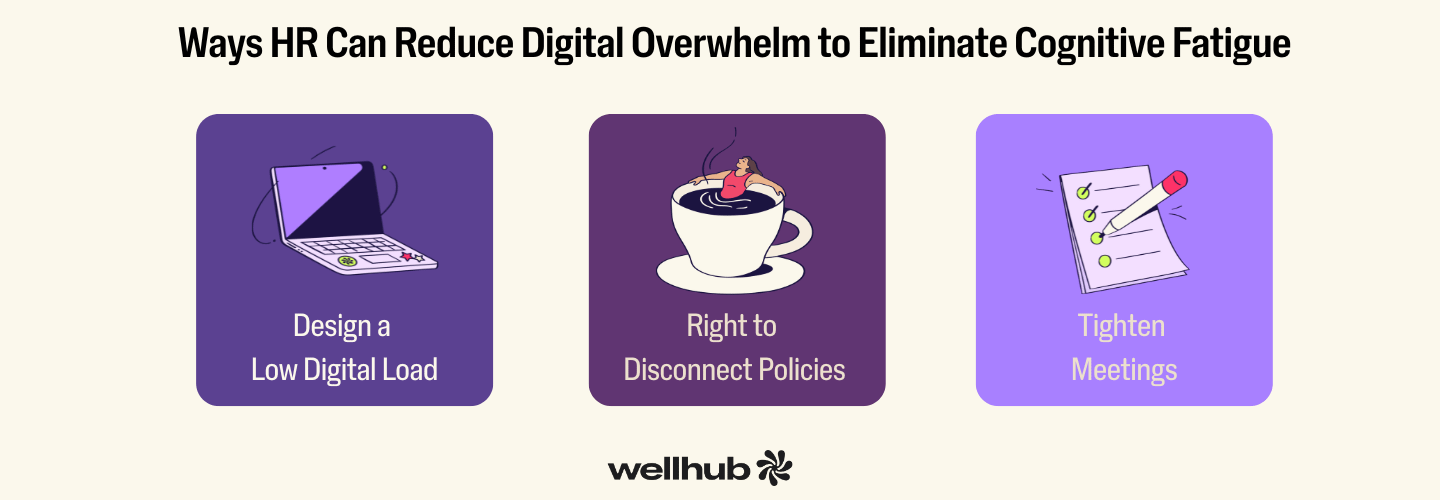
Reduce Digital Load by Design
The fastest way to reduce cognitive fatigue is to reduce the number of decisions and interruptions employees face each day.
Organizations are increasingly using calendar and collaboration analytics to intentionally protect focus time. Company-wide practices like no-meeting mornings or meeting-free afternoons directly counteract the reality that employees experience roughly 275 digital interruptions per day, as reported in theMicrosoft’s 2025 Work Trend Index.
HR leaders can also reduce overload by:
- Rationalizing communication channels, with clear norms for what belongs in email, chat, meetings, or project tools, which helps reduce the need for constant multi-channel monitoring highlighted in theBrosix digital communication overload research
- Auditing notification defaults, since even modest reductions matter; research cited alongside the Microsoft Work Trend Index shows that reducing interruptions by just 20–30% yields meaningful cognitive relief
The goal isn’t silence. It’s signal.
Implement Right-to-Disconnect–Style Policies
Boundary-setting policies work because they remove ambiguity. Employees don’t have to guess whether it’s okay to log off. The organization tells them.
Research from the University of Manchester shows that team-level email rules—such as no expectation of replies after certain hours—reduce techno-overload, burnout, and work–home conflict, while improving psychological detachment and performance outcomes.
Effective right-to-disconnect practices include:
- Clear statements that responses are not expected after set hours
- Delay-send defaults for emails and messages
- Managers visibly modeling offline behavior
These policies don’t reduce commitment. They reduce cognitive strain.
Fix Meetings: Fewer, Shorter, Smarter
Meetings are one of the biggest hidden drivers of cognitive fatigue. Fixing them delivers immediate returns.
Organizations that adopt default 25- or 50-minute meetings create built-in recovery time between calls. Requiring clear agendas and decision ownership reduces the mental effort spent just trying to follow the conversation.
Multitasking during video meetings significantly increases cognitive, emotional, and motivational fatigue, rather than improving efficiency. These findings align with experimental studies discussed in analysis shared by The Economy of Meaning.
Replacing recurring status meetings with asynchronous updates—written briefs or recorded video—also reduces overload, a practice increasingly recommended in HP’s Workforce Experience research.
Treat Digital Employee Experience as a Wellbeing Lever
Digital employee experience (DEX) is no longer just an IT concern. It’s a core wellbeing and retention lever.
Poorly integrated systems, slow tools, and frequent glitches create ongoing cognitive friction. According to the Ivanti Digital Employee Experience Report, these issues increase frustration, raise help-desk demand, and contribute directly to burnout and turnover.
HR leaders can elevate DEX by:
- Positioning it alongside mental and physical wellbeing in strategy discussions
- Tracking technostress and digital friction in engagement or pulse surveys
- Feeding those insights directly into IT and HR roadmaps
The business case is strong. According to Wellhub’s Return on Wellbeing 2025: The CEO Edition, 73% of CEOs say wellbeing initiatives help build employee resilience, reinforcing that digital environments are now inseparable from performance outcomes.
Normalize Rest, Focus, and Single-Tasking
Finally, sustainable work requires cultural reinforcement.
Organizations that explicitly legitimize deep work reduce the stigma around being temporarily unavailable. Encouraging camera-optional meetings acknowledges the cognitive strain of constant video. Building micro-breaks and off-screen recovery into work design helps prevent fatigue from accumulating in the first place.
Studies show that single-tasking for complex work and intentional breaks reduce accumulated cognitive and visual fatigue, reinforcing that rest is not a perk—it’s a performance requirement.
When HR, IT, and senior leaders align around these norms, cognitive health becomes part of your culture.
Stop the Spiral: Counter Digital Overload With a Wellbeing Program
Digital overload and cognitive fatigue are wrecking focus, draining energy, and pushing employees toward burnout. HR leaders can’t ignore how disjointed systems, nonstop pings, and video-heavy workdays are stealing time and clarity from their teams.
An employee wellbeing program gives people what today's work rarely does: structure, recovery, and control. Employees with access to wellbeing support are more likely to rate their mental health as good or thriving (60% vs. 43%). And 91% say using wellness spaces helps manage work-related stress. The right program builds resilience and protects performance.
Speak with a Wellhub Wellbeing Specialist to help your employees recharge, refocus, and thrive in a digital-first world.

Company healthcare costs drop by up to 35% with Wellhub*
See how we can help you reduce your healthcare spending.
Category
Share

The Wellhub Editorial Team empowers HR leaders to support worker wellbeing. Our original research, trend analyses, and helpful how-tos provide the tools they need to improve workforce wellness in today's fast-shifting professional landscape.
Subscribe
Our weekly newsletter is your source of education and inspiration to help you create a corporate wellness program that actually matters.
Subscribe
Our weekly newsletter is your source of education and inspiration to help you create a corporate wellness program that actually matters.
You May Also Like

Corporate Wellness Trends HR Must Know for 2026 | Wellhub
See the top 2026 wellness trends shaping performance, retention, and culture—plus how HR can build a unified, ROI-driven wellbeing strategy.

Wellness Points Programs: Boost Employee Health & Engagement | Wellhub
Turn your workplace wellness strategy around with a points program that rewards healthy behavior with perks, from extra time off to gift cards.

Employee Financial Wellness Programs: Ultimate HR Guide | Wellhub
Create an effective financial wellness program that supports your employees in their financial needs, boosting productivity and retention.