Top Corporate Wellness Trends HR Need to Prioritize in 2026
Last Updated Dec 4, 2025

Key Takeaways
- Corporate wellness in 2026 is being reshaped by a diverse workforce with rising expectations for whole-person wellbeing. Employees across life stages now weigh wellbeing as heavily as salary and see physical, mental, emotional, social, and financial health as deeply connected, pushing HR to design more inclusive and personalized support.
- Wellbeing has become a core business strategy, owned by the C-suite and measured like any other performance driver. CEOs are tying wellness to financial results, retention, and productivity, giving HR the mandate and budget to align programs to leadership KPIs and demonstrate clear “return on wellbeing” through outcome-focused metrics.
- The era of fragmented, one-off wellness perks is ending, replaced by integrated, simplified ecosystems that people actually use. Employees want unified platforms that centralize access to fitness, mental health, sleep, financial tools, and social support, reducing friction so wellbeing feels easy to engage with rather than one more task on their to-do list.
- Flexibility, personalization, and social connection are emerging as non-negotiable pillars of wellness design. Hybrid-ready programs, flexible work policies, tailored wellness pathways, and team-based experiences help employees build sustainable routines, feel seen as individuals, and stay meaningfully connected—no matter where or how they work.
- HR’s role is shifting from program administrator to strategic architect of culture, performance, and resilience. By auditing current offerings, aligning leaders, simplifying access, and building measurable, whole-person ecosystems, HR teams can turn wellness into a competitive advantage that boosts trust, loyalty, and long-term organizational health.
The landscape of employee wellbeing is evolving faster than ever and 2026 is poised to be a breakthrough year for HR leaders.
These trends are grounded in deep research, drawing on insights from thousands of employees and CEOs around the world as revealed in Wellhub’s Return on Wellbeing 2025 report and State of Work‑Life Wellness 2026findings.
You’ll gain a clear view of what’s truly driving wellness in the workplace—from diversity in workforces to unified benefit platforms and measurable ROI—and you’ll be equipped to elevate your strategy so that your team feels supported, engaged, and ready to perform.
Dive into these nine key trends and begin shaping your 2026 wellbeing roadmap with confidence, clarity, and measurable impact.
What’s Driving Corporate Wellness Trends in 2026
Increasing Workforce Diversity
Workforces in 2026 reflect more than just age or job title. They span life stages, work preferences, and personalized expectations around health and wellbeing. Younger employees prioritize mental and emotional wellness. Mid-career professionals are navigating career growth and caregiving responsibilities. Older workers are focused on sustainable, long-term health.
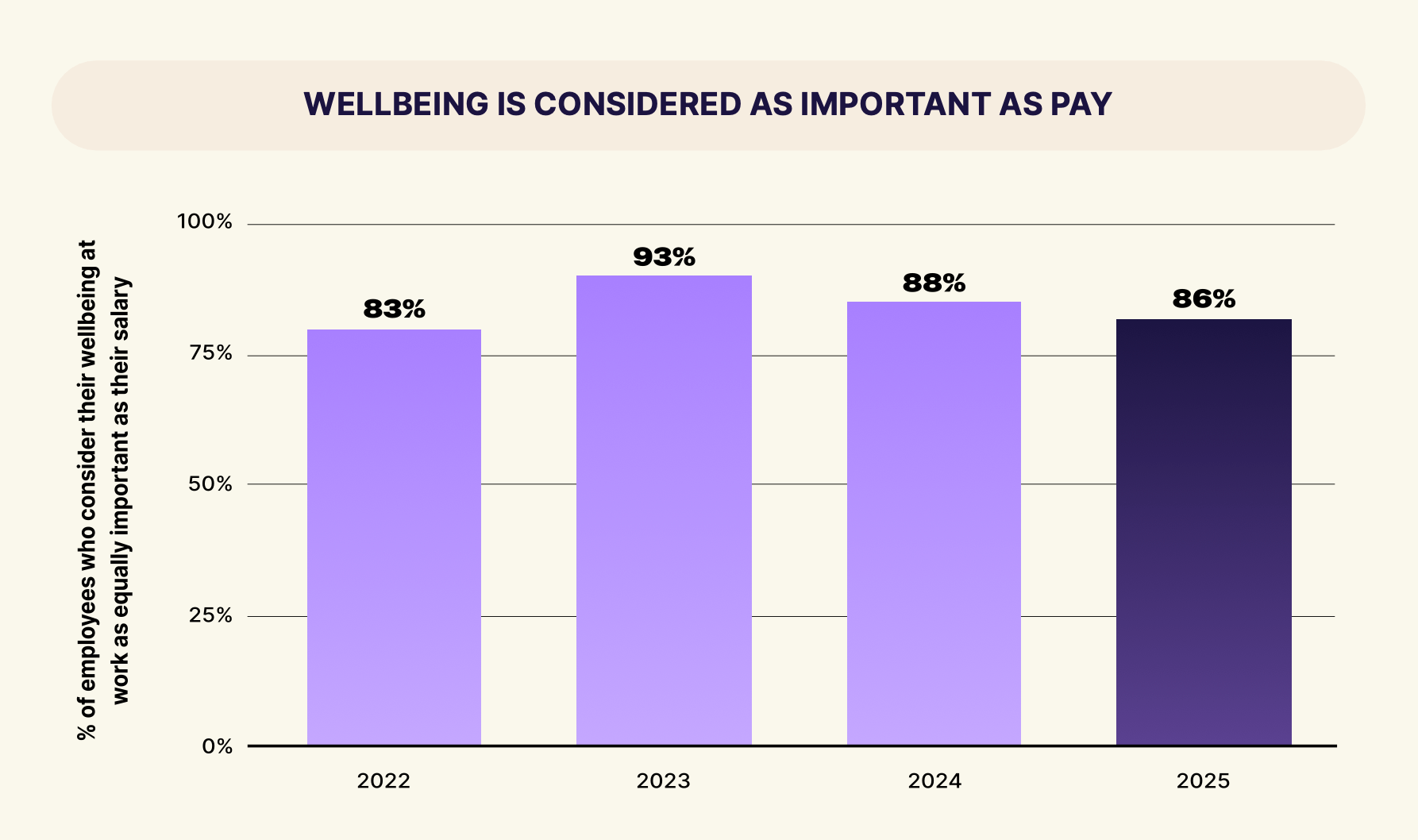
That variety means HR teams are balancing many needs at once. People want benefits that match their real-life situations and support their daily quality of life: the vast majority of employees have rated wellbeing as important as their salary for the last several years.
That’s a big shift. And it’s shaping how organizations build wellness strategies moving forward.
Needing to Increase Productivity while Decreasing Burnout
Talent shortages haven’t disappeared. Burnout levels remain high. And employers are still expected to maintain performance across the board. These realities are increasing the pressure on HR to create environments where people can truly thrive.
The link between wellbeing and performance has never been clearer. When employees prioritize their wellbeing, 89% say they perform better at work. That’s why more HR leaders are leaning into wellness as a proactive lever—not just for support, but for stability. Strategies that promote energy, focus, and balance are becoming essential tools for retention and performance.
Wellbeing as a Brand Differentiator
Company culture is no longer just an internal matter. It’s front and center in how organizations attract and retain talent. And wellness is a huge part of that conversation.
Remember, 85% of employees would consider leaving a company that doesn’t prioritize wellbeing, and 83% are more likely to join wellness initiatives when they include a team component. That means wellness isn’t just an HR perk anymore—it’s a key part of your brand identity. When companies invest in whole-person support, it signals what they truly value. That alignment builds loyalty with both current and prospective employees.
A Data-Backed Push for Whole-Person Support
Wellbeing isn’t one-dimensional. And employees know it. According to Wellhub’s State of Work-Life Wellness 2026, 95% of workers believe that physical, mental, emotional, and social wellbeing are interconnected.
People want support that helps them feel balanced, stay active, manage stress, and stay connected—across every aspect of life. That’s why demand is rising for integrated wellness ecosystems that are both comprehensive and easy to access.
As expectations evolve, wellness strategies must do the same. The next era of corporate wellness is about offering meaningful solutions that meet employees where they are.
Trend 1: Executive Ownership of Employee Wellbeing
Imagine this: you’re in the boardroom, and instead of wellbeing being a “nice-to-have,” it’s front and center on the CEO’s dashboard — right next to revenue, retention, and productivity. That’s exactly where employee wellbeing is headed in 2026. And honestly? It’s about time.
Wellbeing Integrated Into Leadership KPIs
More and more executives are treating wellbeing like the strategic lever it is. A stunning 58% of CEOs strongly agree that wellbeing is critical to their organization’s financial success, according to Wellhub’s Return on Wellbeing 2025: The CEO Edition. When the C-suite sees wellbeing as a driver of profitability, it naturally becomes a leadership KPI — not a side initiative HR has to champion alone.
This shift matters because leaders set the tone. When CEOs track wellbeing outcomes just as seriously as revenue metrics, employees can feel the difference. Wellbeing becomes woven into the way the organization operates, not just something offered in a handbook.
HR’s Role in Operationalizing CEO-Level Wellness Goals
Here’s where you step in. Executive vision is powerful, but HR is the engine that brings it to life. And you are uniquely positioned to translate big wellness ambitions into everyday practices.
Your role involves:
- Aligning wellbeing investments with leadership’s KPIs
- Ensuring programs are accessible, equitable, and easy to engage with
- Building systems to measure your return on wellbeing
- Guiding managers in modeling healthy behaviors
And you have a strong business case to work with — especially since 94% of CEOs now have final sign-off on wellness budgets. When wellness is a C-suite commitment, HR gains the backing needed to scale programs that make real impact.
Impact on Culture, Productivity, and Trust
Leadership ownership of wellbeing changes the employee experience in extraordinary ways. When leaders champion wellness, cultures shift from survival mode to support mode. And the downstream effects are huge.
Employees notice when wellbeing is baked into culture — but today, only 17% strongly agree that wellness is ingrained in their company culture, according to Wellhub’s State of Work-Life Wellness 2026 report. That’s a golden opportunity. Because when leadership supports wellbeing — publicly, consistently, measurably — employees trust the organization more deeply. They stay longer. They feel seen. And they’re able to do their best work.
Trend 2: Whole-Person Wellness Programs Replace One-Off Initiatives
Picture this: instead of offering a single fitness class once a quarter and hoping engagement rises, your company provides an ecosystem of care that supports every part of an employee’s life.
That’s the direction corporate wellness is headed — and employees are asking for nothing less.
Physical, Mental, Emotional, Financial, and Social Health Rising in Importance
Employees today understand that wellbeing is interconnected. And they don’t just want fuller support — they’re actively prioritizing it:
- 82% made positive lifestyle changes to support wellbeing in the last year
- 64% say they’ve become more intentional about wellbeing over the past five years
Employees are telling us loud and clear: wellbeing is no longer isolated to gym access or meditation breaks. It’s holistic. It’s personal. And it affects everything.
Evidence That Employees Expect Holistic Support
Wellbeing expectations are skyrocketing. Consider this:
- 86% of employees say their wellbeing is as important as salary when evaluating a job
- 85% would consider leaving a company that doesn’t prioritize wellbeing
These aren’t soft preferences — they’re deal-breakers. When one-off initiatives fall flat, employees feel it immediately. And they’re ready to vote with their feet.
How Companies Are Expanding Their Wellness Scope
Forward-thinking organizations are already embracing whole-person support. You’ll see companies evolving in ways like:
- Combining mental health support with physical fitness access: Wellness programs now integrate therapy, coaching, meditation apps, and fitness memberships to reflect how stress and physical activity interact.
- Offering sleep tools: Since 69% of employees sleep fewer than the recommended seven hours, companies are adding programs that help employees build healthier routines.
- Introducing financial wellbeing resources: With many workers citing financial strain as a barrier to wellbeing, employers are expanding financial coaching, budgeting tools, and savings support.
- Designing programs that strengthen social health: This is huge for 2026—62% of employees say community and social support are essential for sustaining long-term wellness habits. Companies are responding with team challenges, group fitness options, volunteer events, and culture-building initiatives.
Whole-person wellness is becoming the new standard because it reflects real employee lives. And as the data shows, it’s one of the most powerful ways to support performance, retention, and organizational health.
Trend 3: Streamlining of Wellness Benefits
Imagine logging into your benefits portal and actually knowing where everything is. No hunting. No guessing. No clicking through six different tools to figure out which one offers therapy and which one offers yoga. In 2026, employees are demanding exactly that kind of clarity — and companies are finally making it happen.
Too Many Fragmented Solutions Reduce Utilization
Employees today are juggling more apps, tools, and logins than ever. And when wellness benefits are scattered across disconnected platforms, engagement plummets. That’s especially important because only 29% of employees rate their current wellness offerings as good, down sharply from last year.
That drop signals something big: employees don’t just want more benefits — they want better, simpler ones.
Fragmentation makes it harder to find resources, and harder still to build healthy routines. And since 50% of employees cite “lack of time” as a barrier to wellness spaces, scattered benefits can feel like yet another obstacle instead of support.
Demand for Unified Platforms That Centralize Access
Employees want wellbeing to feel effortless. Employers want better engagement and clearer ROI. Consolidation solves both.
Unified wellness platforms make it easy for people to:
- Explore physical, mental, emotional, and social resources in one place
- Personalize their wellness habits
- Track progress over time
- Engage in programs consistently
And HR wins too — because centralization eliminates the administrative sprawl that slows down program adoption.
Why Streamlined Experiences Improve Engagement and ROI
When employers streamline wellness access, something remarkable happens: usage climbs, outcomes improve, and ROI strengthens. That’s crucial in a moment where 82% of CEOs report a positive ROI on their wellness program investments.
Consolidation also creates a smoother employee experience — and experience is everything right now. Employees who feel supported are far more likely to thrive, and we see that clearly in the data. Wellhub members are 48% more likely to integrate wellness into their workday. When benefits are easy to use, they actually get used.
The formula is simple but powerful: fewer systems, more impact.
Trend 4: Flexible Work and Life Design as Core to Wellness
Now picture this: it’s Monday morning, and instead of dreading the commute (or the Zoom marathon), employees have control over when and how they work — and that flexibility fuels better performance, lower stress, and higher trust. Flexibility is no longer just a perk. In 2026, it’s foundational to wellness.
Insights from the State of Work-Life Wellness 2026 Findings
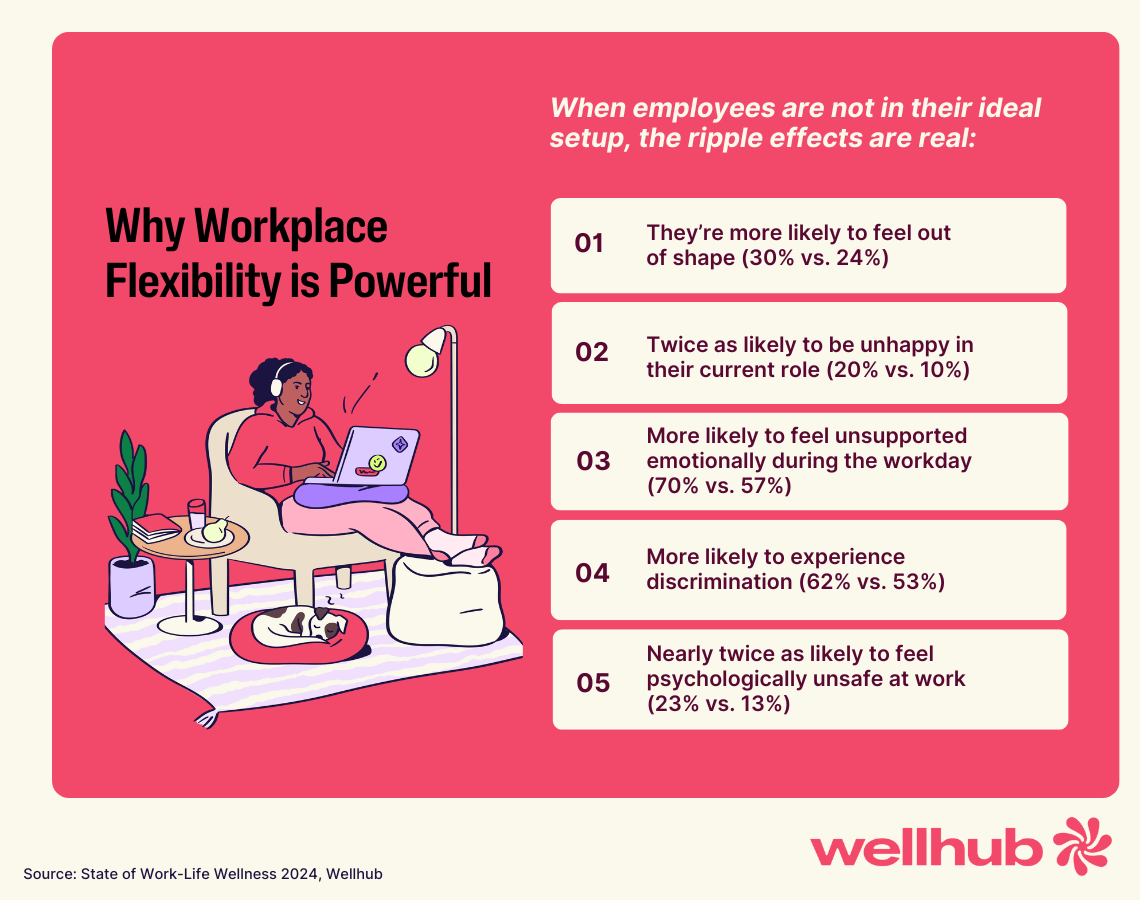
Employees are crystal clear about what they need. Thirty-nine percent say they are not currently working in their preferred environment — whether that’s on-site, remote, or hybrid.
And when people feel misaligned with their work environment, stress rises, burnout accelerates, and productivity dips.
Flexibility is emerging as one of the most powerful wellbeing levers HR leaders can offer. It helps employees find balance and autonomy — both of which are deeply tied to overall wellbeing. And with 90% of employees experiencing burnout symptoms, flexibility is no longer optional; it’s essential.
Flexibility as a Wellness Benefit
Flexibility is becoming one of the most desired wellness benefits worldwide because it eliminates barriers that stand between employees and healthy routines. When workers can adjust their schedules or location, they suddenly have more space to move, rest, recharge, and take care of themselves.
Flexibility also gives employees permission to invest in their wellness without guilt — and that matters. Eighty-nine percent say they perform better when they prioritize their wellbeing, which makes flexibility a direct line to performance.
It’s no surprise that companies offering flexible options often see better retention and stronger engagement.
Policies HR Teams Are Modernizing: Schedules, Hybrid Expectations, Time Autonomy
HR teams across industries are rethinking flexibility with fresh eyes. The goal isn’t just “remote work when needed,” but empowering employees to design their work in ways that support health, focus, and flow.
Here are the policies gaining traction in 2026:
- Flexible scheduling windows that let employees start and finish earlier or later
- Rethought hybrid frameworks that consider commute burden, role needs, and employee preference
- Time-autonomy practices, like meeting-free blocks and customizable break times
- Core hours that balance collaboration needs with individual freedom
- Outcome-based performance management, reducing pressure to be “always on”
These practices create healthier work rhythms — and healthier workers. And they help HR tackle two enormous challenges: retention and burnout.
Trend 5: Rising Expectations for Wellness ROI and Measurement
Imagine this: your CEO asks how the company’s wellbeing investments are performing — and instead of scrambling to pull together participation rates or anecdotal wins, you have clean, confident data that shows impact on productivity, retention, absenteeism, and even healthcare spend. That’s the future of wellness measurement. And it’s arriving fast.
The Business Case Behind “Return on Wellbeing”
Executives are no longer satisfied with “it feels like people like the program.” They want to see numbers — and the great news is that wellbeing delivers them.
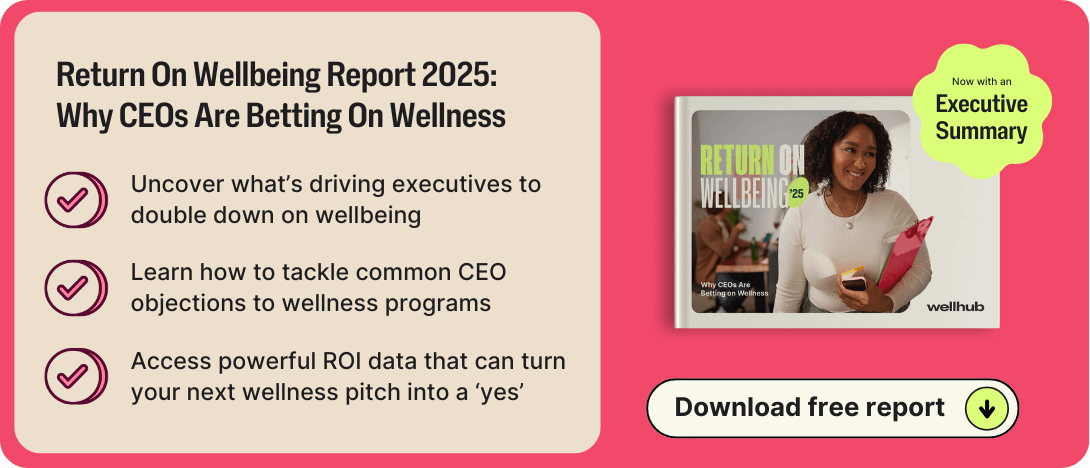
A remarkable 82% of CEOs report a positive ROI from their wellness program, according to Wellhub’s Return on Wellbeing 2025: The CEO Edition. Even more striking, 78% report returns greater than 50%, and 30% see returns above 100%. That means for many organizations, every $1 invested delivers at least $2 back.
The C-suite also sees wellbeing as a clear performance lever:
- 97% of CEOs say wellness programs improve productivity
- 67% say these programs significantly reduce absenteeism
This is why ROI is no longer a metric — it’s a mandate.
What Metrics Matter Most in 2026
HR teams are laser-focused on outcome-driven wellbeing. The most important metrics this year fall into four categories:
Category | Key Metrics HR Is Tracking |
| Productivity | Changes in output, efficiency, focus, stress levels |
| Retention | Turnover rates, resignation risk, exit interview themes |
| Absenteeism | Sick days, unplanned leave, burnout indicators |
| Healthcare Spending | Claims data, chronic condition trends, preventative care utilization |
These are the numbers your CEO cares about — and the ones that wellbeing programs can meaningfully influence.
The employee perspective reinforces this. Eighty-nine percent of employees say prioritizing their wellbeing improves their performance, and 91% say wellness spaces help them manage work-related stress.
When employees feel better, they work better — and the data consistently shows that.
Tools for HR to Better Evaluate Wellbeing Impact
In 2026, HR leaders are adopting more sophisticated measurement tools that make ROI easier to track and communicate. These include:
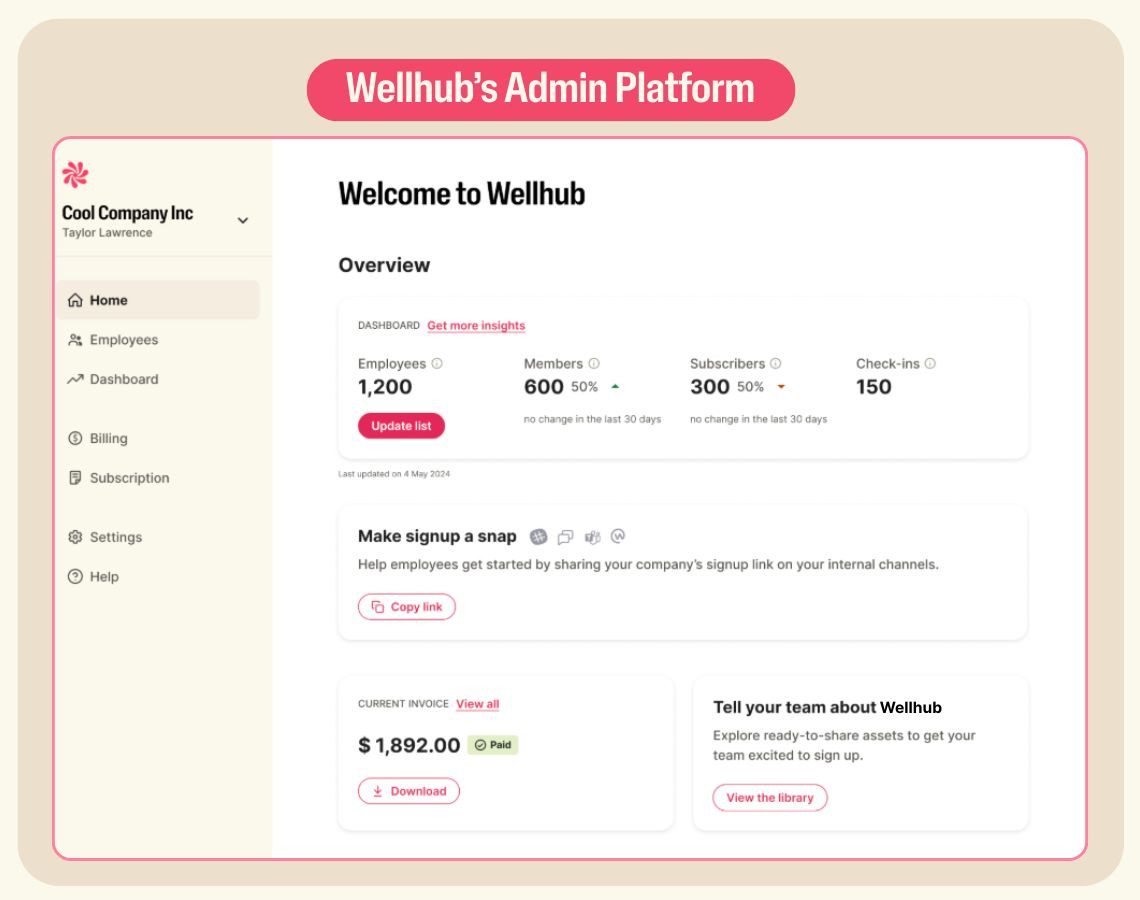
- Integrated wellbeing dashboards
- Centralized benefits platforms with built-in analytics
- Quarterly wellbeing pulse surveys
- Wellness utilization data paired with performance outcomes
- Manager-level reporting on engagement and burnout risk
And here’s the exciting part: 58% of CEOs who receive monthly wellbeing impact updates significantly increased program funding last year. When HR tells a stronger story, leadership invests more deeply.
This is your moment to shine as a strategic partner — not just a program administrator.
Trend 6: Physical Activity as a Foundation for Resilience and Performance
Now imagine this: your employees start the day feeling energized, focused, and ready to take on whatever lands in their inbox. They’re managing stress better. They’re communicating better. They’re thinking more clearly. That’s not magic — that’s movement.
Movement’s Role in Stress Reduction and Cognitive Function
Physical activity is one of the most powerful resilience tools employees have — and they’re using it. Seventy-eight percent of employees engage in physical activity weekly, and 47% now consider themselves fit or extremely fit, a clear rise from previous years.
Movement helps regulate stress, improve sleep, strengthen immunity, and boost mood. And nearly 59% of employees say they use exercise specifically to manage stress, making it the top stress-management practice in the workforce.
Why Physical Activity Demand Is Rising Again
Employees are reconnecting with activity because they’re feeling the effects of modern work: more stress, more screen time, and more cognitive load.
And the data confirms the demand:
- 74% of employees visit wellness or recreation spaces weekly
- 21% go daily
- 40% say exercise is their primary reason for going
Workers are craving movement because it makes everything else — focus, creativity, emotional regulation — easier.
Generational trends amplify this shift. Younger workers are especially motivated: 58% of Gen Z and 55% of Millennials say their physical wellbeing has improved year over year, signaling that wellness is becoming an identity, not an activity.
Fitness Access as a Benefit Essential for 2026
Across industries, companies are recognizing that physical activity should be as accessible as healthcare — because it directly affects health, performance, and retention.
Here’s what leading employers are doing:
- Offering fitness subscriptions that include gyms, classes, and digital workouts
- Providing access to “third spaces” where employees can move, de-stress, and reset
- Supporting varied activity preferences — from yoga to resistance training to running
- Reducing cost and time barriers that make fitness hard to maintain
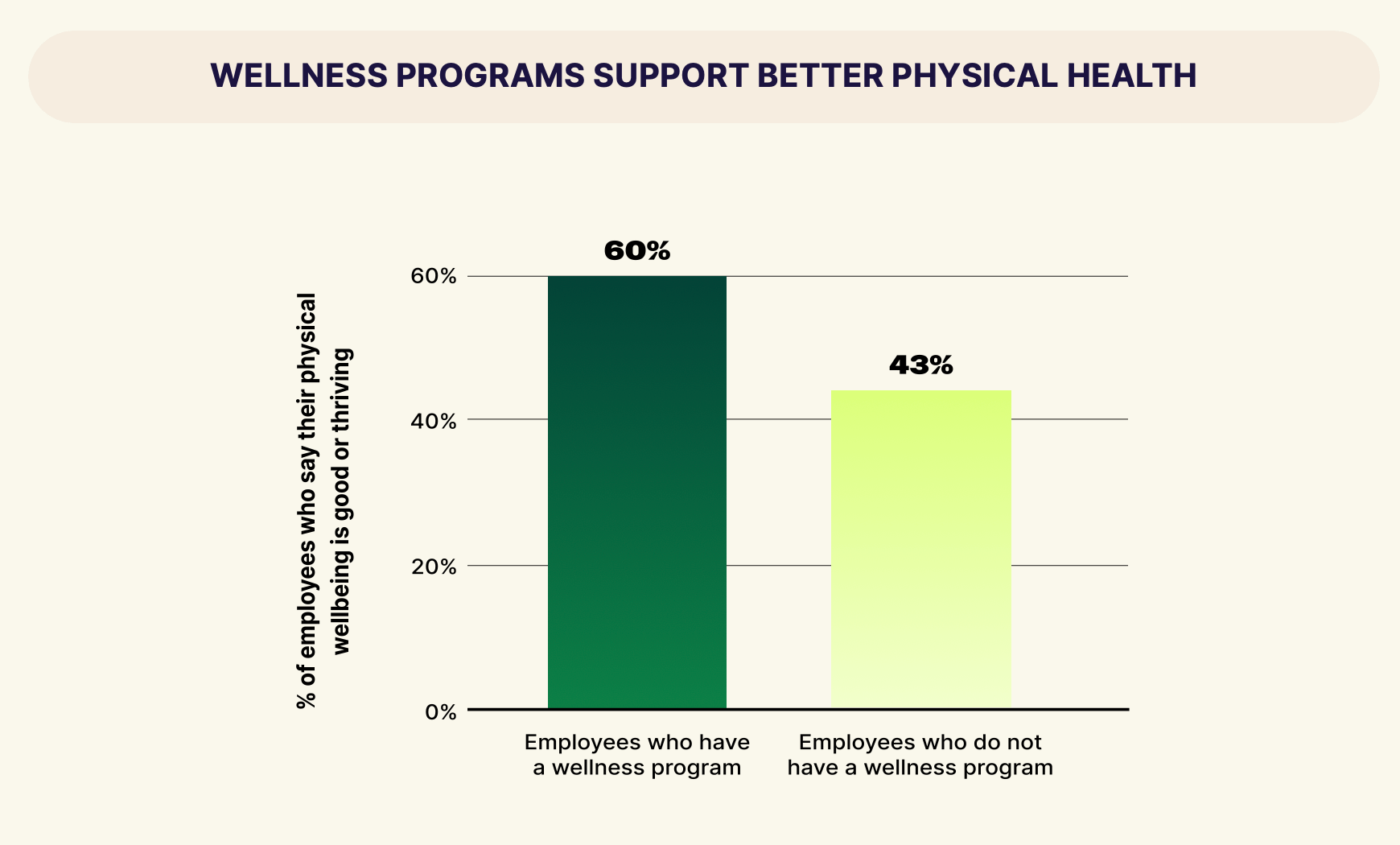
And the workforce notices. Wellhub members are 70% more likely to rate their physical health as good or excellent compared to non-members.
Movement is emerging as the backbone of high performance — and one of HR’s most effective tools for building a resilient workforce.
Trend 7: Preventative Mental Health Support Becomes the Norm
Imagine this: instead of waiting until employees hit a breaking point, your organization gives them the tools, time, and support to stay ahead of stress, burnout, and emotional strain. In 2026, that’s not a futuristic idea — it’s the new standard for workplace care.
Employees Expect Continuous Emotional Support, Not Crisis Response
Mental health needs are evolving fast, and employees are being wonderfully vocal about what they need. A significant 54% of employees rate their mental health as good or thriving, yet 12% say they’re struggling, and 90% have experienced burnout symptoms in the past year.
Burnout is chronic, stress is rising, and emotional health is becoming central to how employees evaluate their work environment. Workers aren’t just asking for therapy — they’re asking for proactive care that helps them feel emotionally grounded before the stress spikes.
That’s why preventative mental health is stepping into the spotlight.
Growth in Coaching, Behavioral Health Tools, and Proactive Care Models
To meet these rising expectations, companies are widening their mental health ecosystems. Today’s employees lean on multiple types of care, and the data paints an encouraging picture:
- 46% of employees engage in therapy (in-person, online, group, or AI-assisted)
- 57% say mindfulness is very important, with 62% practicing at least weekly
- 20% use self-guided meditation, and 33% use mindful walks to reset
- 41% say wellness apps help keep them motivated, and 39% say the apps help build healthy routines
These numbers signal a shift: employees want a menu of mental health tools, not a single resource tucked behind an EAP login.
We’re seeing growth in:
- Stress-reduction coaching
- Mindfulness and emotional regulation workshops
- Digital behavioral health platforms
- AI-driven support tools
- Peer support groups and structured check-ins
- Preventative therapy stipends
This kind of layered support helps employees maintain emotional balance day-to-day — not just in moments of crisis.
How Mental Health Integrates Into Broader Wellbeing Ecosystems
In 2026, leading organizations aren’t treating mental health as a standalone benefit. They’re integrating it into whole-person wellness models because emotional wellbeing influences everything else: physical health, productivity, focus, sleep, relationships, and culture. Preventative care becomes an engine for performance, not a Band-Aid for burnout.
Trend 8: Personalized Wellness Pathways Gain Traction
Picture this: an employee logs into their wellness platform and sees an experience tailored to their needs — not their teammate’s, not a generic company average, but their personal habits, goals, preferences, and wellbeing challenges.
That’s the direction corporate wellness is heading in 2026: fully personalized wellbeing journeys.
Shift Away From “One-Size-Fits-All” Programs
Employees are over generic wellness programming. They want support that reflects their lives — their schedule, their stressors, their physical condition, their goals, and their personality. And honestly? They deserve it.
The data reinforces this shift:
- 64% say their approach to wellbeing has become more intentional
- 82% made positive lifestyle changes in the last year
- 62% use wellness apps weekly, including nearly one in three Gen Z employees using them daily
Employees are already customizing their wellness outside of work. They want their employer’s support to match that level of personalization.
Use of Data Insights, Employee Profiles, and Wellness Journeys
Companies are now using smarter tools to meet those expectations. Personalized wellness programs might include:
- Goal-based activity recommendations
- Tailored mental health pathways based on stress or burnout indicators
- Nutrition suggestions that adapt to lifestyle and budget
- Micro-habits that adjust based on progress
- Customized sleep, movement, and stress dashboards
- Recommendations tied to preferred environments (remote, hybrid, on-site)
Employees love these experiences because personalization feels supportive, not prescriptive. It gives people ownership over their wellbeing — with HR acting as a guide.
Tailored Offerings That Adjust to Each Employee’s Goals
This is where personalization shines. As employees grow, their wellness needs shift. Leading organizations build programs that can shift with them.
Examples of what HR teams are rolling out:
- Fitness access that adjusts to an employee’s preferred activities (running, yoga, strength)
- Mental health support paths that change based on utilization and self-reported stress
- Flexible scheduling tools that help employees protect time for specific wellness practices
- Social wellness opportunities tailored to personality types — introverts and extroverts both included
- Financial wellbeing resources that adapt to life milestones
Personalized pathways help employees feel seen. And when employees feel seen, they’re more likely to stay, grow, and invest in their wellbeing.
Trend 9: Social Wellbeing and Connected Workforces
Imagine this: your employees walk into work — or log on from home — and immediately feel connected, supported, and part of something bigger than themselves. In 2026, this sense of belonging isn’t just a cultural “nice-to-have.” It’s a wellness essential.
Signals of Isolation and Disconnection in the 2026 Report
Even in our hyper-connected world, loneliness is quietly shaping the employee experience. Workers today want community — yet many aren’t finding it at work. And that disconnect hits wellbeing hard.
Here’s what the data tells us:
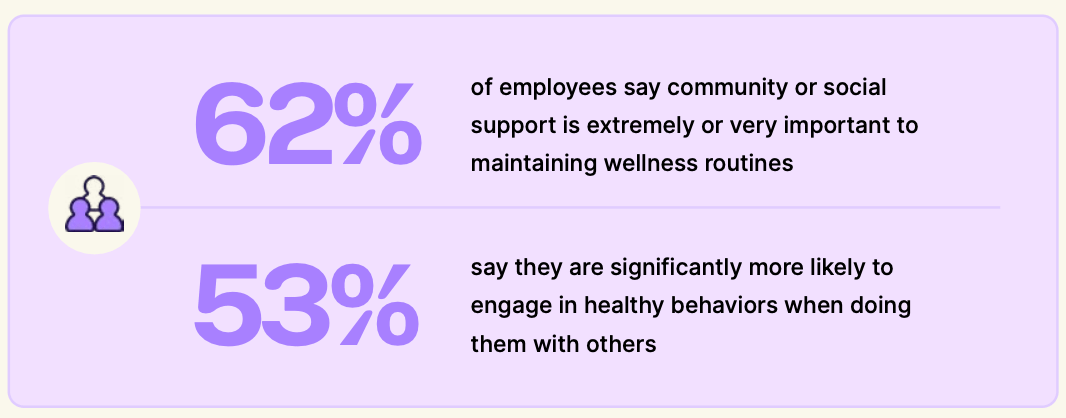
- 62% of employees say community and social support are extremely or very important for maintaining long-term wellness habits.
- 22% connect with coworkers in wellness spaces, showing that social wellbeing is already blending with physical and mental wellness.
- 56% say they feel highly connected during shared wellness activities, highlighting the power of intentional community moments.
Employees are craving deeper relationships — and they’re turning to wellness programming to find it.
How Relationships, Community, and Team Culture Affect Performance
When employees feel socially connected, everything changes. Teams communicate more openly. Workflows feel smoother. Stress becomes easier to manage. And burnout becomes easier to prevent.
Social wellness influences:
- Collaboration and psychological safety
- Engagement levels
- Trust between employees and leadership
- Creativity and problem-solving
- Overall resilience
And here’s the business impact: employees who experience meaningful connection are more likely to stay. They’re also more likely to engage in healthy behaviors — 53% say they’re more likely to pursue wellness goals when doing so with others.
Connection drives consistency. Consistency drives wellbeing. And wellbeing drives performance. It’s a beautifully simple loop.
Popular Social Wellness Programming for 2026
Forward-thinking companies are building community intentionally — weaving social wellness into the fabric of daily work. Here’s what’s gaining traction:
- Team-based wellness challenges — the most appealing challenge format for 36% of employees
- Group fitness classes, both virtual and in-person
- Wellbeing communities and online forums where employees share progress and tips
- Volunteer days and purpose-driven events that spark shared meaning
- Affinity groups with wellness elements, supporting belonging while boosting wellbeing
- Hybrid-friendly social rituals, like virtual coffee chats or walking meetings
And when companies get this right? Engagement booms. Eighty-three percent of employees say they’re more likely to join wellness initiatives if there’s a team or community component. Wellbeing grows stronger when people grow stronger together.
Trend 10: Hybrid-Ready Wellness Experiences
Picture this: your wellness program works beautifully for on-site teams, remote teams, hybrid teams, night-shift teams — everyone. No matter where people are or how they work, they experience the same level of access, care, and support. In 2026, building hybrid-ready wellness is not just a trend. It’s an expectation.
Need for Benefits That Serve On-Site, Hybrid, and Remote Employees
Employees aren’t all gathered in the same place anymore. Work is distributed. Schedules are fluid. Life looks different for every worker. And because 39% of employees say they aren’t working in their preferred environment, equity across work models becomes a core part of wellbeing (State of Work-Life Wellness 2026, source here).
If wellness benefits are only accessible to some employees, they don’t feel like benefits — they feel like barriers. Hybrid-ready programs fix that by meeting employees wherever they work.
Expansion of Virtual, Near-Site, and Flexible Wellness Access
To support every employee, companies are reimagining how and where wellbeing happens. The trend is shifting toward blended ecosystems that include:
- Virtual mental health and coaching services
- Digital fitness classes and wellness apps
- Near-site or local partner gyms, studios, and recreation centers
- Third spaces, like yoga studios or nature trails, for stress relief and community
- Flexible scheduling that allows employees to incorporate wellness during the day
This variety matters because employees use this access differently. Some prefer a local gym. Some prefer at-home yoga. Some thrive in group workouts. And many want a mix.
And the data reinforces why this matters: 74% of employees visit wellness or recreational spaces weekly, and 21% go daily. They’re looking for flexible, convenient access — not one fixed option.
How HR Leaders Can Ensure Equity Across Work Models
Creating hybrid-ready wellness means building programs that feel fair, inclusive, and equally accessible. HR leaders are doing this by:
- Offering universal access to digital and in-person wellness options
- Ensuring that employees in all locations receive clear communication about available benefits
- Standardizing wellness budgets or stipends so workers can choose what works best
- Partnering with global and local wellness providers to support diverse geographies
- Creating wellness experiences (like group challenges) that include both virtual and in-person components
The goal is simple: every employee, in every environment, should have the time and resources to care for their wellbeing. When that happens, stress decreases, connection increases, and culture strengthens — no matter where employees sit.
How HR Teams Can Prepare for These Trends
Imagine this: you’ve just finished reading the latest wellbeing data, and instead of feeling overwhelmed by the rapid pace of change, you feel energized — because you have a clear, practical roadmap for how to get your organization ready for what’s coming. That’s exactly what this section is designed to give you.
Preparing for 2026’s wellness trends isn’t about doing everything at once. It’s about knowing where to focus, taking one thoughtful step at a time, and building a wellbeing strategy that’s as resilient as your workforce.
Key Steps for 2026 Readiness
You’re leading your company into a new era of workforce health. These steps help you do it with clarity and confidence.
- Reevaluate Your Current Wellbeing Ecosystem
Take a step back and look at your wellness offerings holistically. Are they fragmented? Are they equitable? Do they support the full spectrum of physical, mental, emotional, social, and financial health?
This is the moment to assess what stays, what goes, and what needs to be elevated.
- Prioritize Leadership Alignment and Visibility
Executives are increasingly owning wellness as a business priority — and employees feel the difference. With 58% of CEOs strongly agreeing that wellbeing is critical to financial success, you can leverage that alignment to secure resources, visibility, and strategic clarity.
Bring leaders into the conversation early. Their voice is a game-changer.
- Create a Measurement Framework You Can Sustain
Wellness ROI is now a must-have, not a mystery. Build a simple, realistic measurement system that tracks:
- Absenteeism trends
- Turnover or resignation risk
- Productivity signals
- Wellbeing utilization and engagement
- Healthcare cost movements
When you share these insights regularly, you help leaders make smarter, faster decisions. And you help employees see the value of the support they’re receiving.
- Expand Your Definition of Access
Hybrid work isn’t going anywhere — and neither are employee expectations. Make sure your programs meet people where they are, whether that’s a home office, a corporate HQ, or a third space like a fitness studio or park. Flexibility is a wellness benefit in itself.
- Simplify Everything You Can
Employees are busy, tired, and flooded with tools. Simplify logins, consolidate platforms, remove friction. Remember: When accessing wellness feels easy, participating in wellness becomes natural.
Questions to Assess Gaps in Your Current Wellness Strategy
Here are a few questions you can use to guide your internal audit — think of them like your diagnostic toolkit:
- Do employees know how to access all their wellness resources?
- Are offerings inclusive of onsite, hybrid, and remote employees?
- Is leadership actively championing wellbeing — or just approving budgets?
- Where are employees struggling most (stress, sleep, connection, movement)?
- Do our programs support whole-person wellness?
- Are we regularly sharing ROI, insights, or program outcomes with executives?
- Are wellness initiatives culturally embedded or just listed in a handbook?
Each “no” you uncover becomes an opportunity to innovate.
How to Align Offerings With Business Goals and Workforce Needs
This is where your strategic magic truly shines. You’re not just managing a benefits program — you’re shaping the conditions that help employees and performance flourish.
Here’s how to align everything:
Start With Your Workforce Data
The wellbeing numbers tell you exactly where to focus. For example, if 90% of employees say they experienced burnout symptoms, that’s a signal to strengthen mental health and workload support.
Tie Wellness Investments to Business Results
Help your executive partners see the connection between wellbeing and performance. For instance:
- 89% of employees perform better when they prioritize wellbeing
- 73% of CEOs say wellbeing programs improve talent retention
Those insights turn wellness from a “program” into a strategic lever.
Use Personalization and Flexibility to Drive Engagement
Employees increasingly expect wellness to match their lives. Design experiences that meet different needs and preferences, whether those employees are night-shift workers, early-career employees, caregivers, or senior leaders.
Create Clear Communication Channels
Even the best wellness offerings fall flat if employees don’t know how to use them. Build communication that is consistent, warm, and easy to digest. And share reminders often — especially at high-stress moments in the year.
Make Wellbeing Part of the Culture, Not the Calendar
Move the conversation beyond annual benefits enrollment. Embed wellbeing into team routines, manager expectations, daily practices, and leadership storytelling.
When wellbeing becomes part of the way your company functions, employees feel it — and results follow.
Wellbeing Strategies for 2026: What HR Teams Need Most
The trends shaping corporate wellness in 2026 reveal a clear call to action: employees want holistic, personalized support that actually fits their lives. HR teams are juggling fragmented tools, rising burnout, and increased pressure to show real ROI — all while trying to engage a diverse, distributed workforce.
A unified employee wellbeing program like Wellhub can address all of this. It helps reduce burnout, improve productivity, and boost retention by meeting employees’ needs across physical, mental, social, and emotional health.
Speak with a Wellhub Wellbeing Specialist to build a program that supports your team, strengthens culture, and delivers measurable results.

Company healthcare costs drop by up to 35% with Wellhub*
See how we can help you reduce your healthcare spending.
Category
Share

The Wellhub Editorial Team empowers HR leaders to support worker wellbeing. Our original research, trend analyses, and helpful how-tos provide the tools they need to improve workforce wellness in today's fast-shifting professional landscape.
Subscribe
Our weekly newsletter is your source of education and inspiration to help you create a corporate wellness program that actually matters.
Subscribe
Our weekly newsletter is your source of education and inspiration to help you create a corporate wellness program that actually matters.
You May Also Like

Wellness Points Programs: Boost Employee Health & Engagement | Wellhub
Turn your workplace wellness strategy around with a points program that rewards healthy behavior with perks, from extra time off to gift cards.

Employee Financial Wellness Programs: Ultimate HR Guide | Wellhub
Create an effective financial wellness program that supports your employees in their financial needs, boosting productivity and retention.

6 Ways to Mental Health Support at Work | Wellhub
Transform your workplace with effective mental health support strategies to reduce stress, prevent burnout, and create a thriving company culture.