The AI-Driven Stress Cycle at Work: How HR Can Break It Before Burnout Sets In
Last Updated Jan 29, 2026

Key Takeaways
- AI increases stress when it’s introduced without clarity, guardrails, and recovery support. The core issue isn’t fear of technology, but broken systems that raise expectations faster than they provide role clarity or relief. When employees don’t understand how AI affects their jobs or workloads, uncertainty turns into ongoing pressure. Without intentional design, AI becomes a stress multiplier instead of a support.
- The AI-driven stress cycle follows predictable loops that quietly accelerate burnout. Awareness fuels insecurity, insecurity drives overwork, AI adds hidden “work about work,” and faster pace erodes recovery time. Each loop reinforces the next, turning small stressors into systemic burnout. Once the cycle gains momentum, engagement drops and AI adoption suffers—even when the technology itself is sound.
- Job insecurity, not resistance, is what drains energy and undermines performance. Employees work longer hours and take on more tasks to prove relevance when AI feels threatening. That constant self-protection leads to emotional exhaustion, presenteeism, and stalled growth. Framing AI as role support, showing future pathways, and equipping managers for honest conversations helps restore confidence before burnout takes hold.
- AI often reshapes work instead of reducing it, creating overload through coordination and review. Human oversight, approvals, and context switching add cognitive load that rarely shows up in productivity metrics. When AI tools are layered on without removing tasks, employees feel busy but ineffective. Designing for subtraction and auditing hidden review work is essential to breaking this loop.
- Wellbeing and recovery are infrastructure requirements for successful AI adoption. Faster tools without boundaries shrink recovery and push work into home life, making burnout inevitable. When organizations share AI gains through flexibility, lighter workloads, and protected recovery time, trust rises and resistance fades. Embedding wellbeing into AI strategy turns efficiency into sustainable performance instead of long-term fatigue.
AI was supposed to make work easier. So why does it feel like employees are more exhausted than ever?
Across industries, artificial intelligence is accelerating tasks, streamlining workflows, and transforming job roles. But for many employees, it’s also speeding up stress. Instead of feeling empowered, they’re feeling overwhelmed — caught in a loop of rising pressure, blurred boundaries, and shrinking recovery time.
This isn’t about fear of change. It’s about broken systems. When AI is introduced without the right support — like clear job impacts, realistic workload expectations, and built-in recovery time — it doesn’t reduce stress. It amplifies it.
That’s the AI-driven stress cycle. And if left unchecked, it can quietly fuel burnout, resistance, and disengagement — no matter how powerful the tech.
Uncover the hidden loops that turn AI into a stress multiplier — and discover how HR can flip the script to build trust, restore energy, and help AI actually work for people.
What Is the AI-Driven Stress Cycle?
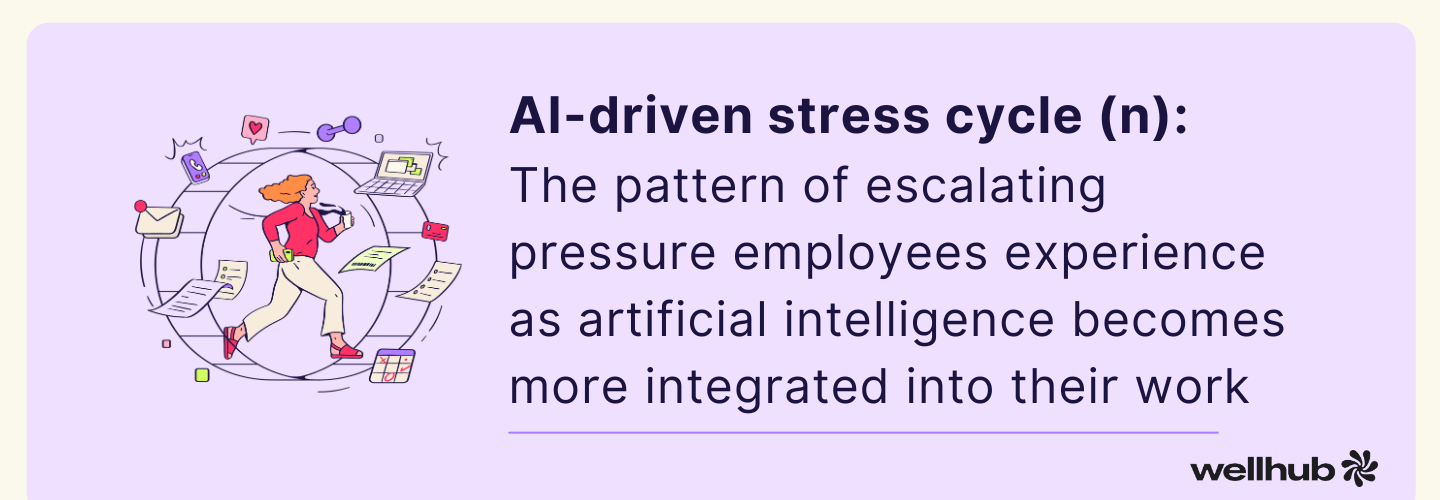
The AI-driven stress cycle is the pattern of escalating pressure employees experience as artificial intelligence becomes more integrated into their work.
It starts when employees are introduced to AI tools—whether through training, headlines, or hands-on use. This awareness often triggers uncertainty or fear, which can lead to stress. As expectations to adapt increase, that stress builds. If it goes unaddressed, it can lead to burnout. Burned-out employees are more likely to view AI as a threat than a tool—deepening the cycle and making adoption even harder the next time around.
This isn’t about employees resisting change. It’s about systems. When AI is introduced without clear role clarity, workload guardrails, and recovery support, it can unintentionally amplify stress instead of reducing it. Over time, that stress compounds. What began as excitement or curiosity becomes fatigue and distrust.
At a high level, the AI-driven stress cycle shows up in four reinforcing loops:
- Awareness → Insecurity → Exhaustion: AI visibility raises fears about job stability and relevance.
- Automation → Workload rebound → Overload: AI speeds work up, but expectations rise right along with it.
- Overload → Work–home spillover → Reduced recovery: Faster pace eats into rest and family time.
- Exhaustion → Cynicism → Poor adoption: Burned-out employees disengage from AI, undercutting its value.
Why does this matter so much for HR? Because cycles accelerate.
Once stress starts reinforcing itself, small issues become systemic ones. Burnout spreads faster. Engagement drops harder. And performance suffers even as technology investment increases. That’s especially risky when ninety percent of employees say they experienced burnout symptoms in the past year, according to Wellhub’s State of Work-Life Wellness 2026 study.
The good news? Cycles can be broken. But first, leaders need a shared language to recognize when AI is helping work flow — and when it’s quietly fueling stress.
Loop One — Awareness Turns Into Anxiety
This is where the cycle usually begins. AI enters the conversation before it enters the workflow. Leaders announce new tools, pilots, or partnerships. Employees hear the message loud and clear. What they don’t hear is context.
What’s Happening
AI awareness rises faster than role clarity. Employees know change is coming, but they don’t know what it means for them. That uncertainty creates a vacuum. And vacuums get filled with fear. People start wondering if their skills still matter, if their role is shrinking, or if they’ll be expected to “do more with less” overnight.
This reaction is human. When the future feels vague, the brain defaults to threat detection. Over time, that low-grade anxiety becomes emotionally draining, even before any real job changes occur.
What HR Sees
This loop shows up early, and it shows up subtly:
- A spike in questions like, “Will my role still exist?” or “Should I be worried?”
- Lower engagement scores right after AI announcements.
- Fewer employees speaking up in meetings or experimenting with new tools.
- A quiet drop in psychological safety.
It’s important to name this clearly: this is not resistance. It’s self-protection.
Action Steps for HR
This loop can be slowed — and often stopped — with intentional communication.
- Step one: Lead with the why. Explain why AI is being introduced before explaining what it does. Is it about reducing low-value tasks? Improving service quality? Supporting growth without burnout? Purpose lowers threat.
- Step two: Make job impact explicit. Share simple narratives: which roles are staying the same, which will change, and which will grow. Even imperfect clarity is better than silence.
- Step three: Pair AI with reskilling from day one. Don’t announce AI without announcing learning. When employees see investment in their future, insecurity drops fast.
This matters more than ever because employees are already stretched. Eighty-one percent of workers believe employers have a responsibility to support their wellbeing, according to Wellhub’s State of Work-Life Wellness 2026 study. Unclear AI messaging does the opposite.
Metric to Track
Watch job security sentiment in engagement and pulse surveys. A dip here is often the first warning sign that the AI-driven stress cycle has started spinning.
Handled well, this moment builds trust. Handled poorly, it sets the tone for every loop that follows.
Loop Two — Job Insecurity Becomes Emotional Exhaustion
Once anxiety takes root, it doesn’t stay abstract for long. It turns personal. Employees stop asking, “How do I do great work?” and start asking, “How do I stay relevant?”
What’s Happening
When people feel even slightly replaceable, their relationship with work changes. Pride fades. Confidence wobbles. Effort shifts from impact to optics. Employees work longer hours and say yes to more tasks, not because it helps the business, but because it helps them feel safer.
This is where AI quietly drains energy. People aren’t collaborating with tools to work better. They’re competing with them to prove they still matter. That constant self-justification is exhausting.
What HR Sees
This loop shows up in both behavior and data:
- Emotional exhaustion scores climb.
- Internal mobility slows as employees cling to “safe” roles.
- Presenteeism rises — people show up, but they’re depleted.
- High performers start to plateau or disengage.
The work is getting done. The people are wearing down.
Action Steps for HR
Breaking this loop requires shifting the narrative from replacement to reinforcement.
- Step one: Map AI to role support, not role erosion. Be explicit about how AI helps employees succeed in their current roles. Frame tools as copilots, not competitors.
- Step two: Update job architecture with future pathways. Show how roles evolve over time. When employees can see where their skills are headed, insecurity loses its grip.
- Step three: Equip managers for real conversations. Train managers to talk about AI with empathy, not hype. Employees don’t need promises. They need honesty, reassurance, and clarity.
Why This Matters
This loop sits at the intersection of performance and wellbeing. When insecurity goes unchecked, burnout follows fast. And employees are paying attention. Eighty-one percent of workers believe employers have a responsibility to help support their wellbeing, according to Wellhub’s State of Work-Life Wellness 2026 study. Addressing job insecurity isn’t just humane. It’s expected.
Handled well, AI can restore confidence by removing friction and elevating judgment work. Handled poorly, it turns everyday work into an emotional endurance test. And that’s a cost no organization can afford to normalize.
Loop Three — AI Adds “Work About Work”
This is the part of the cycle that surprises leaders the most. AI is supposed to save time. But for many employees, it does the opposite.
What’s Happening
AI doesn’t just produce outputs. It produces decisions. And decisions require humans. Employees review drafts, check accuracy, fix tone, validate data, and moderate risk. That oversight is real work. When it stacks on top of existing responsibilities, attention splinters.
Instead of fewer tasks, employees get more micro-tasks. Instead of deeper focus, they get constant context switching. The result is a workday that feels full but unfulfilling.
AI hasn’t reduced the load. It’s changed the shape of it.
What HR Sees
This loop shows up loud and clear in day-to-day signals:
- Workdays quietly stretch longer.
- Employees describe their days as “busy but not productive.”
- Teams complain about juggling too many tools with overlapping purposes.
- Fatigue rises, even when output appears steady.
This matters because excessive workload is already the top burnout driver. Forty-three percent of employees cite excessive workload as the leading cause of burnout, according to Wellhub’s State of Work-Life Wellness 2026 study. When AI adds coordination instead of removing it, it pours fuel on an existing fire.
Action Steps for HR
This loop breaks when leaders design for subtraction, not just automation.
- Step one: Audit where AI adds review layers. Identify every place humans must check, correct, or approve AI output. That hidden labor needs to be visible before it can be managed.
- Step two: Remove or redesign low-value approvals. If AI requires three layers of sign-off to feel “safe,” the process needs rethinking. Simplify workflows so review effort matches actual risk.
- Step three: Subtract tasks when adding tools. Every new AI capability should come with a clear answer to one question: What are we no longer asking employees to do? If nothing is removed, overload is guaranteed.
Metric to Track
Measure time spent on coordination versus core work. When “work about work” grows faster than impact work, the stress cycle is already in motion.
Handled thoughtfully, AI can restore focus by clearing friction. Handled carelessly, it turns knowledge work into an endless loop of checking, chasing, and catching up.
Loop Four — Work Spills Into Home, Recovery Shrinks
This is where the stress cycle stops being just a work problem. It becomes a life problem.
What’s Happening
AI speeds things up. Deadlines tighten. Output expectations rise. But boundaries don’t automatically adjust. When work moves faster without clear stop signals, employees don’t feel “done.” They feel behind.
Always-on tools make this worse. Notifications blur the end of the day. Tasks linger in the back of people’s minds. Even when employees log off, their nervous systems don’t. Recovery time shrinks, and stress quietly compounds.
This isn’t about poor time management. It’s about unfinished work living rent-free in people’s heads.
What HR Sees
By this stage, the signals are harder to ignore:
- More work–family conflict and guilt about not being fully present anywhere.
- Declining sleep quality and shorter recovery windows.
- Burnout shifting from occasional to chronic.
- Employees using PTO to recover, not to rest.
When recovery erodes, performance follows. No amount of efficiency can compensate for a tired brain.
Action Steps for HR
Breaking this loop means treating recovery as a system requirement, not a personal coping skill.
- Step one: Redesign workload expectations alongside AI speed gains. If AI accelerates output, expectations must be recalibrated. Faster tools should not automatically mean fuller plates.
- Step two: Normalize recovery behaviors — not just resilience training.Meditation apps won’t fix a schedule that never ends. Leaders need to model logging off, taking breaks, and respecting boundaries.
- Step three: Share AI gains through flexibility. Use efficiency wins to offer shorter days, flexible schedules, or protected focus time. When employees see tangible benefits, stress drops and trust rises.
Wellbeing Connection
This loop is where wellbeing becomes inseparable from performance. Eighty-nine percent of employees say prioritizing wellbeing improves their ability to perform at work, according to Wellhub’s State of Work-Life Wellness 2026 study. Recovery isn’t a perk. It’s how people stay effective.
When AI compresses work without protecting recovery, burnout becomes inevitable. When recovery is designed in, AI can finally deliver on its promise — not just faster work, but better work.
The Final Loop — Burnout Breeds Resistance to AI
By the time organizations reach this stage, the story flips. AI was introduced to help. Now it’s something employees quietly push against.
What’s Happening
Burnout changes how people interpret intent. When employees are exhausted, even well-meaning AI initiatives feel suspicious. Tools start to look less like support and more like surveillance. Efficiency goals feel like cost-cutting in disguise. And every new rollout lands heavier than the last.
At this point, the problem isn’t the technology. It’s trust. Burned-out employees don’t have the energy to experiment, adapt, or give the benefit of the doubt. So adoption stalls. Benefits don’t materialize. Leaders wonder why the ROI isn’t there — while employees quietly disengage.
This is how burnout turns into resistance.
What HR Sees
This loop shows up culturally and operationally:
- Shadow workflows where employees avoid AI tools or use them “just enough” to comply.
- Inconsistent adoption across teams, even with the same tools.
- Pushback framed as “change fatigue” or “too many initiatives.”
- Cynicism about leadership motives, especially around monitoring and performance.
The tools exist. The value doesn’t.
Action Steps for HR
Breaking this loop requires rebuilding trust before pushing adoption.
- Step one: Separate performance tracking from surveillance fears. Be explicit about what AI does not measure. Clarify where data is used and where it isn’t. Ambiguity breeds fear, and fear kills adoption.
- Step two: Involve employees in improving AI. Create feedback loops where employees can flag friction, suggest improvements, and influence how tools evolve. Participation restores agency.
- Step three: Reposition AI as a wellbeing support, not a productivity whip. Show how AI reduces cognitive load, protects focus time, or prevents overload. When employees experience relief, resistance fades.
Wellbeing Connection
This step is critical because burnout is already widespread. Ninety percent of employees say they experienced burnout symptoms in the past year, according to Wellhub’s State of Work-Life Wellness 2026 study. Rolling out more technology without addressing that reality only deepens the divide.
Handled well, this loop becomes a turning point. Handled poorly, it locks organizations into a cycle where AI investments rise — and human energy keeps falling.
How HR Can Break the Cycle — A Practical Reset Framework
Here’s the empowering truth: the AI-driven stress cycle isn’t inevitable. It’s designed. Which means it can be redesigned.
This is where HR moves from observing the problem to reshaping the system. Not with a single policy or tool, but with a coordinated reset that puts people, flow, and wellbeing back at the center of how AI shows up at work.
Step One: Diagnose Where the Cycle Is Strongest
You don’t need a perfect measurement model to get started. You need directional clarity.
Start by looking at the signals you already have:
- Engagement and pulse surveys that flag stress, workload, or job security concerns.
- Turnover and regretted loss data by role or team.
- Manager feedback about morale, energy, and adoption challenges.
Your goal isn’t to fix everything at once. It’s to identify which loop is accelerating burnout the fastest. For some organizations, it’s insecurity. For others, it’s workload rebound or recovery loss. Precision beats breadth here.
Step Two: Redesign AI Around Flow, Not Output
Most AI strategies optimize for output. Sustainable ones optimize for flow.
That means:
- Fewer tools with clearer ownership.
- Defined handoffs instead of overlapping functionality.
- Automation that removes friction instead of adding review work.
Ask one simple question in every AI decision: Does this make work feel smoother for the human using it? If the answer is no, stress will rise — even if productivity metrics look good on paper.
Step Three: Share AI Gains With Employees
This step is where trust is either built or broken.
If AI creates efficiency but employees never feel it, the stress cycle continues. Gains have to show up in real, human ways:
- Shorter or more flexible workdays.
- Fewer low-value tasks and meetings.
- Greater control over when and how work gets done.
When employees experience benefits directly, AI stops feeling like pressure and starts feeling like progress.
Step Four: Anchor AI Strategy in Wellbeing
This is the foundation that holds everything else together.
Wellbeing can’t sit on the sidelines while AI reshapes work. It has to be treated as core infrastructure — just like systems, data, and security. That expectation already exists in the workforce. Eighty-six percent of employees say wellbeing at work is as important as their salary, according to Wellhub’s State of Work-Life Wellness 2026 study.
When wellbeing is embedded into AI strategy, something powerful happens. Recovery improves. Trust rebuilds. Adoption increases. And performance becomes sustainable again.
Breaking the AI-driven stress cycle doesn’t require slowing innovation. It requires designing it for humans — intentionally, transparently, and with care.
AI, Burnout, and the Role of Employee Wellbeing Programs
By now, the pattern is clear. AI raises awareness. Awareness fuels insecurity. Insecurity increases workload pressure. Pressure spills into home life. Recovery shrinks. Burnout sets in. And once burnout takes hold, even the best AI tools struggle to deliver value.
This is why AI strategy and wellbeing strategy can’t live in separate lanes.
When employees are depleted, they don’t adopt new tools well. They don’t trust intent. And they don’t have the cognitive or emotional bandwidth to change how they work. That’s not a motivation problem. It’s an energy problem.
Employee wellbeing programs play a critical role here because they restore what AI-driven change often drains: recovery, trust, and resilience.
Well-designed wellbeing support gives employees places to reset their nervous systems, rebuild routines, and regain a sense of control. That matters because burnout isn’t just about feeling tired. It’s about feeling overwhelmed and unsupported. And that feeling spreads fast during periods of rapid technological change.
The expectation is already there. Eighty-six percent of employees say their wellbeing at work is as important as their salary, according to Wellhub’s State of Work-Life Wellness 2026 study. When AI accelerates work without strengthening wellbeing infrastructure, organizations create a gap employees feel immediately.
Flexible, accessible wellbeing programs help close that gap. They make it easier for employees to recover during the day, not just after it. They support mental, physical, and emotional resilience at the same time. And they send a powerful signal: efficiency gains won’t come at the expense of human sustainability.
That signal matters. When employees believe their employer is protecting their energy, trust rises. Adoption improves. And AI starts to feel like a tool that supports better work — not one that quietly burns people out.
AI-Induced Burnout Isn’t Just a Tech Problem — It’s a Wellbeing One
While AI speeds up processes, it’s also accelerating stress.
Employees feel uncertain about their roles, overloaded with new tasks, and unable to disconnect. That pressure stacks fast — leading to burnout, resistance, and disengagement.
Wellbeing programs interrupt that stress cycle by restoring the energy AI drains. When recovery, clarity, and flexibility are built into the employee experience, people stop bracing for impact and start embracing change. Ninety percent of employees reported burnout symptoms last year, but 89% say prioritizing wellbeing helps them perform better.
Speak with a Wellhub Wellbeing Specialist to protect your team’s energy and unlock AI’s full potential without burning your people out.

Company healthcare costs drop by up to 35% with Wellhub*
See how we can help you reduce your healthcare spending.
Category
Share

The Wellhub Editorial Team empowers HR leaders to support worker wellbeing. Our original research, trend analyses, and helpful how-tos provide the tools they need to improve workforce wellness in today's fast-shifting professional landscape.
Subscribe
Our weekly newsletter is your source of education and inspiration to help you create a corporate wellness program that actually matters.
Subscribe
Our weekly newsletter is your source of education and inspiration to help you create a corporate wellness program that actually matters.
You May Also Like

Corporate Wellness Trends HR Must Know for 2026 | Wellhub
See the top 2026 wellness trends shaping performance, retention, and culture—plus how HR can build a unified, ROI-driven wellbeing strategy.

Wellness Points Programs: Boost Employee Health & Engagement | Wellhub
Turn your workplace wellness strategy around with a points program that rewards healthy behavior with perks, from extra time off to gift cards.

Employee Financial Wellness Programs: Ultimate HR Guide | Wellhub
Create an effective financial wellness program that supports your employees in their financial needs, boosting productivity and retention.