Employee retention: 88% of companies make it a top priority in 2026
Last updated on 2 Sept 2026

Employee retention remains a defining workforce challenge in the UK for 2026. In fact, 8 out of 10 companies consider it a priority this year — a clear sign that employers are no longer treating retention as a background HR metric but as a strategic business concern.
For HR leaders in the UK, the challenge is more than just preventing people from leaving. It is about creating a workplace culture that attracts and retains talented employees. This means understanding that retention today is about more than just how long someone stays. It also includes commitment, performance, trust, and the belief that staying is worthwhile.
This article looks at why talent retention remains a top priority for businesses in 2026. It also discusses how low turnover can sometimes hide bigger engagement problems, what encourages employees to stay long term, and how wellbeing can help organisations keep their most valuable people.
Why is employee retention still a priority in 2026?
UK employers are facing higher costs, skills shortages, AI changes, heavier workloads, and shifting employee expectations this year. In this situation, keeping people who know the business, have key skills, and deliver value is just as important as hiring new talent.
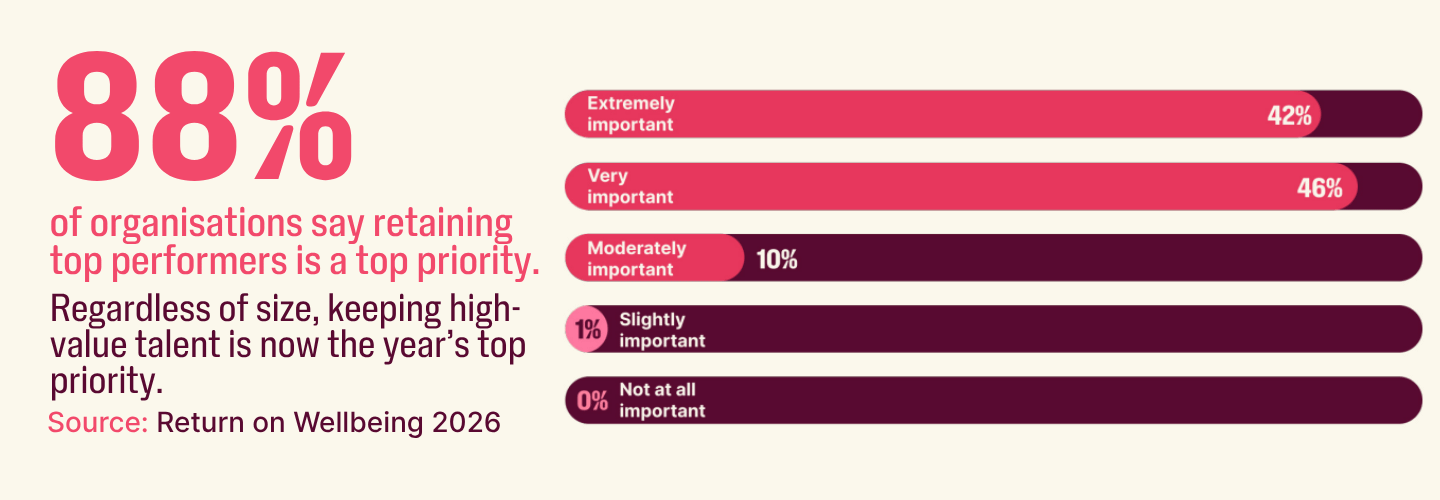
The challenge is clear. Our latest report found that 88% of organisations say keeping top performers is a main priority for 2026.
This is not surprising given the pressure on HR teams. In the UK, recruitment and retention are top concerns for employers this year. Nearly a third of HR professionals say recruitment is a key challenge, and 28% specifically mention keeping employees and top talent.
The reason is simple. Replacing people costs a lot, disrupts teams, and is becoming riskier.
When employees leave, companies lose knowledge, slow down, and put more pressure on those who stay. In the UK, the average turnover is 34%, so more than one in three workers leave their jobs each year. This leads to a cycle of hiring, onboarding, and lost productivity that constantly hurts performance. The cost is real. Replacing an employee earning £25,000 or more can cost about £30,614, including recruitment, training, and lost productivity.
But in 2026, retention is not just about cost. It is also about having the right skills. AI is changing jobs, shifting skill needs, and making it more important to keep employees who can adapt quickly. Our report also found that 62% of HR leaders are concerned about losing people with in-demand or AI-related skills, such as prompt design, workflow automation, and the interpretation of AI-generated outputs.
The false perception of engagement that’s hurting employee retention
Lower turnover might seem positive, but in today’s UK job market, it could mean something else.
After a big hiring surge following the pandemic, with vacancies reaching 1.1 million in 2021 and peaking at 1,295,000 in mid-2022, things have slowed down. From May to July 2025, vacancies dropped to 718,000, a 5.8% decrease from the previous quarter, with most industries seeing fewer openings. In part, this means that some companies are not hiring or replacing staff who leave.
This is the real reason behind the “Big Stay,” where employees are choosing to stay longer at their current jobs.
Employees might not be staying because they feel engaged, but because there are fewer good opportunities elsewhere. At the same time, employers are more careful about hiring. This creates a “no-hire, no-fire” situation, where people are not moving jobs as much, but that does not mean they are motivated, loyal, or truly invested.
This is where many companies might misunderstand what is happening. Having the same number of employees can seem like good retention, but it might just mean people feel stuck.
Employees could be staying because the job market is uncertain, financial security is more important during tough times, or they are waiting for a better chance to leave. Just because people are not quitting does not mean they are engaged.
For example, in 2025, 57% of European workers said it was a good time to find a local job, which was the highest level ever recorded. Still, only 12% of European employees felt engaged at work, and 15% were actively disengaged. This shows that people can feel positive about job prospects but still feel disconnected from their current employer.
Did you know? Among UK Indeed users with an uploaded CV, around 2.4% changed jobs each month between 2022 and mid-2025, with 63% of those moves involving a switch into a different occupation. For employers, the message is clear: people are not only changing companies. They are rethinking what kind of work they want to do.
That gap is where the risk of losing people lies.
For HR leaders in the UK, this is a reminder not to see turnover and retention as the full picture. Just consider that more than one in ten UK workers has never stayed with a single employer for more than a year.
The reasons people leave or stay often reveal a bigger engagement issue. Feeling unmotivated, being overworked, a negative work environment, a lack of room for growth, and the sense that management does not care about wellbeing are all common reasons people resign.
The lesson is clear but hard to accept: people can stay at a company and still feel disconnected. They might keep working while quietly searching for other jobs. They can do what is expected without really caring about the company’s future. By the time they leave, the harm is often already done, with lower productivity, less trust, and a slow decline in extra effort.
In 2026, employee retention is not just about being glad people have stayed. It is about knowing why they are still with the company. In a slower job market, fewer people leaving might give employers more time, but this should not be confused with real engagement. The companies that succeed will use this time well, building workplaces where talented people stay because they truly want to, not just because it feels safer.
What makes employees stay (for the long term)?
Employees rarely stay for just one reason.
Long-term retention usually comes from a mix of practical security, meaningful work, good relationships, opportunities to grow, and a work-life that feels sustainable. People stay when staying feels more valuable than leaving. So, what encourages someone to stay?
“When we understand employees’ needs and expectations more deeply, we can design benefits that truly increase engagement and retention.”
Nadja Minami, Total Rewards Director, PepsiCo Brazil
The importance of career growth
Employees are more likely to stay long-term at organisations where they can grow without needing to leave.
“One-company workers” often work at companies that focus on developing, promoting, and retaining employees with clear policies and strategies. When ambitious employees see a path to move up, across, or learn new skills within the same organisation, outside opportunities seem less attractive.
This is where many retention strategies miss the mark. Too often, employers see progression as a reward for waiting rather than as a clear, practical path.
Employees do not want to wait forever to know what their future could be. For example, Gen Z employees are especially focused on progression and purpose. Career growth, purpose, and impact have been top priorities for them when choosing a company to stay with for at least 5 years.
Balance and wellbeing matter more than salary
For UK employees, balance and wellbeing now stand for a job that feels sustainable, healthy, and emotionally rewarding.
People of all ages say work-life balance is their top career priority. This is much more important than wealth. Pay is still important, but it usually is not enough to keep people if their daily work feels exhausting, rigid, or emotionally unrewarding.
Also, employees are no longer trying to fit wellbeing around their jobs. Instead, they are changing their routines to focus on it. Our research shows that 64% of employees have become more intentional about their wellbeing in the last five years, and 82% have made positive lifestyle changes in the past year to support it.
In addition, 86% of employees see their wellbeing at work and their salary as equally important, and 89% say they do better at work when they put wellbeing first.
For employers, this changes how they keep people. Balance is not about doing less work. Instead, it helps people perform well over time. Employees are not just asking for fewer hours. They want a healthier work rhythm, time to recover, flexibility for life, support for wellbeing, and a culture where self-care is not seen as a weakness.
Companies that keep people long-term will be the ones that design jobs to protect energy, support wellbeing, and give talented employees room to see a future with the business.

The importance of connection
Employees are more likely to stay when they feel connected to more than just their daily tasks. They want to be part of a team that relies on them, work in a culture they identify with, have a manager who notices their efforts, and find purpose in what they do. Keeping people isn’t just about contracts, pay, or benefits. It’s also about creating a sense of belonging.
Belonging matters because most people don’t view work as just a transaction. Employees want to feel that their presence counts, their ideas are heard, and they are more than just another worker. If people feel invisible, even a good salary can lose its appeal.
When employees feel recognized, trusted, and valued, it’s much harder for them to leave. They aren’t just leaving a job; they’re leaving behind relationships, routines, influence, and a sense of shared identity.
This is why a strong organizational culture is key to keeping people for the long term. Employees are more likely to stay when they feel part of the company, trust their colleagues, see their knowledge respected, and understand how their work fits into the bigger picture.
This matters even more with the current generational shift. For example, 94% of Gen Z say feeling heard and valued motivates them (the highest among all groups surveyed).
For younger employees, connection is not just a bonus; it's essential. It’s closely tied to their motivation, sense of identity, and decision to stay.
Job security
Security is important for retention, but not just in the old sense of having a stable job.
Employees want to know that their role has a future, that their skills are still relevant, and that the organization is not asking for loyalty while offering uncertainty in return.
Indeed’s research shows that jobs with higher demand or specialised skills tend to keep workers longer. In fields like nursing, software development, and dentistry, people may switch employers for better conditions, but they rarely leave the profession altogether.
This matters for HR leaders because it shows that retention depends on the structure of the work itself. When employees invest in their skills, see strong demand, and believe in a future in their field, they are more likely to stay. Still, employers must earn that commitment.
Skilled employees may stay in their profession, but they can still leave your organisation if another employer offers better conditions, clearer growth paths, or a healthier culture.
Staying relevant
Employee motivations are changing, and employers need to keep pace.
Sixty-five percent of UK employees say their work motivations have changed in the past five years, influenced by age, financial worries, and a stronger desire for purpose. Retention is not something employers can set and forget. What kept someone three years ago may not work now.
Remember, employees who stay long-term are not always those with the fewest options. Often, they stay because their employer makes leaving feel unnecessary. They can grow, build meaningful relationships, do good work without giving up their wellbeing, and see a future worth investing in.
That is the real test of retention in 2026—not whether people can be convinced to stay, but whether the workplace is good enough for talented people to keep choosing it.
Can employee wellness programmes improve talent retention?
Yes, but only if it is seen as more than just a perk.
For years, many saw employee wellness programmes as a helpful extra. They were offered alongside pay, career growth, and other benefits, but were rarely central to retention strategies.
That perspective does not match the reality of work in 2026. Now, top performers face more pressure, competition for key skills is stronger, and losing great people is too costly for wellbeing to be seen as just a 'nice to have.' This is why 85% of HR leaders worldwide say wellness programmes help keep top performers. Another 82% believe these programmes support ongoing high performance, and 83% say they boost engagement among top talent.
In fact, HR leaders are more likely to see wellness programmes as essential for top performers than for the wider workforce. About 86% say these programmes are very important for top performers, compared to 80% for other employees. This does not mean wellbeing should only be for a select few. It shows that the risk of losing employees is higher when they have more choices and greater value in the job market.
Corporate wellness programmes help keep employees when it creates conditions for them to perform well without burning out. It supports the physical and mental abilities needed for high performance, such as focus, energy, resilience, recovery, and motivation. These are not minor benefits. They are the foundation for lasting contributions.
Top performers do not stay long in workplaces that exhaust them. If their wellbeing needs are not met, they are more likely to join organisations where support is clear, trustworthy, and part of daily work. Wellhub’s report makes this clear: retention must be earned, not taken for granted. Employees choose to stay based on their daily experiences, not on what is promised in a benefits brochure.
This is where many wellness strategies either succeed or fall short. A scattered programme that few people use will not improve retention. Employees need support that is easy to access, meets different needs, and is trusted. A strong programme should go beyond physical fitness. It should cover all aspects of wellbeing, including mental health, sleep, recovery, nutrition, social connection, financial stress, and the ability to manage work in a healthy way.
The business case for wellness programmes is also getting stronger. We found that 91% of organisations say these programmes help improve employee productivity and engagement, and 87% say they help lower healthcare costs. Of the organisations that measure the return on investment, 95% see a positive result. Retaining top performers is part of this benefit because it lowers replacement costs, keeps valuable knowledge in the company, and prevents the results drop that occurs when key people leave.
For UK HR leaders, the message is clear. Wellness incentives can help you keep your best talent, but only if it is more than just a policy. It needs to be used, trusted, measured, and part of everyday work life. It should help people recover from stress, not just push through it. It should support managers, not leave them to handle everything alone. Most importantly, it should show employees that their health, energy, and future are just as important as their performance.

Get started on your company's wellbeing journey
Work-life wellness with Wellhub benefits everyone - healthier people, happier companies, proven savings.
Category
Share

The Wellhub Editorial Team empowers HR leaders to support worker wellbeing. Our original research, trend analyses, and helpful how-tos provide the tools they need to improve workforce wellness in today's fast-shifting professional landscape.
You May Also Like

The Ultimate Guide to Small UK Business Wellness Programmes in 2026
Boost retention, cut costs, and build resilience with simple wellness strategies designed for small businesses working with lean budgets.

See how to reduce employee health insurance costs | Qualidade de vida, gestão de pessoas e conteúdo para RH
It is important to offer employees a good health insurance plan, although it may not be mandatory in many sectors. Such benefits bring peace of mind and allow employees to focus on the job, not to mention the motivation factor which attracts and retains talents. Moreover, health is wealth. The wise saying makes sense, particularly […]

6 Ways Corporate Team Building Exercises Can Improve Employee Productivity | Qualidade de vida, gestão de pessoas e conteúdo para RH
Why should companies invest in team building? It is like asking why people should invest in their staff; it’s about increasing engagement from staff, in the pursuit of increased productivity which will ultimately provide the sought after, return on investment. Happy & engaged staff make for a better, more productive workplace. The benefits of team […]