AI at Work: Is It Boosting Productivity or Increasing Stress?
Last updated on 4 Jun 2026

Artificial intelligence is already setting companies and employees apart. It helps speed up work, supports better decisions, and creates new chances for people to grow in their careers.
However, AI does not affect everyone in the same way. It is creating a gap between people who know how to use it and those who do not. This can add stress to teams and sometimes leads to the opposite of what is intended: more tools, more pressure, and lower productivity.
In this article, we examine the results of our latest study on the ROI of Wellbeing. We explore how AI is changing the UK’s workforce and highlight some hidden risks that many companies may not notice.
AI skills are in high demand, and companies are putting more effort than ever into finding qualified candidates.
For a long time, companies saw “digital talent” as a way to get ahead. Now, AI skills are no longer just for tech teams—they are valuable across all markets. And, like any scarce resource, their value is rising. For example, in 2024, workers with AI skills earned 56% more than others in similar jobs who lacked those skills. This pay gap also grew by 25% compared to the previous year.
Put simply, people who can use, understand, and apply AI at work are seeing quick rewards.
This change is about more than just pay. It also shows how organizations are growing. As more companies use AI, the most proficient employees will have more options, stand out more, and move faster into better positions.
The challenge is that demand for AI skills is rising faster than the number of qualified candidates. Our report shows that while total job postings dropped by 11.3%, jobs requiring AI skills increased by 7.5%. This is an alarm alert for companies: even with fewer jobs overall, competition for AI talent is getting tougher.
Employees are feeling the pressure, too. In jobs most affected by AI, the skills employers want are changing 66% faster than in other roles. This means workers need to constantly learn new skills to stay relevant, not just to meet current demands.
Right now, many people are asking, “Will my skills still be enough a year from now?”
The 'shadow AI' phenomenon
Around the world, 88% of organizations use AI in at least one area of their business, but just 7% have rolled it out across the whole company.
This gap between trying out AI and fully implementing it creates uncertainty. Many companies hope to improve productivity, but their teams often lack approved tools, sufficient training, or clear guidelines to achieve it.
This is when 'shadow AI' appears, which is when employees use AI tools on their own, often without the company knowing about it.
The numbers stand out: 78% of people using AI at work bring their own tools, and 52% are unsure whether they should tell anyone when they use AI for important tasks. This means AI is already in use, even if companies have not fully set up how it should be used.
The issue is that this informal use of AI can split employees into two groups:
- Employees who got early access to AI tools and learned how to automate tasks, work faster, and boost their productivity.
- Others who lack access, training, or confidence to use AI tools and are falling behind.
This split is not about job title or seniority. It depends on who took the first step to use AI.
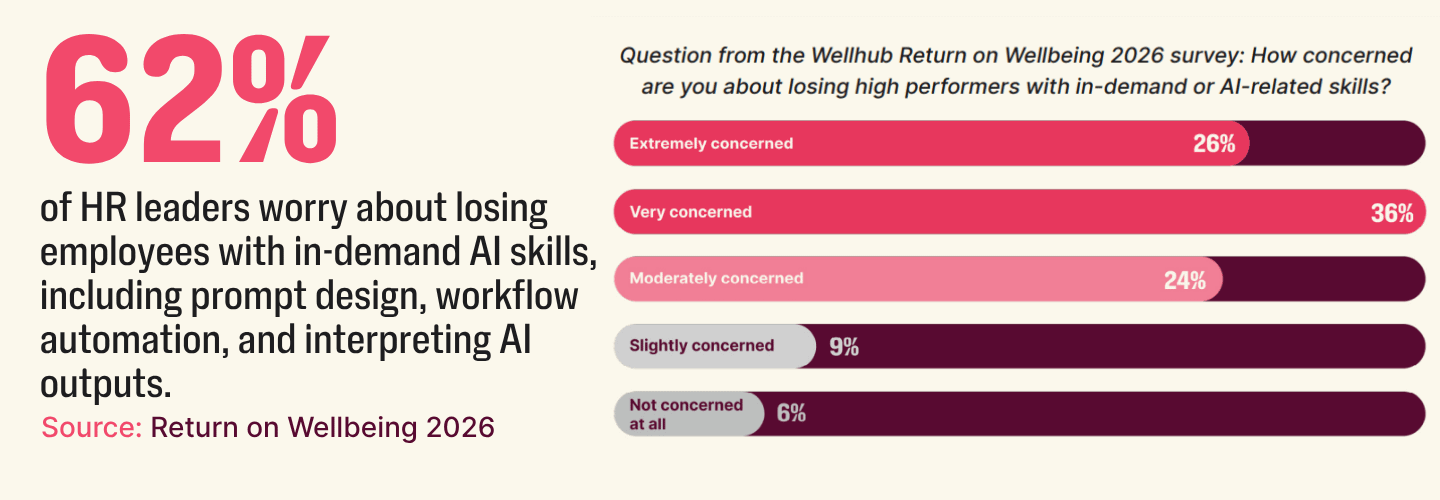
As companies aim for better efficiency and results with smaller budgets, people who know how to apply AI skills such as prompt design, workflow automation, and understanding AI outputs can quickly become key employees. In fact, 62% of HR leaders worry about losing staff with these in-demand or AI-related skills. This concern is even greater among small and medium businesses at 64%, compared to 59% in large companies.
But what about the people who do not know how to use AI?
In addition, 'shadow AI' does not just create gaps in productivity. It also puts the company's responsibility to manage and control its information at risk. After all, sensitive info can end up in systems the company does not control, increasing data exposure and the risk of misuse.
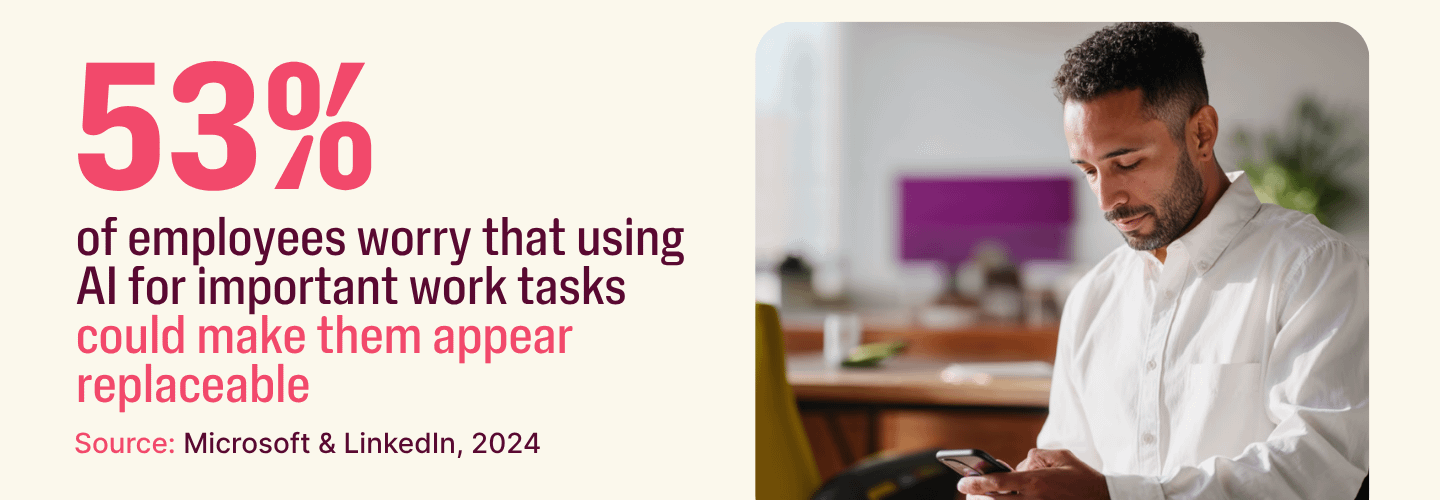
There is also a big psychological challenge: 53% of workers worry that using AI for important tasks will make them seem replaceable. This fear makes people less open, limits shared learning, and means only a few people benefit from AI instead of everyone in the company.
This is why HR should not try to stop people from using AI, but instead help bring its use into the open. Companies need to give everyone fair access, hands-on training, clear rules, and encourage a culture that treats AI as a valuable skill, not a danger.
Only then can AI help everyone grow, rather than widening the gaps between employees.
AI boosts performance, but also increases pressure on teams
Artificial intelligence promises higher productivity, faster results, and better outcomes for companies. But there is a key question many organizations miss: what happens if productivity increases faster than people can keep up?
AI can speed up learning, close skill gaps, and help more people perform better. But it also creates tension within organizations. When some employees start producing more with AI, expectations often rise for everyone, even if not everyone has the same access, training, or confidence to use the technology.
This is where “performance compression” starts.
Employees are asked to do more, faster, often with the same resources. In theory, AI should make work easier, right? In reality, it can also raise the bar for what counts as normal performance, and suddenly the whole team starts facing higher standards, but the pressure is not shared equally.
As we have mentioned, it’s the top performers who often try new tools first, add them to their workflows, and find ways to improve results. But this early lead does not protect them from overload. In many cases, it actually increases the demands on them. They are expected to maintain their high standards, help colleagues adapt, address problems with new processes, and take on additional coordination work during the transition.
In other words, AI can make top talent more productive, but it can also turn them into buffers who take on the stress of organizational change.
We can already see the effects. For example, 68% of workers say they struggle to keep up with the pace and amount of work, and 46% feel exhausted. These numbers show that if a productivity strategy does not also support the people doing the work, it risks burning out the most valuable employees.
The message is clear. Investing in AI without also investing in people is only a short-term fix.
The companies that will benefit most from this technology are those that connect two areas often treated separately: performance strategy and wellbeing strategy.
This means giving employees not just access to AI tools, but also the training, time, clarity, and support they need to use them well. It also means setting realistic expectations, protecting high performers from becoming informal change managers, and making sure productivity gains do not lead to exhaustion.
At the end, AI can help organizations achieve more. But lasting growth depends on whether companies also help their people work better, not just faster.
The effects of AI use: “AI brain fry”
One less obvious effect of using artificial intelligence is that work does not always decrease. Instead, it just changes.
Rather than doing some tasks themselves, many employees now spend more time checking, fixing, and approving what AI creates. This new job of always supervising might seem easier, but it actually takes steady focus, good judgment, and ongoing decisions.
Experts are calling this problem “AI brain fry.” It is a kind of mental tiredness that comes from using AI tools a lot and having to manage them all day. This “brain fry” can happen daily, especially if employees must use multiple systems, check different results, adjust prompts, update instructions, and figure out which information they can trust.
The main issue is not just using AI, but the mental effort it takes. In a study of 1,488 full-time workers at large U.S. companies, about 14% reported mental fatigue from using this technology. The most common symptoms were brain fog, headaches, trouble focusing, and slower decision-making.
This mental strain gets worse when people have to use too many tools at once. The study also highlights that using two AI tools can make people more productive, but adding a third or more starts to hurt productivity. If employees use four or more systems simultaneously, their productivity can even drop. This is not because workers are not skilled. It happens because each tool has its own rules, layouts, ways of working, and checks.
HR leaders should see this as a warning sign. It is not enough to just ask if teams are using AI. Companies also need to find out how much mental strain this use is causing.
A good approach to using AI is not just adding more tools without a plan. Instead, companies should create clearer ways of working. They need to ask which tasks really need AI, when people should check the results, how accurate the work should be, who is responsible for final decisions, and which steps can be simplified rather than made more complicated.
AI can be a great help. But if every new tool adds more hidden choices to the workday, it will eventually hurt focus, work quality, decision speed, and employees’ mental health.
“AI-free zones”: when switching off technology can also be an advantage
While many companies are eager to bring artificial intelligence into the workplace, some are now asking a more thoughtful question: which tasks and processes do not require AI?
This isn’t about turning away from technology. It’s about setting smart (and healthy) boundaries. That’s why the idea of “AI-free zones” is becoming more relevant.
The idea is straightforward. Not every task needs to be optimized with artificial intelligence. Some activities matter most for their results, such as summarizing information, drafting documents, automating routine work, or analyzing large amounts of data. In these situations, AI offers speed, efficiency, and scale.
But some tasks are important because they help develop qualities like judgment, trust, creativity, critical thinking, empathy, and stronger relationships between people.
This is where “AI-free zones” become useful. These can be spaces, meetings, processes, or times during the workday when teams choose not to use AI tools. The aim isn’t to slow anyone down, but to protect and build the skills companies need to stay strong.
A tough conversation with an employee, making an ethical choice, giving feedback, leading a sensitive discussion, or running a creative team session doesn’t always get better when handed over to a tool. Sometimes, it’s the human touch that makes these tasks valuable.
This trend also addresses a real worry. If every idea, answer, or decision goes through an AI system, teams might slowly lose the skills they need to use their logic, work together, and solve tough problems.
The goal isn’t to ban AI, but to figure out where it helps and where it might hurt. One good question to ask is whether a tough task helps build a skill the organization wants to keep. Another is whether the work needs ethical judgment, human sensitivity, trust, or a deep understanding of context. If so, it might be best to keep that area free from AI.
Can workplace wellbeing help reduce the negative effects of using AI?
Adopting artificial intelligence means more than just learning new technical skills. Teams also need to adapt, stay focused, and handle ongoing changes without losing energy or clarity.
In this situation, having a workplace wellbeing strategy is no longer just a nice extra—it is necessary for successful technological change. For example, 91% of organisations say wellness programmes help boost employee productivity. Also, 82% see these programmes as key to keeping their top talent performing well, and 83% connect them to higher participation and engagement.
“We are moving towards a new reality where data and technology help us better understand how employees feel and how their work environment affects them. But as these tools improve, organisations need to make sure they support their people, not just expect more from them.”
Camila Holanda, Director of Benefits and Compensation at Schneider Electric
The link is clear. People who can use AI, automate tasks, or understand results from this technology are more valuable in the job market. However, if they work in environments where change is constant and support is lacking, they are more likely to seek companies where they can grow without burning out or sacrificing their mental health.
This is why having an holistic employee wellbeing approach needs to be part of daily work routines. Just offering separate resources is not enough. Companies need to provide accessible and varied tools that meet the real needs of their teams, including physical and emotional health, rest, social connection, and recovery.
In the age of AI, having a competitive edge is not just about using better tools. It also depends on creating an environment where people can learn, adapt, and keep performing well over time.

Get started on your company's wellbeing journey
Work-life wellness with Wellhub benefits everyone - healthier people, happier companies, proven savings.
Category
Share

The Wellhub Editorial Team empowers HR leaders to support worker wellbeing. Our original research, trend analyses, and helpful how-tos provide the tools they need to improve workforce wellness in today's fast-shifting professional landscape.
You May Also Like

The Ultimate Guide to Small UK Business Wellness Programmes in 2026
Boost retention, cut costs, and build resilience with simple wellness strategies designed for small businesses working with lean budgets.
See how to reduce employee health insurance costs | Qualidade de vida, gestão de pessoas e conteúdo para RH
It is important to offer employees a good health insurance plan, although it may not be mandatory in many sectors. Such benefits bring peace of mind and allow employees to focus on the job, not to mention the motivation factor which attracts and retains talents. Moreover, health is wealth. The wise saying makes sense, particularly […]

6 Ways Corporate Team Building Exercises Can Improve Employee Productivity | Qualidade de vida, gestão de pessoas e conteúdo para RH
Why should companies invest in team building? It is like asking why people should invest in their staff; it’s about increasing engagement from staff, in the pursuit of increased productivity which will ultimately provide the sought after, return on investment. Happy & engaged staff make for a better, more productive workplace. The benefits of team […]