Employee Wellness Programme: Guide for UK HR Leaders
Last updated on 4 Mar 2026

Wellness programmes are becoming part of UK workplaces. Effective programmes help employees feel better, manage stress, and get support early. As a result, people have more energy, focus, and resilience at work. Employers see clear benefits too. When wellbeing is a priority, employees often perform better, feel healthier, and are more engaged. HR leaders also see fewer sick days.
Use this guide to find over 25 ideas by category, a step-by-step launch plan, key metrics to track, and easy checklists. Start improving your team's wellbeing today.
What is an employee wellness program?
An employee wellness programme helps employers support their staff’s health and wellbeing at work. They often include practical initiatives, benefits, and resources that encourage healthy habits, stress management, and overall wellbeing.
These programmes is more than just one perk, such as a gym discount. The best ones are well-organized, ongoing, and bring together different kinds of support like:
- Physical wellbeing support. For example, movement initiatives, health checks, nutrition support.
- Mental health and emotional wellbeing, such as access to mindfulness apps, Employee Assistance Programmes (EAPs), and stress management programs.
- Work-life balance support like flexible working and policies that reduce burnout risk.
- Social and financial wellbeing options where relevant, such as community-building activities or financial education.
Simply put, a wellness programme helps you find out what your workforce needs, offers support people will use, and gets better over time with feedback and participation.
Why do wellness programmes matter?
In our two main studies, State of Work Life Wellness and Return on Wellbeing, we found that corporate wellness programs prevents burnout and stress, reduce sick days and absenteeism, and boost productivity by helping employees perform at their best. These programs help retain and attract talent, raise engagement, and improve job satisfaction. Also, they promote a healthy workplace where people feel valued and supported. Over time, they lower health-related costs by focusing on prevention and early action.
Wellness programmes can lower burnout and stress
Burnout is a major daily challenge for HR teams today. In the UK, 91% of employees have experienced burnout symptoms in the past year, according to our data. Of those, 39% feel symptoms at least once a week, and 18% feel them every day. As burnout increases, so do sick days, drops in productivity, workplace complaints, and staff turnover.
The positive side is that employees know what is causing burnout. The main reason is too much work. Other key factors relate to poor communication from leaders, not enough flexibility, and a lack of recognition or career growth.
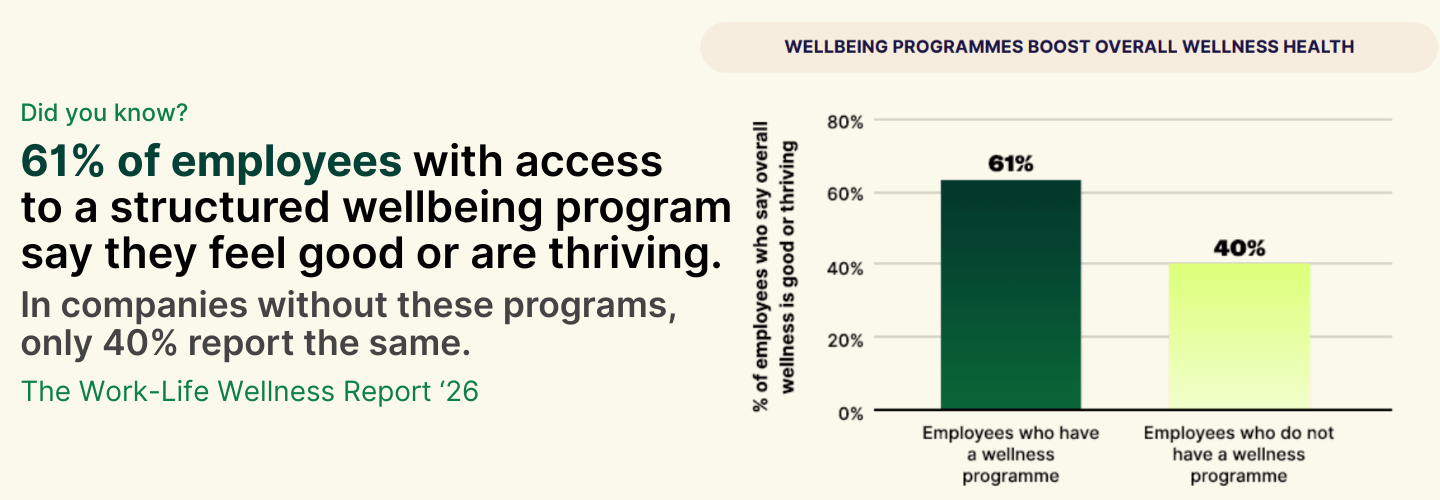
A wellness programme gives you a clear way to address burnout. It helps you spot problem areas, support managers, and offer employees early help, especially with mental and emotional health. It also provides HR with clear steps to reduce stress, encourage recovery, and assess whether wellbeing is improving. When these programmes are in place, more employees report feeling good or thriving.
Improve productivity by helping employees feel and perform at their best
Employees consistently link wellbeing to performance. According to our survey results, 89% of UK respondents agree that they perform better at work when they prioritise wellbeing. In fact, when a well-planned programme is in place employees report feeling better and more engaged with their work. This shows that prioritising wellbeing strategies delivers tangible productivity gains.
Reduce sick days and absenteeism by offering consistent, accessible support
Wellbeing programmes can help companies lower employee absences. Our research found that 89% of companies with these programmes report fewer sick days, and 13% have reduced sick days by at least five per employee each year. This means each person saves about a full work week.
In addition, 67% of senior leaders have noticed a significant drop in absenteeism because of wellbeing strategies.
Improve retention and talent attraction
Employee wellbeing now plays a key role in whether people decide to join or stay with a company. In the UK, 85% of employees would consider leaving an employer that does not prioritize their wellbeing. Our data shows that 89% of people will only consider employers who make wellbeing a priority in their next job search. Also, 62% are more likely to stay when "strong" programs are available. Eight out of ten employees also consider health and wellness benefits when choosing where to work.
Increase employee engagement and satisfaction
A well-designed wellbeing program can boost engagement by making employees feel supported in their daily lives. For example, 89% of employees at companies with wellness programs report high job engagement and happiness. After all, employees who are happy with their company’s wellbeing program tend to have better results. To be precise, 65% of satisfied employees say they are thriving or in good health, compared to 54% of those who are not satisfied.
Significant reduction of healthcare costs
Studies show that every dollar spent on wellness programs can lower medical costs by about $3.27 and reduce absenteeism costs by $2.73. Furthermore, 68% of HR leaders think these programs help cut healthcare expenses. For instance, one program reduced the number of high-risk individuals by 57% and lowered annual medical claims by $1,421 per participant.
8 core elements every wellness program should have
As we have mentioned, a strong employee wellness programme works best when it supports the whole individual, not just by offering fitness perks. This means covering physical, emotional and mental health, and reducing daily pressures that affect how people feel and work.
1) Provides physical health options people will actually use
Most programmes start here because it’s easy for employees to understand and quick to engage with. For the most comprehensive ones, the “physical” aspect should go beyond discounted gym access and include flexible ways to move (in-person, digital, on-demand), as well as prevention-led options such as health checks and wellness challenges.
Did you know? According to our yearly trends behaviour study, in the UK, employees are most likely to engage with strength training, with Pilates being the fastest-growing workout. This is a strong signal that employees want both performance-focused training and lower-impact options that support mobility and recovery.
Also, people are most active at 5:00pm, making post-work sessions a great time for classes, challenges, or live sessions, especially for hybrid teams.
2) Offers mental wellbeing tools that feels safe and easy to use
In the UK, one in four people face mental health challenges each year. In a survey of over 2,000 UK workers, 89% said their mental health affected their work.
A good first step is to offer confidential support, like an Employee Assistance Programme, and provide resources to help employees handle daily stress and anxiety. Many people also want access to therapy or mindfulness, so basic wellbeing support is no longer enough. Younger employees now expect mental health support, and it is no longer just a nice extra.
Our research shows that 68% of Gen Z and 59% of Millennials see therapy, meditation, and mindfulness as very important for their wellbeing. In comparison, 45% of Gen X and 33% of Baby Boomers feel the same way. Still, only 46% are actually using these services in any form, whether in-person, online, in a group, or with AI support.
About 14% of employees feel a lot of anger during their day, and 17% often feel sadness.
The main barrier is practical. Cost is the biggest challenge, followed by time and other issues that make it hard to begin. That’s why mental wellbeing support should be simple and stigma-free. Make it normal, easy to access, and offer flexible options, such as virtual sessions through apps that fit into the workday. When therapy is easy and feels safe, more employees use it and are more likely to stay engaged and resilient.
Did you know? Demand for mental wellbeing support is rising fast. In the UK, “Mind” is Wellhub’s fastest-growing wellness category, which suggests employees are actively seeking tools for stress management, focus, and emotional wellbeing (not just physical fitness).
3) Supports healthier nutrition habits that fit real working patterns
Many companies overlook nutrition, even though employees often ask for it. A strong program includes nutrition as part of daily energy and resilience, and makes it work for hybrid teams, not just by providing healthy snacks at the office. Remember, if your wellness options don’t match how people actually work, fewer employees will use them and the benefits will be limited.
Did you know? In the UK, Nutrition is Wellhub’s leading wellness category, suggesting people are actively seeking help to improve everyday energy, mood, and work consistency (Don't forget to download our guide wellbeing nutrition and healthy habits).
4) Makes wellbeing more accessible by reducing financial barriers
For many employees, the biggest obstacle to looking after their wellbeing is not a lack of motivation, but the cost. Our research shows that 73% of employees struggle to invest in their wellbeing because of their finances. When money is tight, people often cut back on things that help their health and performance, such as exercise, nutrition, and mental health care.
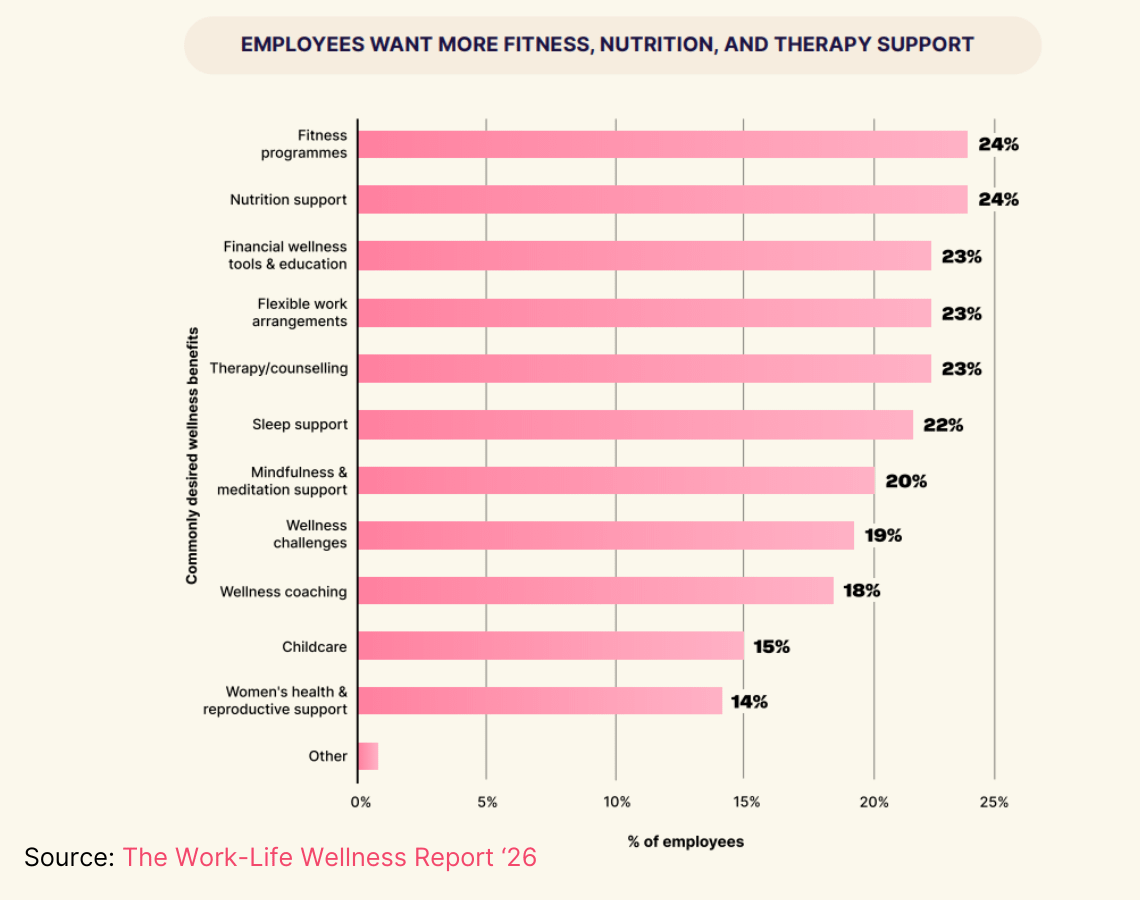
This matters because employees want more support in areas that often cost extra, such as fitness programs, nutrition programs, therapy, mindfulness, and financial wellness support. Cost is a real barrier: 23% cannot access to therapy because it is too expensive.
A wellness program can help by making it easier and more affordable for employees to access wellbeing options through work. For example, a programme might let someone use a gym near their job or home, or join a pilates class they otherwise could not afford. This support helps people start and keep up healthy habits. Over time, more employees join in and build routines, even when money is tight.
Younger generations especially are increasingly prioritizing wellness. Nearly 30 percent of Gen Zers and millennials report prioritizing wellness “a lot more” compared with one year ago, versus up to 23 percent of older generations.
5) Builds social connection and community to strengthen belonging
Wellbeing is not just about the individual; it also involves feeling like you belong.
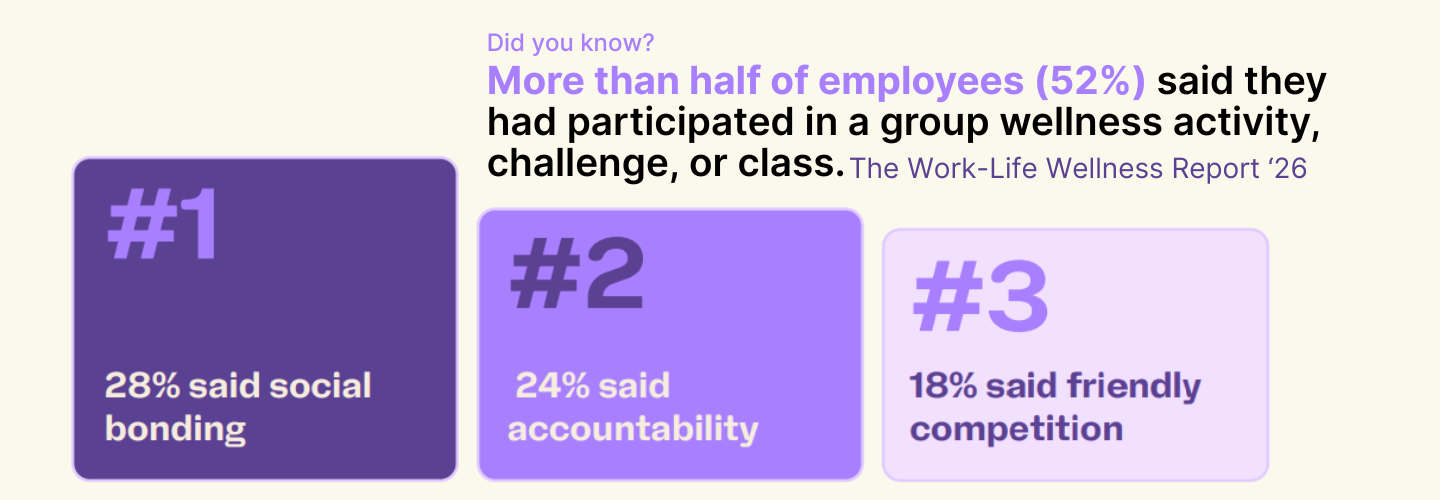
Many employees find that having a community or social support helps them stick to healthy habits. The best programs include shared activities such as group classes, wellness challenges, and community groups. These activities help people connect with others across teams and locations, which can also make the company culture stronger.
6) Enables work life balance with practical daily habits
A wellbeing program should support employees as they face the demands of work and life. That's why usability is crucial. If resources do not fit employees’ schedules, are not accessible to remote workers, or are hard to use, engagement will stay low, even if employees value wellness support.
7) Offers an holistic approach so employees can personalise support
Top-performing programs take a holistic approach, allowing employees to choose the support they need most. These programs often cover several areas, such as physical, emotional, financial, social, and occupational wellbeing. In fact, 95% agree that physical, mental, emotional, and social wellbeing are all connected.
8) Removes access barriers with flexible, simple, hybrid friendly delivery
Your programme should not be one-size-fits-all. When it is too rigid, too generic, or not clearly explained, fewer people take part and results get worse.
To fix this, add personalization by offering different formats and schedules for different employees. Include variety by giving people more than one way to take part. Make sure it is easy to access and that communication is clear. The best results come when you shape the programme with input from employees. This also helps you avoid spending on benefits employees cannot access or do not value, and keeps it relevant as your workforce changes.
30+ Employee Wellness Programme Ideas and Examples (by Category)
Remember: a strong wellness programme is not just one initiative. It is a set of options that meet different needs across your workforce.
The ideas below are grouped by category to help you build a wellbeing programme that feels relevant, supports different wellbeing goals, and gives you clear initiatives to launch, test, and improve:
Mental health and emotional wellbeing ideas
- Employee Assistance Programme (EAP) with confidential counselling and practical advice (often including financial/legal guidance too).
- 1:1 therapy or counselling sessions (virtual options help uptake).
- Mindfulness and meditation breaks (short, regular sessions beat one-off campaigns).
- Stress management workshops (help managers and employees spot early signs and act sooner).
- Peer support and community groups to reduce isolation and normalise wellbeing.
Preventive care and early-intervention ideas
- Health screenings / health checks to flag risks early and guide healthier habits.
- Health risk assessments (paired with follow-up coaching to drive action).
- Ergonomic assessments to prevent musculoskeletal issues (especially for hybrid teams).
Fitness and movement ideas
- Walking meetings for low-friction movement during the workday.
- Mid-day or post-work classes (in the UK, 5:00pm is the peak time and is ideal for live options).
- Free access to gyms and studios so employees choose what works (gym, Pilates, classes).
The wellness plans employees love to make resolutions last
Wellhub offers the best fitness, mindfulness, nutrition, and sleep options all in one affordable subscription to make 2026 your healthiest year yet.
- Wellness challenges (steps, strength, Pilates, mobility) with light gamification.
- Extended lunch breaks / wellness breaks that make movement realistic, not aspirational.
Nutrition and healthy habits ideas
- Nutrition workshops or education sessions (simple, practical, not preachy).
- Healthy food options at work (subsidised lunches, healthier canteen choices).
- Discounted healthy recipe boxes / supplements to make healthy choices easier at home.
- Hydration and balanced eating challenges (easy entry point; builds consistency).
Telemedicine and faster access to care ideas
- Online GP access / virtual primary care to reduce time-to-treatment.
- Physiotherapy access (virtual or in-person) for quicker support and recovery.
Financial and professional wellbeing ideas
- Financial planning workshops (budgeting, debt, savings, retirement basics).
- Season ticket loans/practical financial support that reduce day-to-day stress.
- Financial wellbeing challenges (small habit changes; high engagement potential).
Work-life balance and flexibility ideas
- Flexible work schedules (a core wellbeing lever, not just a policy page).
- Regular check-ins to spot pressure early and adjust workload before burnout builds.
Social connection and community ideas
- Social events that encourage connection (especially useful for hybrid teams).
- Team-building with a wellbeing angle (movement + connection beats forced fun).
- Group challenges and shared goals to build camaraderie and participation.
Looking for a holistic wellness programme (all-in-one support)?
If your current wellbeing initiatives feel “disconnected”, switching to an all-in-one solution can make it easier for more people to join in. Rather than having employees juggle separate gym discounts, apps, and one-off initiatives, you can use a platform that brings together fitness, mental wellbeing, nutrition, and sleep support. This makes it simpler for people to build healthy routines that suit their lifestyle.
At Wellhub, we help UK employers offer a single wellness platform that covers all areas of wellbeing in one place. Employees can access over 3,600 gyms and studios, as well as top wellbeing apps for fitness, mindfulness, nutrition, sleep, and more.
Users can choose what works for them, from strength training and Pilates to meditation or nutrition coaching, without extra admin for HR. This flexible approach helps more employees get involved because they can choose what they actually want to use, rather than being limited to just one option. Learn more about Wellhub and get a free quote.
How to build a successful wellness programme: Your 6-step launch plan
Building a wellness programme follows the same steps as other people's initiatives. First, identify the need, set clear goals, communicate well, and keep improving based on how people use it and what they say about it. The steps below are practical and simple to follow.
Step 1: Understand your people's needs
Begin by finding out what employees need most and what keeps them from using wellbeing support.
Run a short survey and hold a few listening sessions. Break down the results by role, location, work pattern, and life stage. If you already have data, use it as your starting point—look at sickness absence, EAP usage, engagement survey themes, turnover hotspots, and any signs of stress or heavy workload from managers.
Step 2: Set your goals and success metrics
Decide what “success” looks like for your business, then choose a few metrics you can track regularly. Typical goals are higher engagement, better retention, less absence, and more participation. From the start, track practical metrics like participation rate, repeat usage, employee satisfaction, sickness absence trends, and signs of retention risk in key teams.
Step 3: Build your strategy according to your budget
Design your programme as a menu of options, not just one perk. Offer a mix of support for physical health, mental health, nutrition, and work-life balance so employees can pick what suits them. A simple budget model is usually enough:
- with a low budget, focus on policies and habits that make things easier, run wellbeing education sessions, encourage walking meetings, provide manager toolkits, and clearly point people to existing support,
- with a medium budget, you can improve your EAP, run structured challenges, offer wellbeing apps, set up coaching programmes, and hold regular workshops,
- if you have a higher budget, consider broader platform access, more clinical support, health screenings, and a benefits package that covers many wellbeing needs in one place.
Step 4: Establish governance
Programmes often lose momentum if only one person runs them and there’s no clear structure. Assign someone to lead, set up a small wellbeing committee, and recruit wellbeing champions to keep it relevant, visible, and shaped by employee feedback.
Good governance also helps you run pilots, manage vendors, and keep leaders focused on priorities.
Step 5: Communicate and launch
Launch your programme as you would an internal product. Explain why it matters, show employees how to use it, and make the next steps clear.
Keep communication steady all year, not just at launch. Use simple messages, repeat them across different channels, and give managers a short script so they can confidently guide people to support. Always make confidentiality clear, especially for mental health support.
Step 6: Evaluate and improve
Set up a regular review process from the beginning. Track participation and repeat usage every month, gather feedback every quarter, and run a short wellbeing survey at least twice a year.
Use what you learn to improve it, stop what isn’t working, and invest more in what employees use most. This also helps you build a stronger business case over time, since it’s easier to show results like reduced absence when you track them consistently.
Is your wellness programme going to be successful? [Checklist]
A successful programme is one that employees actually use and trust. The simplest way to build that is to treat it like a checklist. If you get these four elements right, you will usually see higher participation, stronger engagement, and clearer outcomes over time:
Is your coverage going beyond gym discounts?
A strong programme supports more than physical fitness. The most effective approach combines physical health with mental wellbeing and everyday lifestyle support, so employees can choose what they need most. This matters because wellbeing needs are connected, and a single perk rarely shifts outcomes on its own.
Is your programme inclusive and DEIB-friendly by design?
Wellness programmes work better when they are built for people with different backgrounds, bodies, and life stages. That means offering options that suit different abilities and preferences, using inclusive language and imagery, and ensuring providers and activities feel relevant to a diverse workforce.
When employees do not see themselves reflected in it, they are far less likely to participate.
Is your programme aligned with your culture and values?
A programme cannot succeed if day-to-day work practices contradict it. Employees need to feel wellbeing is part of the culture, supported by leaders, and reflected in how work is planned and managed. This is a common gap: only 44% of employees agree wellness is truly ingrained in their company culture.
Is your programme accessible, confidential, and consistently promoted?
Even great benefits fail when they are hard to access or feel unsafe to use. Your programme should work for hybrid and remote employees, be easy to find and use, and clearly state its confidentiality policy, especially for mental health support.
It also needs ongoing promotion, not a one-time launch, because employees engage through repeated reminders, seasonal campaigns, and clear signposting from managers.
The most common objections HR faces about wellness programmes (and how to respond)
Even executives who support wellness programmes usually have questions before giving approval. According to our Return on Wellbeing report, CEOs are most concerned about engagement, cost, proving ROI, data security, and the extra workload for HR.
“Employees won’t use it”
This is the top concern: 30% of CEOs worry that it will start strong but then see participation drop. This often reflects deeper worries about wasting money or not showing real results.
How can you respond this objection? Bring proof, not just promises. Show clear participation data from similar organisations, using a simple dashboard. Support this with employee feedback from quick surveys and quotes. A phased rollout or pilot can also help gather early data and testimonials before expanding.
“It’s too expensive and we have other budget priorities”
Cost is a major barrier: 29% of CEOs think wellness programmes are too expensive, and 22% say other priorities like hiring, pay, and operations take precedence.
How can you respond this objection? Begin with affordable options that still boost engagement, such as virtual workshops, mindfulness sessions, and team challenges. Suggest digital tools as valuable choices that do not require big upfront investments (For example, our £0 monthly digital plan)
Next, link spending to business results that leaders already monitor, like absenteeism, satisfaction, performance, retention, and cost savings. Show this information to boards and stakeholders in clear, data-driven communications.
“We can’t measure the impact”
Measurement is a big challenge: 27% of CEOs find it hard to measure impact, and many want a clearer link between wellness activities and business results.
How can you respond this objection? Make reporting a core part of your programme. Use clear dashboards to track participation, satisfaction, and cost savings, and show how they connect to goals such as productivity, retention, and lower absenteeism.
Frequent updates also make a difference: CEOs who get monthly impact reports are much more likely to increase wellness funding.
“The ROI won’t be worth it”
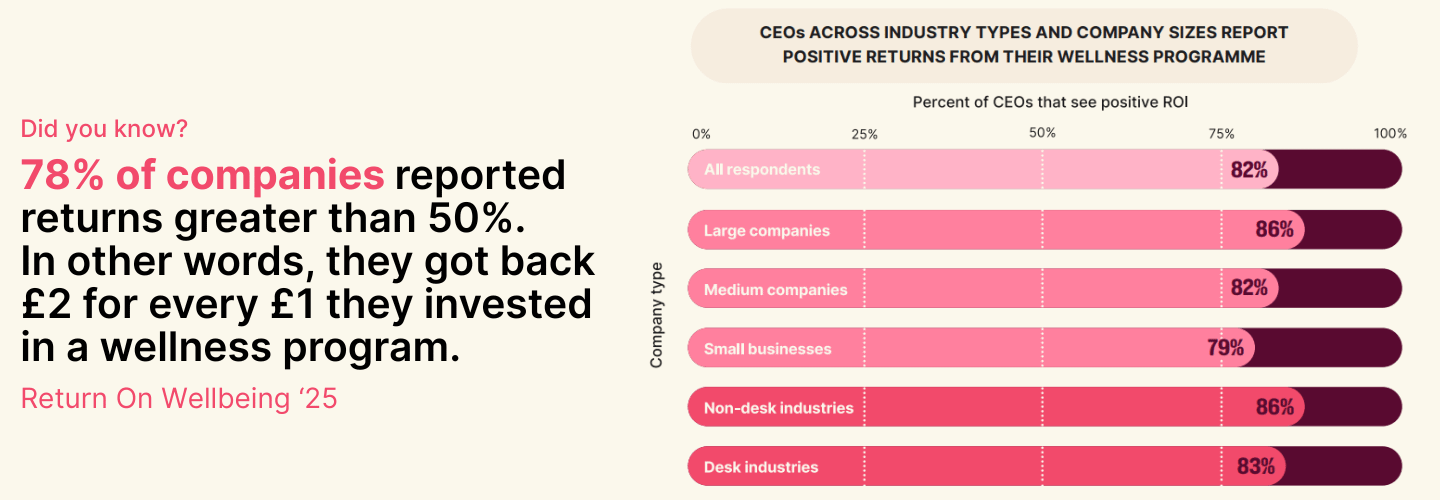
In addition to measurement, 24% of CEOs doubt whether the ROI is worthwhile. Usually, leaders want proof that wellbeing will lead to better performance, retention, and cost savings.
How can you respond this objection? Use our report insights to show what ROI other companies have achieved with their wellness programmes. If your own data is limited, use third-party validation and industry results, along with benchmarked assessments like stress, sleep, habits, and satisfaction, to highlight how wellness initiatives impact engagement and retention.
“We’re already supporting employee wellbeing”
Some leaders think that having an EAP or running occasional awareness campaigns means the company is already “covered,” so they see no need for a broader programme. This objection often comes up when support is reactive, scattered, or difficult for employees to access.
How can you respond to this objection? Highlight the difference between reactive and proactive support. Ongoing options for fitness, emotional wellbeing and mental health help prevent problems early, while one-off or crisis support often comes too late to protect health, engagement, and costs.
It also helps to review current support to find gaps, then offer a more complete mix that employees in different roles and work patterns can actually use.
“A programme won't actually improve wellbeing”
This is the “prove it works” concern. Leaders worry that it might look good on the outside but not actually improve results inside the company.
How can you respond to this objection? To answer this, just like with ROI, build your case with real results. Use proof from similar organisations and your own baseline data. Share clear outcomes such as lower absenteeism, higher productivity, and better satisfaction. Use benchmarked assessments to show where employees are struggling now and what improvements are possible.
Also, collect employee feedback before launch to show there is real demand for structured support in areas like mental health, fitness, and stress management.
“It will overload HR” and “It’s too complex to manage”
Operational complexity is a real issue: 21% of CEOs think wellness programmes are too complicated for HR to handle. This often happens when there is limited internal capacity, too many different vendors, or concern about managing one that will require constant follow-up.
How can you answer to this objection? Pick simple, automated solutions that cut down on admin by handling enrolment, participation tracking, and reporting, and that work well with current benefits systems.
It also helps to use third-party experts to reduce pressure on HR, and to create shared ownership by involving "wellness champions" and visible leaders. This encourages adoption without HR carrying all the responsibility.
“What about data security and privacy?”
Data security is a major concern: 26% of CEOs mention it as a worry.
In many organisations, this becomes a barrier when leaders are not sure what data is collected, who can access it, or how risks are managed.
How can you answer to this objection? Start working with credible partners (Like Wellhub). Many organisations rely on outside experts and third-party vendors to design and run your programmes in a professional, scalable, and manageable way. In practice, this means involving the right internal stakeholders early and choosing providers who offer clear reporting and smooth implementation without adding new risks.
“There’s pushback from other executives” (and “We’ll struggle to justify it externally”)
Internal resistance is common: 19% of CEOs say pushback from other executives is a barrier, and some also worry about explaining the spending to shareholders. This usually happens when wellness is seen as a perk instead of a business tool.
How can you answer to this objection? Get support from more leaders than just the CEO. Our research shows that executive and HR backing is crucial. Involve leaders like your CFO and those focused on revenue in impact reporting so they can see how it connects to profits.
Peer CEO endorsements can also change opinions. Regular impact reports help leaders see wellbeing as a strategic investment, not just an optional expense.
Start building a wellness programme that your employees will use and your leaders will value.
A strong employee wellness programme is a practical way to support your team and improve business results in UK workplaces. When employees get support early and build healthy routines, you lower burnout risk, reduce absences, and boost engagement and retention.
Good execution is essential. Begin by understanding what employees need, offer support that fits different lifestyles, make it easy and private to use, and keep promoting it all year. Track participation and results, and update the program regularly to keep it useful. If you want to get started quickly, an all-in-one approach can make things easier and encourage more employees to join by offering one place for fitness, mindfulness, nutrition, and more.
The wellness plans employees love to make resolutions last
Wellhub offers the best fitness, mindfulness, nutrition, and sleep options all in one affordable subscription to make 2026 your healthiest year yet.
Employee wellbeing programme FAQs
How to create an employee wellness programme?
Start by using a short survey to find out what employees need. Choose a mix of activities that support physical health, mental wellbeing, and lifestyle. Make sure someone is responsible for the programme and keep everyone informed. Track participation and feedback, and keep making improvements.
What is the goal of an employee wellness programme?
The goal of employee wellness programme is to help employees feel better, which can boost their performance and encourage them to stay with the company.
How to start an employee wellness programme?
Begin with a small test run. Choose one to three main focus areas and introduce simple activities that employees can easily join. Keep what works and drop what does not.
What’s the ROI of a wellness programme?
ROI typically shows up through fewer sick days and lower costs over time. 89% of HR leaders report wellness programmes reduce sick days, and 13% report reducing sick days by at least five days per employee per year.
Category
Share

The Wellhub Editorial Team empowers HR leaders to support worker wellbeing. Our original research, trend analyses, and helpful how-tos provide the tools they need to improve workforce wellness in today's fast-shifting professional landscape.
You May Also Like

Wellness Incentives: Guide and 30 ideas for all budgets
Discover 30 wellness incentive ideas for every budget, plus a practical action plan to launch a successful programme in 2026.

Workplace Wellbeing: 15 initiative ideas for UK companies
Discover useful workplace wellbeing initiatives for UK organisations with this guide, including practical ideas to support employee health, engagement, and productivity.

Employee wellbeing survey in 2026: 120 sample questions +tips
Discover how to run an effective employee wellbeing survey, why it matters, and 120 questions to improve wellbeing at work.