Top 15 employee benefits in the UK for 2026 (a guide for employers)
Last updated on 8 Apr 2026

Employee benefits have become a key factor in where people choose to work and whether they stay. In the UK, most employers are planning to increase their benefits budgets for 2026, with 76% expecting to spend more next year. Most are looking at moderate increases between 10% and 49%, while only a small number plan to reduce spending. Even in a cautious market, benefits remain a priority because employers see their direct impact on attracting, retaining, and satisfying employees.
This focus on benefits makes sense. Recent research shows that only 12% of employees are fully satisfied with their current rewards, and more than a third would switch jobs for better benefits. UK employees are also getting more selective about what matters to them. Training and development attract 82% of employees, health assessments appeal to 81%, retail discount platforms to 79%, comprehensive occupational healthcare to 78%, and physical wellbeing programs to 77%. Employees want benefits that are useful, relevant, and support them in their daily lives—not just more options.
Employers have a lot at stake. Losing good people is expensive, and replacing someone earning over £25,000 can cost up to £30,000. That’s why benefits are no longer just a nice extra. They are now one of the best ways for employers to stand out, build a strong culture, support wellbeing, and encourage the skills and behaviours they want in their teams. The best benefits schemes do more than look good in a job ad—they help people feel valued, motivated, and more likely to stay.
In this article, we’ll look at why employee benefits matter more than ever in the UK, and which benefits employees value most in 2026.
What is an employee benefit?
Employee benefits are rewards and perks that an employee gets in addition to their regular salary. These can include flexible work hours, health and wellbeing support, pension contributions, paid time off, and extras such as gym memberships and learning budgets. In short, benefits are everything your employer gives you to support you beyond your basic pay.
In the UK, employee benefits fall into two main categories: statutory and optional.
Statutory benefits are the legal protections employers must provide, such as paid annual leave, workplace pension contributions, Statutory Sick Pay (SSP), and statutory maternity, paternity, and adoption pay. For example, eligible employees get at least 28 days of paid annual leave, and employers must enroll eligible staff in a workplace pension and make minimum contributions. These benefits form the basic level of employee protection.
When employers talk about benefits strategically, they usually mean the voluntary or optional benefits offered on top of the legal minimum. These extra benefits can help one employer stand out from another. In the UK, employee benefits are usually grouped into four main types:
- Mandatory statutory benefits: legal rights such as workplace pensions, paid annual leave, Statutory Sick Pay, and family-related leave and pay.
- Health and wellbeing benefits: support options such as private medical insurance, dental cover, health cash plans, mental health support, and Employee Assistance Programmes (EAPs).
- Financial protection benefits: these provide security during difficult times, such as life insurance, critical illness cover, income protection, bonuses, or share schemes.
- Lifestyle and perk benefits: optional extras that improve daily work life, such as flexible working, cycle-to-work schemes, season ticket loans, employee discounts, and gym memberships.
All these benefits support employees in four main areas: legal protection, financial security, health and employee wellbeing, and work-life balance.
Why Are Employee Benefits Important?
Employee benefits play a big role in keeping people happy, committed, and loyal to a company. Good benefits packages improve quality of life, support wellbeing, and help employees balance work and personal responsibilities.
The best benefits strategies offer more than just extra pay. They provide real support, such as flexibility and practical help. As a result, benefits influence not only how attractive a job is, but also how valued employees feel each day.
Today, having “extra benefits” is among the main things employees look for in a job. For employers, this can mean attracting new talent, keeping people engaged, and encouraging them to stay. They can also be the deciding factor in whether someone accepts a job, stays loyal, and feels motivated to do their best.
A thoughtful benefits plan also helps build a healthier workplace, increases satisfaction, reduces absenteeism, and improves performance.
Recent data from the UK shows that more employees are satisfied with their benefit packages. In 2025, 68% of UK employees said they were happy with their employer’s benefits, a significant increase from 2024. Satisfaction rose by 9 points, and disagreement fell by 8 points, from 22% to 14%. These results show that benefits matter more to employees when they fit what people actually need.
At the same time, most employers still feel confident about the benefits they provide. In fact, 76% of employers believe their employees are satisfied, a number that has stayed about the same from 2024 to 2025. However, there is still an 8-point gap between what employers expect and how employees actually feel.
Even though this gap is smaller now, the main point remains: benefits are more than just extras. They are a key part of making a job attractive, lasting, and truly supportive.
What benefits do UK employees value the most in 2026?
To understand which employee benefits are most important in the UK, we reviewed major surveys, employer reports, and studies on employee opinions, including data from AON, Mercer, MetLife, and WTW, as well as our own research.
There seems to be a clear trend, UK employees value benefits that help them:
- Feel financially secure
- Maintain their health and wellbeing
- Balance work with personal life
- Grow and stay relevant in their careers
Employers are also putting more emphasis on retention, engagement, and bringing all rewards together. This shows that benefits have become a central part of business, not just a responsibility for HR. By combining all the insights, we identified a list of the most valuable employee benefits for UK employees:
- Competitive pay + meaningful benefits package
- Flexible working (hybrid, remote, flexible hours)
- Work-life balance programmes
- Health & wellbeing programmes
- Mental care & stress management support
- Retirement & pension support
- Financial wellbeing & education
- Income protection & private insurance (life, disability)
- Career development & advancement opportunities
- Learning, reskilling & future skills support
- Personalised / flexible benefits
- Preventative healthcare & fitness support
- Family & care support (childcare, elder care)
- Employee assistance programmes (EAPs)
- Women’s Health Support
- Competitive pay + meaningful benefits
A good salary still matters when attracting new talent, but it is not enough to keep employees. In the UK, fair pay is now seen as a basic requirement, especially as living costs rise. Research shows that financial security is a top concern: 65% of people are worried about retirement, and 55% about job security.
Salary is still the main motivator, but depending only on pay is less practical for employers because wage increases are expensive and easy for competitors to match.
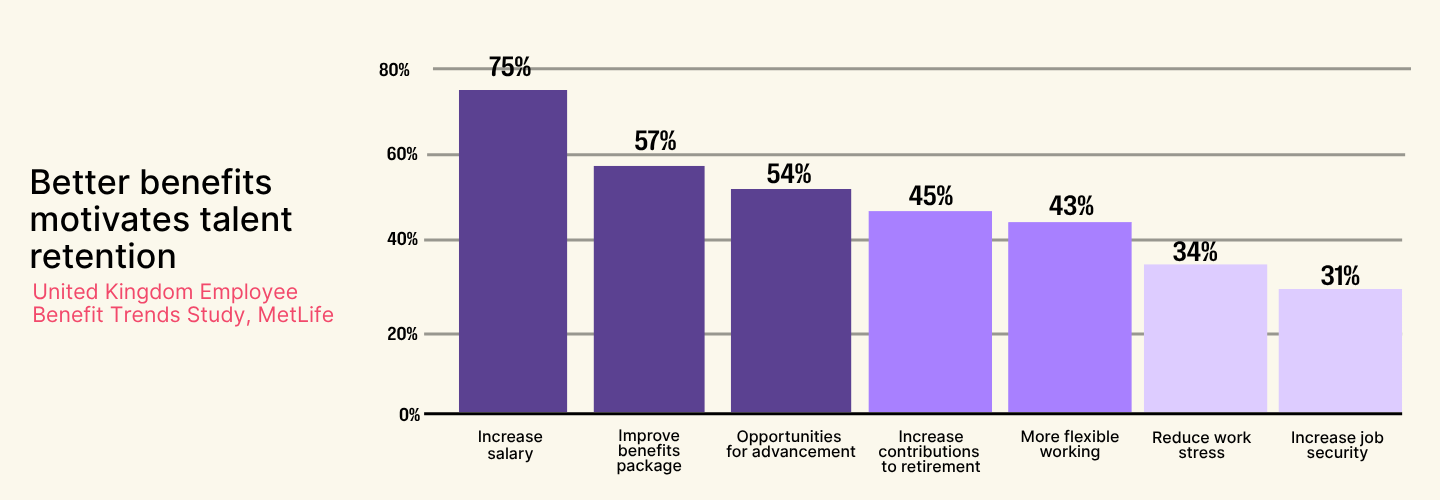
Today, employers can stand out by offering both a good salary and meaningful benefits. Data shows that while salary is the main reason people stay, better benefits are the next most important factor (57%), even more than career progression (54%) or pension contributions (45%).
Employees do not choose between pay and benefits; they look at the whole package. UK employers are noticing this change, with 89% saying that employee expectations for flexibility, wellbeing, and benefits are rising. The key point is that benefits that meet real-life needs add more value than higher pay alone.
Meaningful benefits help turn pay into real engagement. Salary attracts employees, but benefits influence how they feel and perform at work. Studies show that employees who value their benefits are more engaged, more loyal, and more willing to go the extra mile. That is why leading organizations are adopting 'total rewards' strategies, where pay, wellbeing, flexibility, and financial support all work together. As one insight puts it, salary helps keep employees, but benefits are what truly engage them.
- Flexible working (hybrid, remote, flexible hours)
Flexible working is now a core expectation in the UK labour market, rather than just a perk. Most employers see its value: 91% offer some type of flexible working, and 74% have hybrid models. Adoption has settled into a long-term pattern, with about 28% of UK employees working in hybrid setups and more working fully remote. This marks a real shift—flexible working is now a standard part of how work gets done.
Flexibility matters because it best meets employees' needs. People are not just using flexible options—they want even more. Half already work from home, 38% use flexitime, and more are asking for options like compressed hours or a four-day workweek. Flexibility is so important that many employees would rank it on par with, or even above, other benefits. It reduces commuting, boosts wellbeing, and gives people more control over their daily routines.

For employers, flexible working has become one of the most powerful tools for attracting and retaining talent. About 61% say it is important for bringing in new people, and hybrid models help reach candidates outside local areas.
Flexibility is also linked to better engagement and performance. When done well, hybrid setups can boost productivity, wellbeing, and retention. The message is clear: companies that do not offer real flexibility risk losing staff, while those that do can gain a strong, cost-effective advantage.
- Work-life balance programmes
Data shows that 52% of employees worry about their work-life balance, making it one of their four main concerns along with financial security and job stability. This points to a bigger change in what employees want. People are less willing to sacrifice their wellbeing for work and now expect employers to help them find a healthy way to manage both their jobs and personal lives.
In fact, half of employees are interested in work-life balance programmes supported by their employers, making these some of the most popular wellbeing benefits right now.
These programmes might include flexible hours, help with managing workloads, time-off policies, and ways to reduce stress or prevent burnout. They are valuable because they tackle several issues at once: they support mental health, lower absenteeism, and help employees stay productive over time. In short, work-life balance programmes are not just a bonus—they have a direct effect on business results.
For employers, the strategic value of these programmes is clear. Research shows that more organisations are focusing on benefits that help employees balance work and personal life, with 70% of employers naming this as a main goal in their benefits strategy.
Balance is closely tied to engagement. Employees who feel supported in managing life outside of work are more likely to stay, do well, and stay loyal.
Have you considered offering extra leave days? Offering more annual leave than the legal minimum has become a way to show employees their time matters. In the UK, the law requires 28 days' paid leave, including bank holidays, but many companies are offering 25 days plus bank holidays. Some also add extra days for long service, making this benefit even more meaningful over time.
Many employees consider extra holiday one of the most valuable benefits because it gives them something salary cannot: more time to rest, recharge, and manage life outside of work. Some companies now offer unlimited holiday, but this usually works best when there is high trust, clear expectations, and supportive managers.
When employees get more leave, they spend less time at work, but the benefits often outweigh the costs. People with enough time off are usually more productive, creative, and less likely to burn out. This is why extra annual leave appeals to employees of all ages. It improves wellbeing and supports long-term performance.
- Health & wellnes programmes
Health and employee wellness programmes are now a major employee benefit in the UK. This shift comes from rising stress, longer careers, and more pressure on public healthcare.
Employers see their importance, with 82% saying that improving health and wellness is a top goal in their benefits plans. The focus has moved from only treating illness to preventing it, helping employees stay healthy, engaged, and productive.
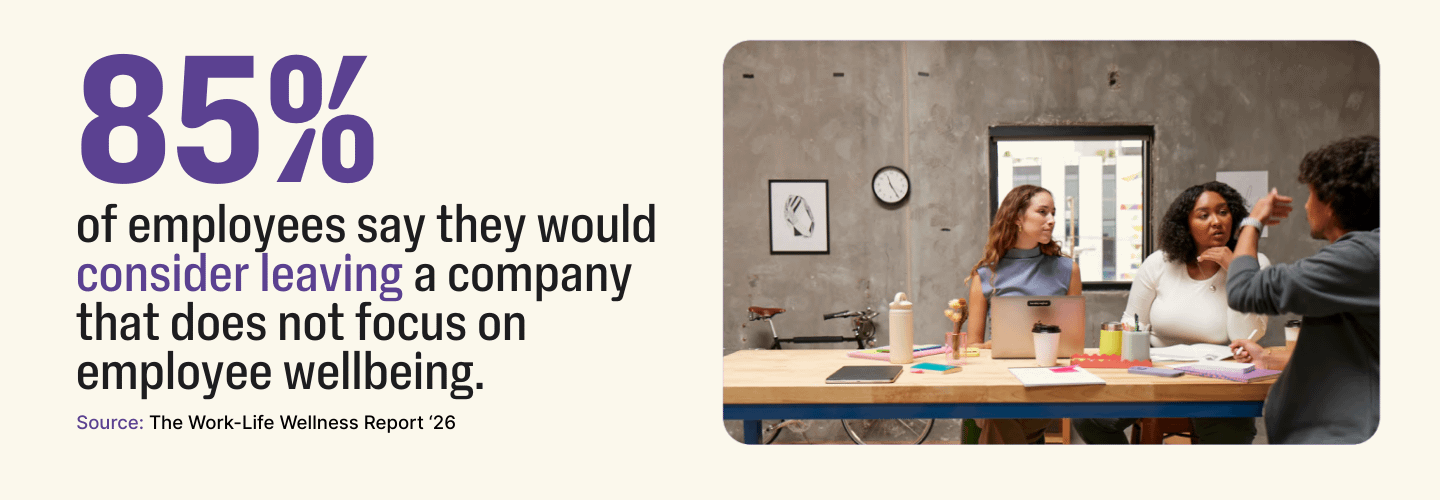
Employees are clear about what they value. Many want preventative care (65%), fitness support (57%), health information (54%), and stress management programmes (51%). Our research shows that wellbeing is now a key factor in how people see employers: 86% of employees say wellbeing at work is as important as salary, 89% say they do better when they focus on wellbeing, and 85% think employers should support it. Wellbeing is now a core part of what employees want, not just a nice extra.
There are clear business reasons for employers to invest in these programmes. More than 80% of CEOs see a positive return on wellness programmes, and 47% say these programmes have a big impact on productivity. Also, 67% of CEOs have seen less absenteeism thanks to wellbeing-related benefits.
The challenge is that simply offering a programme is not enough. Many initiatives fail because few people participate, often because they are poorly promoted or difficult to access. For example, only 14% of companies now offer structured wellness programmes.
We recommend you reading: Best corporate wellness programs in 2026 for UK companies
- Mental care & stress management support
Mental health is now one of the most visible and urgent challenges in UK workplaces. Both employees and employers see its impact.
Stress is a top concern for both groups: employers and employees. Mental health is no longer just a personal issue; it is now a key business risk that affects productivity, absenteeism, and the long-term health of the workforce.
Employees are asking for more support, and this demand is rising. The data shows that 51% of employees want stress management programs and other wellbeing options. These include counseling, resilience training, mental health days, and proactive support.
Success depends a lot on leadership and workplace culture. Research shows that only 35% of employees feel their manager supports their wellbeing, indicating a significant gap. The main point is that mental health support should not stop at programs. It needs to be part of the manager's actions, communication, and daily workplace culture.
- Retirement & pension support
Many people feel anxious about their future, with 65% of employees worried about their financial security in retirement. At the same time, 51% say they are behind on their retirement savings or have no plan at all. This gap between concern and action gives employers a real chance to make a difference.
Retention data also shows how important pension support is. Raising employer contributions can make a big difference, as 45% of employees say it would encourage them to stay. But the challenge is not only about how much is contributed; it is also about understanding. Only 24% of employees feel confident making retirement savings decisions, so many are not making the most of the benefits offered to them. Without education and guidance, even good pension plans may not be seen as valuable.
For employers, retirement benefits are a long-term investment in both employee security and organisational stability. Supporting pensions, financial planning, and contribution protection, such as through income protection schemes, helps reduce employee stress and builds trust. More importantly, it helps keep employees in an aging workforce.
By 2026, the most effective companies will do more than just offer pensions; they will help employees understand, improve, and protect their financial future.
- Financial wellbeing & education
Financial wellbeing is an important but often ignored factor in how employees perform.
Many companies focus on salaries and pensions, but employees still face challenges with daily financial decisions. Only 15% feel sure about making investment decisions. This uncertainty leads to stress, distraction, and lower productivity at work.
Retirement concerns are not the only issue. Many employees are also facing financial pressures right now. Research shows that many employees lack the time or knowledge to make good financial choices, and 31% say they do not have time to look into their options. Because of this, many do nothing, even if they know about risks like not saving enough or lacking protection. Financial stress is common and often not properly addressed.
Financial wellbeing programs can be a powerful and scalable solution for employers. Offering education, tools, and guidance helps employees feel more in control of their finances, which is important. Simple, affordable steps such as financial education, planning tools, and advisory support can make a real difference in both wellbeing and performance.
- Income protection & insurance
We have talked about retirement and financial stress, but what about income protection and private insurance help? Almost half of employees worry about losing income if they become ill or disabled, and a similar number are concerned about their family’s finances if they die early. Even so, many workers still lack access to these benefits, leaving a significant protection gap in the UK.
The main issue is not just whether these benefits are available, but whether employees actually use them. Many people hesitate to buy insurance on their own, but participation goes up when employers help pay. For instance, life insurance enrollment jumps from 23% to 59% with employer contributions, and retirement planning rises from 24% to 61%. This shows that when employers get involved, more employees take advantage of financial protection benefits.
For organizations, providing income protection and private insurance is not just about managing risk. It also helps build trust and shows employees that they are valued. These benefits give people peace of mind during tough times, help reduce financial stress, boost productivity, and help keep employees from leaving.
By 2026, companies that take action on financial protection will be seen as those that genuinely care about their employees, both at work and beyond.
- Career development & advancement opportunities
Career development is a major factor in keeping employees engaged and loyal, especially in a competitive job market.
According to the data, 54% of employees would stay with their employer if they had better chances to move up. This makes career growth almost as important as benefits and salary when it comes to why people stay in their jobs.
More employees now want more than just a job; they look for clear ways to grow and learn new skills. When these opportunities are missing, people—especially those with more experience—can lose interest and feel ignored. Not having development options can lead to dissatisfaction and can push employees to leave. On the other hand, companies that offer clear career paths are more likely to keep and motivate their staff.
For employers, investing in career development is essential. It helps keep employees, builds skills within the company, and lowers hiring costs. Most importantly, it shows employees that the company is committed to their long-term growth. When good talent is hard to find, offering real chances to develop is one of the best ways to stand out and succeed.
- Learning, reskilling & future skills support
Building on the earlier point about career development, learning and reskilling are essential to preparing the workforce for the future.
Companies are focusing more on productivity and adaptability. They see that employees need to keep learning new skills to keep up with technological advances and workplace changes. This is especially important in areas such as AI and digital transformation, where skill requirements change rapidly.
Employees now expect their employers to help them stay employable over time. Learning opportunities are no longer just a nice extra—they are a big reason why people choose a job. When employees see their skills improving, they are more likely to stay, perform well, and support the company’s growth. But if there is no focus on development, people may lose interest and decide to leave.
For employers, providing learning and reskilling programs is a way to invest in future success. These programs help build a more flexible team, close skill gaps, and make it easier for employees to take on new roles within the company.
- Personalised / flexible benefits
Personalized benefits are becoming more popular because employees want options that match their needs, situations, and life stages.
Nearly 70% of employers say that meeting these diverse needs is a top goal, which is why flexible benefits schemes are on the rise. This is a big change from the old standard packages. By 2026, a one-size-fits-all approach will no longer work for a workforce with very different priorities.
Employees appreciate having choices because their needs can be very different based on their age, family, health, or finances. For instance, younger workers might care more about learning and flexibility, while older workers may look for pensions, healthcare, or financial protection. Flexible benefits let people create a package that fits their lives, making the benefits more useful and valuable. When employees feel their employer understands and supports their situation, they are much more engaged.

Get started on your company's wellbeing journey
Work-life wellness with Wellhub benefits everyone - healthier people, happier companies, proven savings.
Personalising benefits is also key to building a more inclusive and fair workplace. Different groups, such as minorities, people with disabilities, and others, often have needs that standard benefits do not meet. For example, they may need accessible healthcare, special wellbeing resources, or benefits that match their culture, family, or health needs. By offering flexible and custom options, employers can make sure benefits include everyone, instead of leaving some people out.
For employers, personalising benefits is a strong way to make a bigger impact without raising costs. Letting employees choose can boost engagement, satisfaction, and retention in a diverse team. But flexibility is not enough on its own. Clear communication and easy access are also needed, so employees know how to use their options. By 2026, the best benefits strategies will mix flexibility, personalisation, and inclusion to create a truly employee-focused experience.
The Employment Relations (Flexible Working) Act 2023 came into force in the UK on 6 April 2024, making flexible working a day-one right. Under the Act, employees can make up to two statutory requests within a 12-month period, employers must respond within two months, and they must consult with the employee before rejecting a request.
- Preventative healthcare & fitness support
Preventative healthcare is now a central part of modern wellbeing strategies, moving the focus from treating illness to preventing it.
More and more employees are interested in proactive health support: 65% in preventive care and 57% in fitness-related benefits. When a company encourages healthier lifestyles, it can reduce absenteeism and boost productivity. Preventative care also works well with mental health programs, offering a more complete approach to wellbeing.
For employers, investing in preventative healthcare supports both wellbeing and performance. It helps build a healthier workforce and reduces the long-term effects of illness. By 2026, organisations that focus on prevention will be better able to support lasting employee performance and resilience.
- Family & care support
Family and care responsibilities are playing a bigger role in benefit packages. Almost four out of every 10 employees worry about having enough time and resources to care for ageing parents, which is a growing issue as the population gets older. On top of this, childcare duties still affect many working families.
These pressures can make it harder for employees to focus and do their best at work. Without enough support, they may feel more stressed, get less done, and miss more days. Because of this, family-related benefits are now an important part of a benefit strategy.
When employers offer support in this area, they can see real benefits, such as improved retention and engagement. Flexible working, childcare help, and elder care assistance all make it easier for employees to handle their responsibilities.
- Employee Assistance Programmes (EAPs)
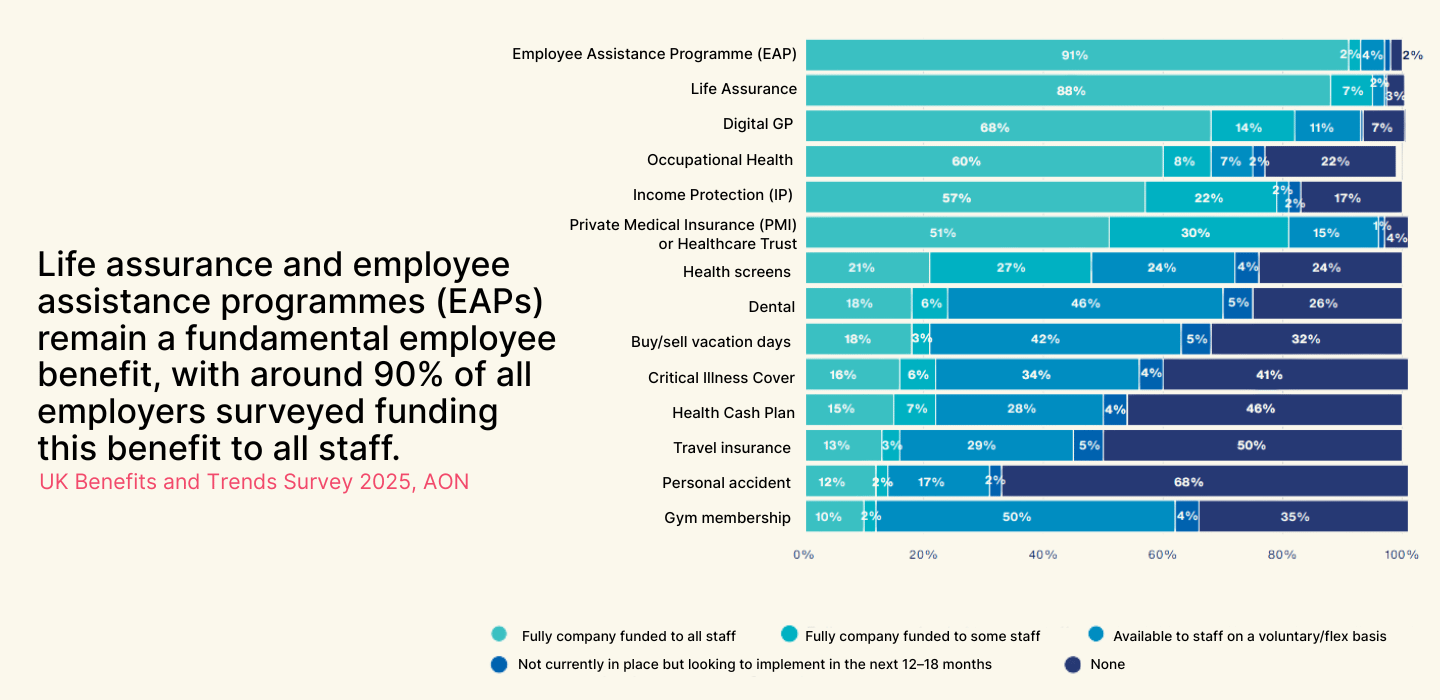
Employee Assistance Programmes (EAPs) help employees handle both personal and work-related challenges. They usually offer counselling, financial advice, and wellbeing resources to support people dealing with stress, debt, or family issues. Many organisations include EAPs in their overall wellbeing plans.
But EAPs only work well if employees know about them and can easily use them. Many people do not realise this support is available, so they do not take advantage of it. This shows a bigger issue with benefits: it is not enough to offer a programme. Employees need to understand and actually use it.
For employers, EAPs are a useful way to support health, wellbeing and boost productivity. If these programmes are clearly explained and incorporated into daily work life, they can help solve problems early and prevent bigger issues from arising.
- Women’s health support
Support for women’s health is quickly becoming a top priority, but many employers have not yet caught up. According to recent surveys, 37% of employees believe their employers should support women’s health, including topics like menstruation and menopause.
This shows that women’s health is no longer a niche concern. Instead, it is now a standard expectation, especially as companies aim to offer more inclusive and relevant benefits for employees of all ages.
Also, studies show that female employees value benefits that help with real-life challenges, not just basic coverage. Women are focusing more on engagement, work-life balance, mental health, and the needs of a diverse workforce. In practice, this could include menopause support, easier access to specialists, flexible policies for symptoms and treatment, maternal leave, and special day-permissions for mums.
How to choose the right benefit package for your employees?
An effective employee benefits package strategy is more than just extra perks. It should be a plan that fits what your employees truly need and value.
Begin by learning about your team. Factors such as age, life stage, and personal circumstances shape what matters most to them. For instance, younger employees might want support with student loans, while older staff may care more about retirement plans and healthcare. When your benefits match these needs, they feel more meaningful and can increase engagement.
Once you know your team’s needs, balance those with your business goals and budget. A good benefits package should help you attract, retain, and motivate employees, but it must also be affordable. Focus on benefits that matter most, such as healthcare, financial security, and flexibility. Each benefit should support your employees’ wellbeing and your company’s success.
Offering choice and flexibility is important too. Many companies now offer flexible benefits, allowing employees to choose what suits their lifestyle. This approach makes benefits feel more valuable without increasing costs and helps support a more diverse workforce.
Clear communication and regular updates are essential for a successful benefits programme. Employees need to understand what’s offered and how to use it, or even great benefits may go unused. By gathering feedback, reviewing data, and making changes as needed, you can keep your program in line with employee needs and stay competitive. The best strategies are flexible, data-driven, and people-focused.
A smart addition to your employee benefits strategy
As people expect more flexibility, personalisation, and a focus on overall wellbeing, organisations need to keep up or risk being left behind. The best benefits schemes are those that adapt to what employees need, match business goals, and support every aspect of a person, not just their job.
Investing in a good benefits solution does more than boost satisfaction. It also affects performance, retention, and company culture. When employees feel supported in their physical, mental, and social wellbeing, they are more engaged, productive, and likely to stay.
This is where solutions like Wellhub stand out. Employees are actively seeking holistic, flexible ways to integrate wellbeing into their daily lives — from accessing fitness spaces and digital tools to building social connections through wellness activities.
Wellhub enables this by offering a comprehensive platform that connects employees to gyms, studios, wellness apps, and community experiences, making wellbeing accessible, consistent, and engaging. By integrating our platform into your benefits package, organisations can move beyond fragmented perks and deliver a scalable, high-impact wellbeing strategy that supports healthier employees, stronger teams, and more resilient business outcomes. Do you want to learn more? Get your free quote here
Employee benefits FAQs
What are some employee benefits examples?
Employee benefits are the extra perks that come in addition to salary. In the UK, these often include paid holidays, pension contributions, private medical and life insurance, income protection, flexible working, mental health support, gym memberships, cycle-to-work schemes, employee discounts, and budgets for learning or development. Some benefits help protect employees financially, some support their health, and others make daily work life smoother.
How much do employee benefits cost?
In the UK, employee benefits usually cost employers about 20% to 50% more on top of salaries, depending on what is offered. Many companies use 32% of salary costs as a guide, and some figure total compensation as 1.25 to 1.4 times base pay. The actual cost depends on things like company size, employee ages, salary levels, industry, and the types of benefits included. For instance, basic benefits for a small business might start at £2 to £11 per employee each month, while more complete packages are much pricier.
How do benefits improve employee morale?
Benefits help boost morale by making employees feel supported, secure, and valued. For example, health insurance can ease worries about medical bills, extra time off can help prevent burnout, and flexible working can make daily routines easier. When employees see that their employer cares about their wellbeing, they tend to be more satisfied, motivated, and positive at work. In practice, good benefits often lead to better engagement, less stress, and greater loyalty.
What are flexible employee benefits?
Flexible employee benefits let people choose or adjust perks to suit their needs. Rather than everyone getting the same package, employees can choose options such as extra holidays, different insurance, wellbeing support, or lifestyle perks. This is important because people want different things at different times in their lives. Flexible benefits make the package feel more useful and personal.
How do benefits affect employee retention?
Benefits play a big role in whether employees want to stay with a company. A good benefits package can help people feel secure and supported, and reduce their likelihood of seeking other jobs. For example, strong health cover, pension support, flexibility, and wellbeing perks can all boost loyalty. Put simply, salary might attract employees, but benefits often help keep them.
What is a good employee benefits package?
A good employee benefits package offers the main perks employees care about and makes them simple to understand and use. In the UK, this often means a mix of health support, pension contributions, paid time off, financial protection, wellbeing support, and flexible working. A strong package does not have to include everything; it just needs to include the right benefits for your team. The best packages are practical, relevant, and clearly explained.
How do benefits affect employee retention?
Benefits play a big role in whether employees want to stay with a company. A good benefits package can help people feel secure and supported, and reduce their likelihood of seeking other jobs. For example, strong health cover, pension support, flexibility, and wellbeing perks can all boost loyalty. Put simply, salary might attract employees, but benefits often help keep them.
How do benefits affect employee retention?
Benefits play a big role in whether employees want to stay with a company. A good benefits package can help people feel secure and supported, and reduce their likelihood of seeking other jobs. For example, strong health cover, pension support, flexibility, and wellbeing perks can all boost loyalty. Put simply, salary might attract employees, but benefits often help keep them.
Category
Share

The Wellhub Editorial Team empowers HR leaders to support worker wellbeing. Our original research, trend analyses, and helpful how-tos provide the tools they need to improve workforce wellness in today's fast-shifting professional landscape.
You May Also Like

The Ultimate Guide to Small UK Business Wellness Programmes in 2026
Boost retention, cut costs, and build resilience with simple wellness strategies designed for small businesses working with lean budgets.

See how to reduce employee health insurance costs | Qualidade de vida, gestão de pessoas e conteúdo para RH
It is important to offer employees a good health insurance plan, although it may not be mandatory in many sectors. Such benefits bring peace of mind and allow employees to focus on the job, not to mention the motivation factor which attracts and retains talents. Moreover, health is wealth. The wise saying makes sense, particularly […]

6 Ways Corporate Team Building Exercises Can Improve Employee Productivity | Qualidade de vida, gestão de pessoas e conteúdo para RH
Why should companies invest in team building? It is like asking why people should invest in their staff; it’s about increasing engagement from staff, in the pursuit of increased productivity which will ultimately provide the sought after, return on investment. Happy & engaged staff make for a better, more productive workplace. The benefits of team […]