Wellness Incentives: Guide and 30 ideas for all budgets
Last updated on 24 Feb 2026

UK organisations face economic pressures, hybrid work, higher stress, and tough competition for talent. In these conditions, employee wellbeing is key to strong performance. Yet, even well-designed wellbeing programmes often struggle to keep people engaged.
Wellness incentives can help with this challenge. People do not develop healthier habits by accident. They need motivation, clear communication, support from leaders, and real rewards.
Wellness incentives encourage people to make positive changes that last:
- they give people a reason to begin,
- motivation to continue,
- support to build healthy habits,
- and recognition that helps build a stronger workplace culture.
When done right, incentives do not take away people’s own motivation. Instead, they help by making healthy choices easier to notice, try, and enjoy. When people feel better, they also perform better.
What are wellness incentives?
Wellness incentives are rewards employers offer to encourage employees to participate in wellness programmes and adopt healthier behaviors.
These incentives help people take part in activities like fitness programs, mental health support, preventive screenings, and other healthy habits. The goal is to encourage positive behavior and keep people involved over time.
They work best when they reward people for joining in and making progress, rather than punishing them for missing goals. This way, programs include everyone and do not make employees feel left out.
These incentives can be effective even if they are not expensive. The key is good planning. They should be based on what we know about changing habits and should reward steady actions over time, not just one-time achievements. Cultural factors also matter, and incentives are most effective when they fit with recognition strategies and the organization’s values.
In simple terms, wellness incentives are structured motivators that help employees:
- Participate in wellbeing programmes
- Adopt healthier habits
- Stay engaged over time
- Feel recognised and valued
They are the bridge between strategy and sustained behavioural change.
Types of wellness incentives (with examples)
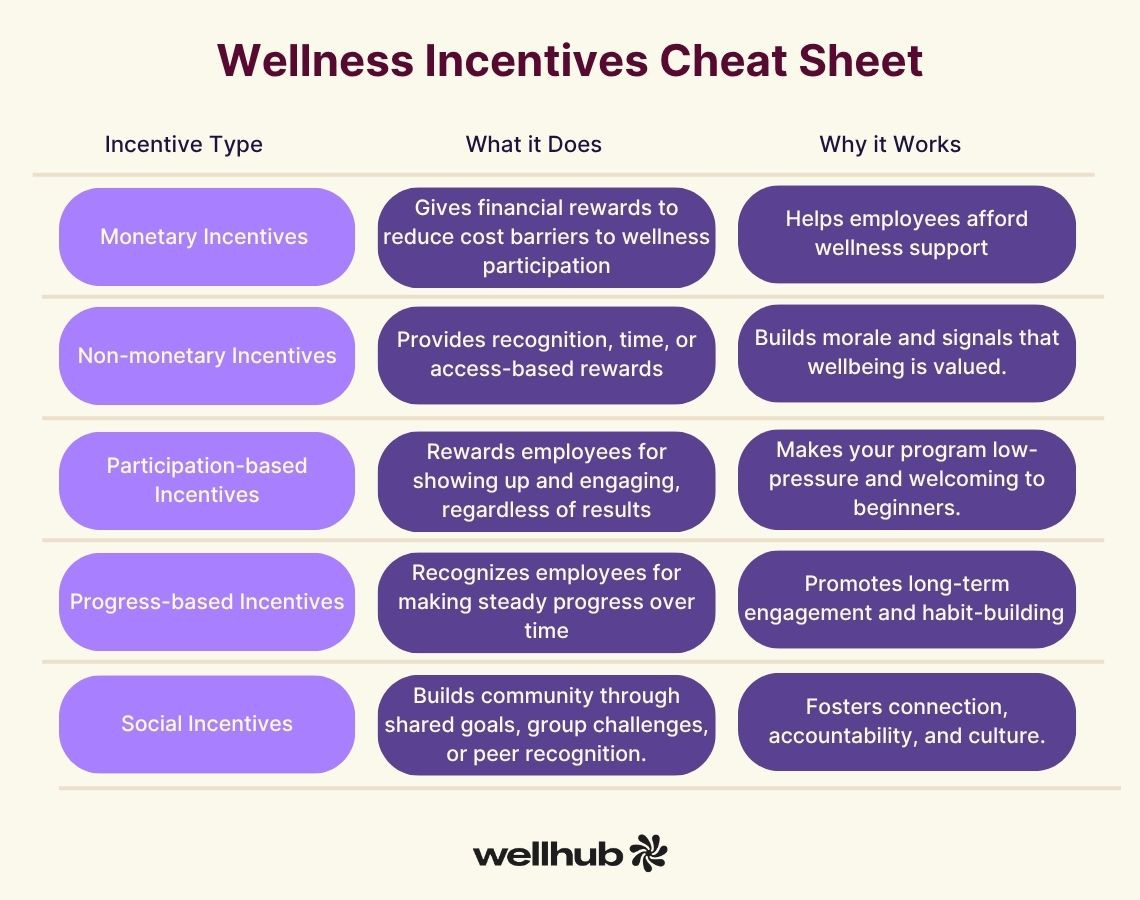
Wellness incentives work best as part of a system, not as one-off rewards. Because employees are motivated by different things—such as time, money, recognition, social connection, or personal growth—the most effective strategy use a mix of incentives to reach everyone.
Financial incentives
Financial wellness incentives offer employees direct economic value. They are useful for encouraging early participation, speeding up sign-ups, and motivating employees to join activities they might otherwise delay, like preventive health checks.
Examples
- Gift cards (supermarkets, high street brands, online retailers)
- Cash bonuses for completing milestones
- Wellness stipends (monthly/quarterly allowance for wellbeing spending)
- Reimbursements (gym memberships, classes, fitness apps, wearable devices)
Where financial incentives shine
- Launch phase: When you need momentum quickly
- Low-awareness programmes: When employees don’t yet see the benefit
- Barrier-reduction: When cost prevents participation (e.g., fitness access)
Key risks to manage
- If employees participate only for the reward, their engagement may decrease once the incentives stop.
- Employees may view rewards as unfair if they are based on health outcomes, such as weight loss, rather than on effort.
Best-practice design
- Reward actions as well as results. For example, give credit for attending a wellbeing session, not just for reaching a target weight.
- Offer tiered rewards, like a small reward for joining and a larger one for staying consistent, to keep people engaged over time.
- Ensure rewards feel valuable. Even small rewards can work well if employees believe they are worth the effort.
Non-monetary incentives
Non-monetary wellness incentives are often effective because they feel more personal and less transactional. They are also affordable and easy to scale.
Examples
- Extra paid time off (wellbeing day, “earned” recovery day)
- Flexible scheduling perks (late start, early finish, meeting-free morning)
- Priority booking for popular benefits (classes, coaching sessions, workshops)
- Workspace perks (better parking space, upgraded chair/desk accessories)
- Recognition awards (wellbeing Champion, Team Wellbeing Award)
- Skill-based rewards (access to training, wellbeing learning sessions)
Where non-monetary incentives shine
- Building culture: Use these incentives when you want wellbeing to become part of daily work, not just an extra activity.
- Retention and morale: These work well when employees value flexibility and autonomy.
- Hybrid workforces: These incentives are helpful when experiences and time-based perks can reach employees wherever they work.
Key risks to manage
- If recognition feels generic or insincere, it can reduce trust.
- Time-based perks need to be fair for all roles, especially for frontline or shift-based teams.
Best-practice design
- Give specific recognition, like “for leading weekly walks that increased participation by 30%,” instead of general praise.
- Offer equivalent options for different job types (e.g., shift-friendly flexibility alternatives).
- Link non-monetary rewards to clear milestones so employees understand how to earn them.
You may also like to read: Wellness Wednesday (ideas to boost your staff wellbeing at work)
Behavioural (points-based) incentives
Behavioural wellness incentives reward consistent actions over time. They help build habits by encouraging small steps and keeping people motivated.
This type often uses gamification, like points, streaks, badges, and levels. It works best when paired with a platform or a simple tracking system.
Examples
Employees earn points for:
- Completing a wellbeing assessment
- Attending sessions (fitness, mindfulness, nutrition, sleep)
- Participating in challenges (steps, hydration, movement breaks)
- Completing learning modules (stress, burnout prevention, financial wellbeing)
- Logging healthy habits (walks, meditation minutes, screen breaks)
Points can be redeemed for:
- Gift cards
- Extra wellbeing time off
- Wellness merchandise
- Experiences (classes, workshops, coaching)
- Donations to chosen charities
Where behavioural incentives shine
- Sustained engagement: When participation drops after the initial campaign
- Habit formation: When you want long-term behaviour change
- Measurable ROI: When leadership expects participation metrics and outcomes tracking
Key risks to manage
- Too much competition can discourage people who are less confident.
- If the system is too complex, people may not take part because they do not understand how it works.
Best-practice design
- Reward how often and how regularly people participate, such as joining each week, rather than only rewarding those who do the most.
- Keep the structure simple, for example, give 10 points for each activity and a reward for reaching 100 points.
- Provide severalways to earn points so the strategy includes people with different abilities and preferences.
- Recognize personal progress, not just those who finish first.
Social and team-based incentives
Social wellness incentives work well because people often follow each other's behavior. When wellbeing is visible and shared, more people join in due to a sense of belonging, accountability, and encouragement.
Examples
- Team step or movement challenges
- Department wellbeing leaderboards (with fairness adjustments)
- Buddy “wellbeing partners”
- Group goals (e.g., “as a team, complete 300 hours of movement this month”)
- Charity-linked activity challenges (miles walked = donation)
- Team rewards (shared lunch, team experience, recognition)
Where social incentives shine
- Building connection and morale: These incentives are especially helpful in hybrid workplaces, where it can be harder to maintain a sense of community.
- Onboarding and culture: Use these incentives to help new employees settle in and build shared habits.
- Employee-led wellbeing: These incentives help employees feel supported by their peers rather than managed solely by HR.
Key risks to manage
- Social comparison can be harmful if rewards only go to employees who are already very fit.
- Hybrid teams may feel excluded if activities focus only on employees in the office.
Best-practice design
- Reward participation and team progress, not just winning.
- Design challenges so remote workers, people with disabilities, and those with limited time are included.
- Encourage teamwork by celebrating group progress and shared successes.
Experiential incentives
Experiential incentives create meaningful moments that help people feel more connected to wellbeing and to your organization. These experiences can be simple, like onsite sessions, or more elaborate, like retreats. Their value often comes from being memorable.
Examples
- Guided mindfulness sessions
- Yoga/Pilates classes (in-person or virtual)
- Sleep workshops or fatigue management sessions
- Financial wellbeing clinics (budgeting, pensions, debt support, signposting)
- Coaching sessions (fitness, nutrition, stress)
- Wellbeing days or “recharge events.”
- Health fairs (screenings, consultations, wellbeing taster sessions)
Where experiential incentives shine
- Deepening engagement: Use these incentives to make wellbeing a real part of daily life, not just an extra perk.
- Reinforcing culture: Shared experiences show employees that leaders are committed to wellbeing.
- Wellbeing education: These experiences help employees build skills such as stress management, healthy sleep habits, and financial resilience.
Key risks to manage
- If the timing is wrong or the topics are not relevant, fewer people will participate.
- Make sure experiences are inclusive and accessible by considering time zones, shift schedules, and options that work for neurodiverse employees.
Best-practice design
- Offer a mix of live and on-demand formats.
- Ask employees what they want and design experiences based on their interests. Find out what employees want and design experiences based on their interests.milestones in a broader incentive pathway (e.g., “attend 3 workshops → unlock a wellbeing day”).
Why does a mixed incentive model work best?
Relying on just one type of incentive rarely leads to lasting change. The best strategies combine several types:
- Financial incentives to activate participation and reduce barriers
- Behavioural incentives to reinforce habit formation
- Social incentives to build belonging and accountability
- Non-monetary incentives to strengthen autonomy and culture
- Experiential incentives to create meaning and emotional stickiness
The aim is not simply to pay people to be he. Instead, ty. Instead, the goal is to make wellbeing easy to keep up, and rewarding enough that it becomes a natural part of daily life and work culture.
Benefits of providing wellness incentives
Wellness incentives do more than increase sign-up rates. With good planning, they can change behaviour, improve workplace culture, and help the whole company perform better by making healthy choices easier to start and maintain.
Increased participation and sustained engagement
Wellness incentives give employees a clear reason to join, like a reward, recognition, or reaching a milestone. They also keep people involved by offering step-by-step goals and regular encouragement, which helps turn one-time actions into lasting habits.
Stronger habit formation and behaviour change
Incentives can help people start new habits, encourage them to keep going, and let them see the benefits, which can motivate them further. Incentive activities work best when they reward effort, consistency, and progress, making it easier for everyone to join in, no matter where they start.
When employees join in activities like exercise, stress management, better sleep, mental health tools, and health checks, incentives help them build healthier routines. This brings more energy, better resilience, and greater awareness of health risks, especially when rewards focus on habits, not just one-time actions.
Reduced absenteeism and presenteeism
Incentives that encourage healthy habits often lead to fewer short-term absences and better recovery. They can also reduce presenteeism by improving focus, mood, and mental stamina, especially when they support activities like movement breaks, stress relief, and better sleep.
A clear wellness incentives program shows your company truly supports wellbeing. It also helps keep employees by building trust and loyalty. People are more likely to stay when they know their long-term health and balance matter to their employer.
Better performance, resilience and connection
Wellbeing incentives support key parts of good performance, like energy, focus, emotional balance, and recovery. This helps employees keep working without burning out, boosts daily productivity, and makes the organisation more resilient during busy times.
Rewarding certain behaviours helps set workplace norms. Offering wellbeing incentives builds a culture that values long-term performance. Team incentives also help people feel connected and included, which matters in hybrid workplaces. They create shared goals, encourage positive peer influence, and make healthy habits more visible.
Lower organisational risk and cost exposure
Encouraging employees to join wellbeing activities can reduce problems like absences, burnout, and turnover. It also helps prevent small issues from turning into costly long-term problems, making incentives a useful tool for managing risk and supporting people.
Over time, wellness incentives support sustainable performance cultures by normalising recovery, balance, and preventive care, reducing “always-on” patterns that lead to chronic fatigue and attrition, and helping organisations maintain consistent performance without exhausting the people who deliver it.
30 wellness incentive ideas (for all budgets)
Below are 30 practical wellness incentive ideas, segmented by budget level:
Low-cost / budget-friendly ideas
- Public recognition in company communications
Celebrate employees who take part in activities or health campaigns by mentioning them in newsletters, intranet updates, or at town halls. This recognition encourages good habits and shows others what they can achieve, all at no extra cost.
- Digital badges for participation
Hand out digital badges when employees finish challenges or join sessions. These badges show progress and motivate people, especially when everyone can see them on company platforms.
- Team hydration challenge (The “hydration league” or “water wins” Campaign)
Make daily water intake fun by starting a team campaign like the “Hydration League” or “Water Wins” challenge. Teams track their hydration points over a set time, such as earning one point for each refillable bottle finished. As teams reach themed milestones like “Rainmaker,” “River Builders,” or “Ocean Achievers,” you can show their progress with visual trackers in the office or on the intranet.
To keep people interested, offer small rewards at each milestone, like infused water stations, smoothie vouchers, or a “Hydration Happy Hour” where the team enjoys healthy drinks together. This makes hydration more visible, social, and fun, while building a simple but powerful daily wellbeing habit.
- Walking meetings (the “step & solve” Series)
Turn regular meetings into energising “step & solve” sessions, where some internal catch-ups become walking meetings. Set a simple structure: 30 minutes, no slides, a clear agenda, and a short summary shared afterwards. Teams can track their walking-meeting minutes and earn small rewards when they reach milestones.
Make it more fun by adding themed routes like “Strategy Stroll” or “Innovation Loop,” and use reflection prompts to spark creative thinking. You can also have monthly “Power Walk Fridays,” where each department takes at least one meeting outdoors.
For hybrid teams, remote employees can join by audio while walking in their own space, so everyone can take part. This approach boosts movement and also helps creativity, focus, and teamwork by changing the meeting environment.
- Wellness leaderboard
Create a points leaderboard for joining different activities. When everyone can see the scores, it encourages friendly competition and keeps people engaged.
- Peer-nominated wellness champion award
Allow employees to nominate coworkers who show healthy habits. This helps build community and highlights positive role models.
- Team “move-to-money” pot (group lunch or Friday team-building)
Turn the team’s total steps or activity minutes into a shared wellness fund. For example, every 10,000 steps or 60 minutes of activity adds money to the pot, up to a set monthly limit. When the team hits the goal, they get a reward like a group lunch, coffee outing, or an early Friday finish for a team activity such as an escape room, bowling, mini golf, or a wellbeing workshop.
This way, everyone’s effort matters, and the reward brings the team together while supporting wellbeing.
- Healthy recipe competition (with live cook-off or cafeteria feature)
Ask employees to share their favourite healthy recipes, and let colleagues vote for the most appealing, practical, or creative one. To make it more engaging, the winning recipe can be cooked live in the office kitchen as a team cook-off or featured on the cafeteria menu for a day or week, if possible. This makes the incentive a shared experience, not just a contest.
It celebrates healthy eating, starts conversations about nutrition, and gives the winner visible recognition while encouraging others to try something new.
- Wellbeing newsletter spotlights
Share tips, personal wellbeing stories, or department successes. These stories help people connect and keep wellbeing in focus.
- Mental health awareness webinars (The “mind Gym” series)
Turn traditional webinars into a branded “Mind Gym” series with short, high-impact sessions that build practical mental fitness skills. Instead of just listening, each session covers one actionable theme, like “Stress Reset in 10 Minutes,” “Sleep Upgrade,” or “Burnout Early Warning Signs,” and includes live exercises employees can try right away.
To boost engagement, offer a digital “Mind Gym Passport” where employees collect stamps for joining sessions, completing reflection prompts, or trying micro-habits between webinars. When participants collect enough stamps, they earn a reward like a wellbeing hour, a small voucher, or a chance to win a prize.
You can also add anonymous Q&A or peer story spotlights to make the sessions feel safe, relevant, and relatable. This turns mental health education from a one-time event into an ongoing, skill-building experience.
Moderate budget ideas
- Gift cards for milestone completion (The “wellness wins wallet”)
Try a tiered “Wellness Wins Wallet” instead of single-use vouchers. Employees earn higher-value gift cards as they reach engagement streaks, like £10 for 4 weeks and £25 for 8 weeks. Surprise “double points weeks” can boost motivation, making gift cards part of an ongoing journey.
- Fitness challenge prizes (mystery wellness drops)
Instead of fixed prizes, offer “Mystery Wellness Drops” unlocked when participation goals are reached. Prizes might include fitness gear, experience vouchers, or recovery tools like massage balls and yoga kits. The surprise factor helps boost excitement and participation across teams.
- Wellness merchandise (build-your-own wellbeing kit)
Let employees create their own “Wellbeing Kit” with credits they earn, rather than giving everyone the same items. They can choose from things like resistance bands, desk stretch guides, sleep masks, blue-light glasses, or mindfulness journals. This choice makes the reward feel more valuable and personal.
- Extra half-day leave for participation (recharge pass)
Offer extra leave as a “Recharge Pass” for employees who regularly take part in wellbeing activities. They can use it for a Friday afternoon break, a mental health day, or a longer weekend. Present this as a way to support lasting performance, not just a bonus day off.
- Self-care hour vouchers ("wellbeing time bank")
Introduce “Self-Care Hour” passes that employees earn through consistent participation in wellbeing activities. These passes can be redeemed during the working day for restorative activities such as a walk outdoors, a gym session, mindfulness practice, reading break, or simply uninterrupted quiet time.
To make it more engaging, frame it as a “Wellbeing Passport” where each completed activity (e.g., workshop attendance, challenge participation, mental health session) earns a stamp. Once employees collect a set number of stamps, they unlock a Power Hour.
You could even introduce themed passes — “Move Hour”, “Mind Hour”, or “Reset Hour” — allowing employees to choose how they recharge. This removes guilt around taking restorative time and formally embeds recovery into performance culture, signalling that wellbeing is not a reward after work — it’s part of work.
- Healthy snack deliveries (fuel fridays or energy stations)
Make snack rewards more fun with themed experiences like “Fuel Fridays,” where teams unlock snack boxes by reaching participation goals. For hybrid teams, give healthy grocery vouchers. You can also set up rotating “Energy Stations” in the office with smoothies or healthy snacks.
- Mindfulness or wellbeing app subscription (the 30-Day reset challenge)
Rather than quietly offering app access, launch a 30-day guided reset challenge using the platform. Provide weekly prompts, short reflection check-ins, and progress badges. Employees who complete the full reset unlock an additional reward, reinforcing sustained use rather than passive access.
- Onsite or virtual yoga sessions (pop-up reset sessions)
Offer surprise “Pop-Up Reset” sessions, like 20-minute yoga, stretching, or breathwork breaks announced on the same day to spark spontaneous participation. Departments with the most attendees each quarter earn a shared reward that brings movement and team bonding together.
- Nutrition workshops (cook & learn series)
Make nutrition education hands-on with a “Cook & Learn” series. Host live demos in the office kitchen or online so employees can join from home. Share ingredient lists ahead of time and reward participants with a digital recipe book or a healthy ingredient voucher.
- Department competition rewards (wellbeing league cup)
Start a quarterly “Wellbeing League Cup” where departments earn points for joining different activities like movement, workshops, or mental health sessions. Rather than just a trophy, the winning team picks a shared reward, such as a team lunch, early finish, or team-building event. Changing up the challenges keeps things fresh and welcoming.
Strategic investment ideas
- Gym membership reimbursement (the “move your way” fund)
Replace the usual reimbursement policy with a flexible “Move Your Way” fund, allowing employees to pick how they stay active. Choices might include gym memberships, climbing centers, dance classes, martial arts, swimming, or outdoor clubs.
Offer quarterly “movement milestones” so employees who stay active can earn extra perks, such as an afternoon off. This approach gives everyone more options and makes fitness more inclusive, not just focused on the gym.
- Wellness stipend allowance (personal wellbeing portfolio)
Provide the stipend as a “Personal Wellbeing Portfolio,” giving employees an annual allowance for their physical, mental, or financial health. They can use it for therapy, ergonomic equipment, fitness programs, or sleep tools. At the end of the year, invite employees to share what was most helpful, so everyone can learn from each other.
- Preventive screening incentives (the proactive health passport)
Start a “Proactive Health Passport” program where employees collect stamps for completing preventive screenings or health checks. When their passport is full, they earn a meaningful reward, like extra wellbeing leave or a special experience. Presenting screenings as empowering, not just required, encourages more participation and highlights the value of prevention.
- Health benefit contribution enhancements (wellness multiplier programme)
Set up a “Wellness Multiplier” so employees who regularly take part in wellbeing programs get extra employer contributions or added benefit credits. The aim is to reward steady participation, not penalize anyone. This links healthy habits to real financial rewards and supports fairness and transparency.
- Wearable device reimbursement (the data-to-discovery challenge)
Offer subsidies for wearable devices and use them in optional “Data-to-Discovery” challenges. Employees can track and learn about their sleep, stress, and movement patterns. Offer insight sessions or digital dashboards to help people understand their data. When employees reach milestones, they can earn recovery kits or special rewards, making data useful for self-awareness.
- Recharge day (the company reset day)
Host an annual “Company Reset Day” focused on rest and reflection. The day can feature guided movement, expert talks, creative workshops, quiet spaces, and team activities. Offer virtual options for hybrid teams as well. This event becomes a key part of company culture, underscoring the importance of recovery and long-term performance.
- Structured Points-Based Rewards Platform (The Wellbeing Marketplace)
Create a digital platform where employees earn points for joining wellbeing activities. They can spend these points in a curated “Wellbeing Marketplace.” Rewards could include experiences, merchandise, extra time off, or charity donations. Update the marketplace regularly so employees always have choices that match their goals.
- Employee Wellness Ambassador Programme (Wellbeing Catalysts Network)
Develop a network of “Wellbeing Catalysts” across departments to lead initiatives, host small events, and collect feedback. Ambassadors can earn leadership development or exclusive training as rewards. This approach puts wellbeing ownership in teams instead of only in HR.inancial Wellbeing Incentives (The Future-Proof Fund Series)
Start a financial wellbeing pathway where employees join workshops on budgeting, pensions, mortgages, or debt management. When they finish the pathway, they unlock contributions to a savings pot, a financial coaching session, or matched savings. This approach frames financial literacy as empowerment rather than just crisis support.
- Tiered Performance-Linked Wellness Bonus (The Sustainability Bonus Model)
Set up a long-term tiered system where ongoing participation throughout the year leads to bigger rewards. For example, bronze is for quarterly consistency, silver for six months, and gold for a full year. The top tier could offer a premium experience, extra leave, or more benefit credits. This model encourages lasting engagement and shows that sustainable wellbeing leads to better performance.
90-Day launch roadmap for a wellness incentive strategy
A strong wellness incentive strategy develops in stages. The first 90 days matter most because they build trust, create excitement, and set the habits that keep people involved over time. Here’s a clear plan broken into three 30-day phases: Design, Launch, and Embed.
Days 1–30: design and foundation
- Clarify objectives and define success metrics
Decide on your main goal, like raising participation to 60%, lowering stress-related absences, or improving engagement scores. Choose 3 to 5 key metrics to track from the start, such as participation rate, repeat engagement, or session attendance.
Collect baseline data now so you can see your progress later.
- Gather employee insight
Run a short pulse survey (5–7 questions max) to identify:
- Preferred incentive types (time off, gift cards, recognition, experiences)
- Biggest wellbeing priorities (stress, movement, financial health, sleep)
- Barriers to participation (time, workload, awareness)
Make the survey short and easy to find. Share the main results with your team to stay transparent.
- Design the incentive architecture
Define:
- What activities earn points or milestones
- How rewards are structured (tiered system works best)
- How frequently rewards are distributed
- What the cap or budget limit will be
Keep things simple. If employees can’t explain the incentives in one sentence, make it easier to understand.
- Secure leadership sponsorship
Brief senior leaders on:
- The business case
- Expected outcomes
- Their role in modelling participation
Invite at least two or three well-known leaders to join the first challenge and show their support openly.
Deliverables by Day 30:
✔ Clear objectives and KPIs
✔ Defined incentive structure
✔ Leadership endorsement secured
✔ Communication plan drafted
Days 31–60: launch and activate
- Create a strong strategy identity
Pick a name for your stratedy and your cmapaigns, like “Thrive90,” “Move & Mind,” or “Wellbeing Wins.” Create simple visuals and use the same style throughout. Good branding helps people remember and trust the initiatives.
- Launch week campaign
Use a multi-channel approach:
- Launch email from senior leader
- Intranet spotlight
- Team briefing slides for managers
- Posters or digital banners
- Short explainer video (optional but powerful)
Explain clearly:
- Why this strategy exists
- How to participate
- What rewards are available
- When the first milestone is achieved
Clear information helps people feel confident about joining.
- Run a 30-day kick-off challenge
Begin with an easy challenge that everyone can join, like tracking movement, attending wellbeing workshops, drinking more water, or taking mental reset sessions. Early wins help people feel confident.
Offer:
- Small milestone rewards
- Weekly updates
- Visible progress tracking
Send short reminders to keep everyone motivated.
- Recognise early adopters
Thank teams or individuals who join in the first month. Recognizing early participants encourages others to get involved too.
Deliverables by day 60:
✔ Strategy visibly launched
✔ First challenge completed
✔ Participation metrics collected
✔ Early wins shared internally
Days 61–90: embed and optimise
- Review data and feedback
Assess:
- Participation rates
- Drop-off points
- Most popular activities
- Feedback from pulse surveys
Watch for any problems, like confusing tracking, unclear rewards, or time issues that might stop people from joining.
- Adjust and refine
Make small improvements:
- Clarify instructions
- Add additional participation pathways
- Refresh reward options
- Simplify any complex processes
Making quick improvements shows you’re listening and builds trust.
- Introduce a second themed cycle
Change the focus each month to keep things fresh, like starting with movement, then mental resilience, and then financial wellbeing. Mixing it up keeps people interested.
Consider introducing:
- Bonus point week
- Team-based challenge
- Limited-time incentive multiplier
- Share impact transparently
Communicate:
- Total participation numbers
- Collective milestones achieved
- Stories from employees
- Sharing results openly helps keep people engaged and builds a positive culture. cultural momentum.
Deliverables by day 90:
✔ Participation trends identified
✔ Adjustments implemented
✔ Second cycle launched
✔ Internal impact report shared
How does success looks like after 90 days
By the end of the first 90 days, you should have:
- A clear participation baseline
- Demonstrated leadership involvement
- Visible cultural traction
- Repeat engagement (not just one-off sign-ups)
- A refined incentive structure ready for scale
By now, the strategy moves from being something new to becoming a regular part of how your team works.
Wellness incentives are just one part of your wellbeing strategy
Wellness incentives can encourage people to take action, but they work best as part of a bigger wellbeing plan. More leaders now recognize that wellbeing is important for business success. Over half say it is critical for financial results, and most see a positive return on investment from wellness programs.
Still, incentives alone are not enough to turn good intentions into real improvements for employees. Lasting change comes from moving beyond one-time perks to a program that supports every part of a person’s wellbeing, including physical, mental, nutritional, financial, and social needs. This kind of program should focus on what employees need, work for both in-office and remote staff, and fit easily into daily routines.
A strategic partner can help put this into practice. A digital-first, holistic approach can reduce administrative work and give employees more choices, so they can participate in ways that work best for them.
Wellhub offers flexible accessand a wide range of options for physical, mental, and financial wellbeing. This whole-person approach helps organisations build healthier, more engaged, and more loyal teams.
The wellness plans employees love to make resolutions last
Wellhub offers the best fitness, mindfulness, nutrition, and sleep options all in one affordable subscription to make 2026 your healthiest year yet.
Category
Share

The Wellhub Editorial Team empowers HR leaders to support worker wellbeing. Our original research, trend analyses, and helpful how-tos provide the tools they need to improve workforce wellness in today's fast-shifting professional landscape.
You May Also Like

Workplace Wellbeing: 15 initiative ideas for UK companies
Discover useful workplace wellbeing initiatives for UK organisations with this guide, including practical ideas to support employee health, engagement, and productivity.

Employee Wellness Programme: Guide for UK HR Leaders
Build a wellness programme your employees actually use. Get 30+ ideas, a simple launch plan, and ROI metrics to prove impact.
Employee wellbeing survey in 2026: 120 sample questions +tips
Discover how to run an effective employee wellbeing survey, why it matters, and 120 questions to improve wellbeing at work.