What is employee wellbeing? Everything you need to know in 2026
Last updated on 2 Mar 2026

Did you know that many employees in the UK and around the world see workplace wellbeing as an essential element of their overall health, engagement and performance? Expectations are changing. People want more than just job security or career growth. They want workplaces where they feel healthy, balanced, and supported. As we look ahead to 2026, it will be important to make wellbeing a core part of your company culture. This can help keep your team motivated and engaged, while also lowering stress, absenteeism, and burnout. So, what should you do next?
This guide is for leaders, HR professionals, and anyone responsible for talent or company culture who wants to promote workplace wellbeing. You’ll learn its key parts, benefits, challenges and how it affects UK companies. Also, you'll get practical tips for creating a plan that supports your business goals and delivers real results.
What is employee wellbeing?
Employee wellbeing covers mental, emotional, and physical health, as well as social, financial, and professional stability in both work and personal life. It reflects how supported, safe, and fulfilled a person feels, as well as their potential for growth over time.
Employee wellbeing extends beyond wellness. Wellness focuses on habits like exercise, sleep, nutrition, and stress management, while wellbeing also includes quality of life, day-to-day experiences, and broader priorities such as belonging, purpose, job satisfaction, relationships, and financial security.
By meeting individual needs and providing help at work, companies can create a workplace that supports wellbeing through offering resources such as:
- Flexible work options and autonomy, including schedule flexibility, workload support, and time off.
- Better life-work balance, including healthy habits, physical activity, mental support and emotional stability.
- Financial wellness tools, including education, planning support, and benefits that reduce financial stress.
- Opportunities for growth and purpose, including learning, career development, recognition, and meaningful work.
- A safe, inclusive environment, including psychological safety, respectful leadership, and a culture of belonging.
Holistic approach to employee wellbeing
Employee well-being is holistic. Gallup identifies five interconnected dimensions that shape how people feel and function at work and beyond: mental and emotional health, physical health, social connection, financial security, and professional fulfillment. Our research shows that 95% of employees believe improving one aspect of wellbeing leads to improvements in the others. This highlights the importance of a comprehensive approach to wellbeing.
Mental and emotional wellbeing
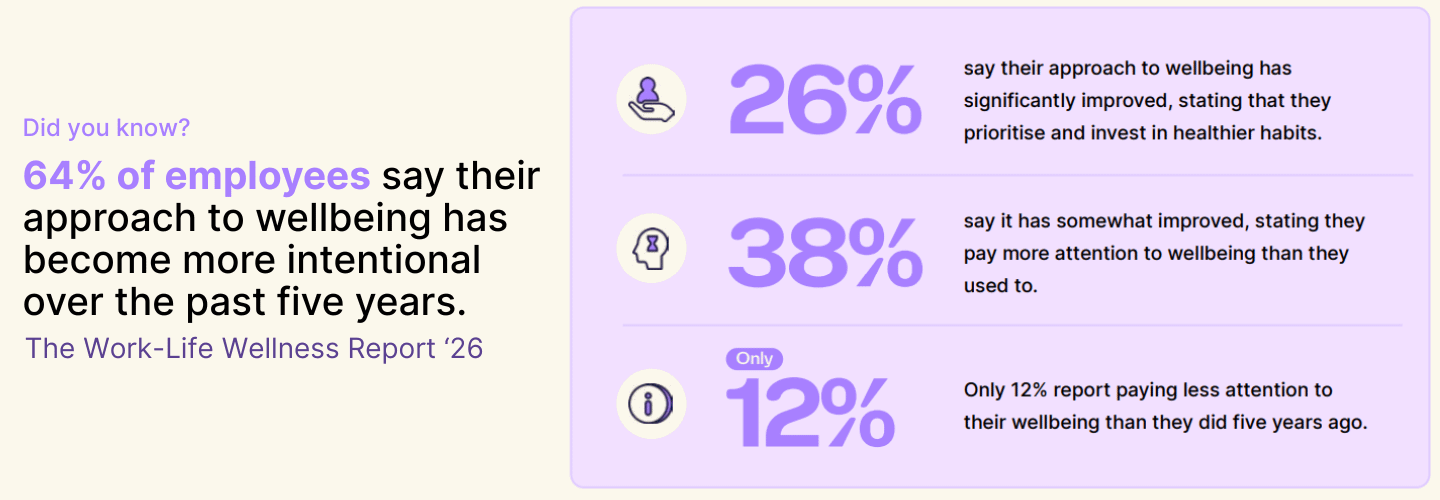
Mental and emotional wellbeing means coping daily: Can your employees manage stress correctly, stay calm under pressure, and recover from a tough week without feeling drained? In our State of Work Life Wellness report, just over half of employees mentioned their mental health is good or thriving. Those with a workplace wellbeing programme see better results: 60% rate their mental health as good or thriving, compared with 43% without one.
Poor sleep (44%) and work stress (40%) are the main challenges employees face. After all, exhaustion increases stress, lowers concentration, and disrupts healthy routines.
Physical wellbeing
Physical wellbeing is about having enough energy for daily tasks and being able to recover for the next day. It includes staying active, eating well, getting enough sleep, and keeping up healthy habits at work. However, less than half of UK employees say their physical wellbeing is good or thriving.
The main issue isn’t that people don’t care, but that it’s tough to stay consistent. While 78% are active at least once a week, 51% say lack of time is their biggest challenge. Many also find it hard to stay motivated or manage the costs.
Social wellbeing
Social wellbeing goes beyond having a support system. It means feeling like you belong, knowing you are not alone, and having people who notice when you are struggling. This is more important than many organizations realize. In our survey, 62% of employees said that community or social support is very important for maintaining wellness routines.
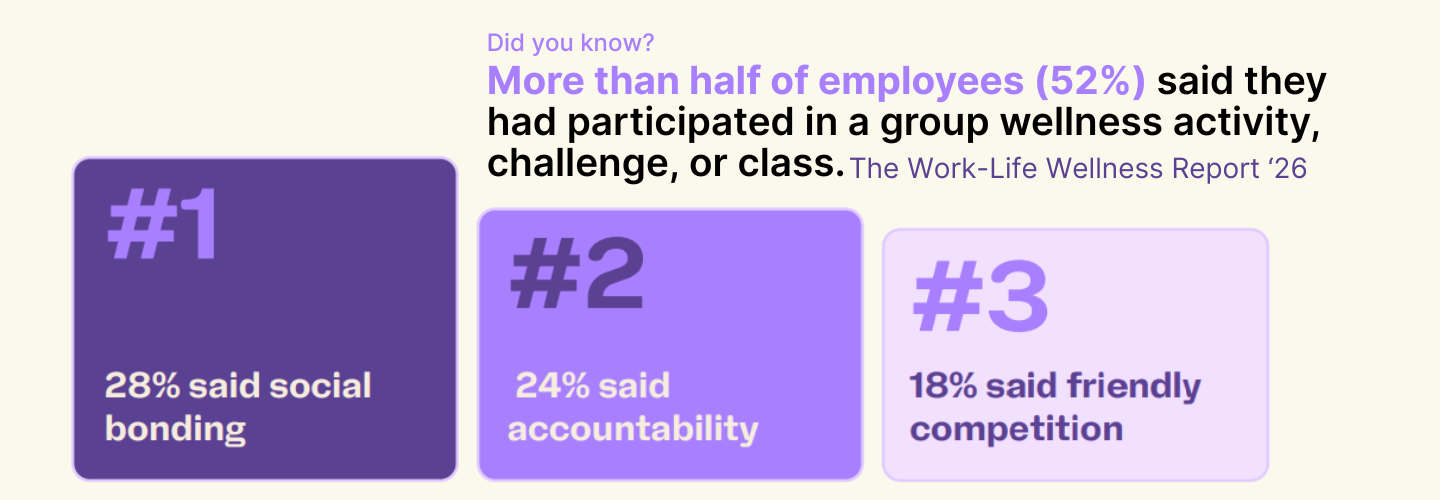
Social connection also helps people stick to healthy habits. More than half of employees have joined group wellness activities and say these experiences boosted their motivation. For hybrid and remote teams, shared wellness activities can help rebuild connections. In fact, 56% feel very connected to others during these activities.
Financial wellbeing
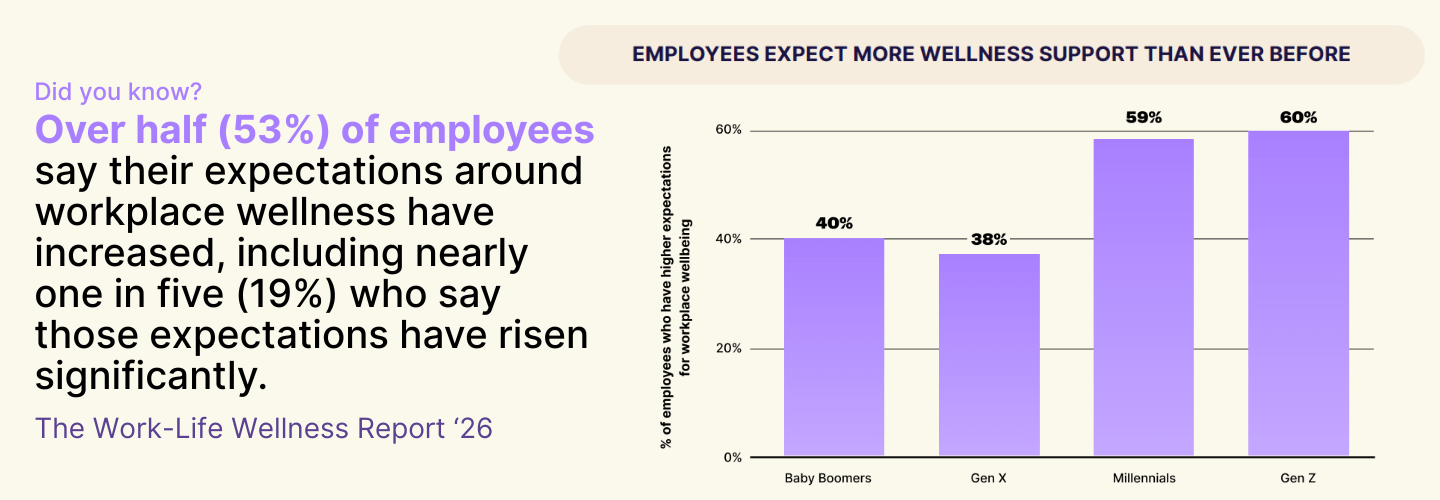
Financial wellbeing goes beyond just salary. It’s about having stability and peace of mind. Can your employees meet daily needs, plan for the future, and make healthy choices? The scale of the challenge is clear: 73% of employees think their financial situation makes it hard to invest in their wellbeing.
Key takeaway: Financial struggles significantly hinder employee wellbeing efforts. Tight finances may force people to delay therapy or skip healthy eating and exercise, even though these would help them in the long run.
Professional wellbeing
Professional wellbeing is about how employees feel at work. It covers things like having a sense of purpose, chances to grow, being recognized, having clear boundaries, and a workload that can be managed.
These factors help boost both job satisfaction and engagement. Still, burnout is a major issue, with 9 out of 10 employees reporting feeling some level of it in the past year. Because of this, what people expect from their jobs has shifted: 86% of employees now see workplace wellbeing as just as important as salary, and 89% say they perform better when it is a priority.
Afterall, personal wellbeing is shaping the employer brand: 85% would consider leaving a company that neglects employee wellbeing.
Why is employee wellbeing important?
For UK companies, employee wellbeing is essential for business. It shapes performance, influences retention, and affects how much pressure an organisation can handle when work becomes demanding.
Drives performance, productivity, and better work
When companies invest in employee wellbeing, people have more energy and focus to do their best work. For example, improving workplace wellbeing worldwide could add $11.7 trillion to the global economy, according to the World Economic Forum (WEF). In contrast, poor wellbeing can cost companies an additional $20 million per 10,000 employees and $322 billion worldwide due to burnout and lost productivity.
Even analysts estimate burnout raises voluntary turnover costs by 15%-20% of total payroll.
Reduces stress and the hidden costs of poor mental health
Wellbeing has become urgent. Our research finds that over half of full-time employees have felt more work-related stress in the past year. Meanwhile, Great Place To Work reports that 53% of UK employees feel their job demands cause too much stress. MHFA England also estimates that work-related mental health issues cost the UK economy £57.4 billion each year.
The good news is that wellbeing support can make a real difference. Our insights also show that many employees cope with work stress by exercising (59%), getting more sleep (56%), or spending time with family or friends (47%). In the UK, 66% confirm that using wellness spaces such as gyms and fitness classes helps them manage work-related stress.
Reduces healthcare costs
Lower healthcare costs are a real advantage. The impact shows in claims, premiums, and spending, not just survey results. In our Return on Wellbeing research, 68% of CEOs confirmed their corporate wellness programme helps cut healthcare costs. Companies with a wellness plan can save up to $3.27 in medical costs for every $1 they spend, a 227% return on investment. This is why many companies now treat wellbeing as part of their healthcare strategy, not just an extra benefit. In fact, 65% of wellness funding comes from the main healthcare budget.
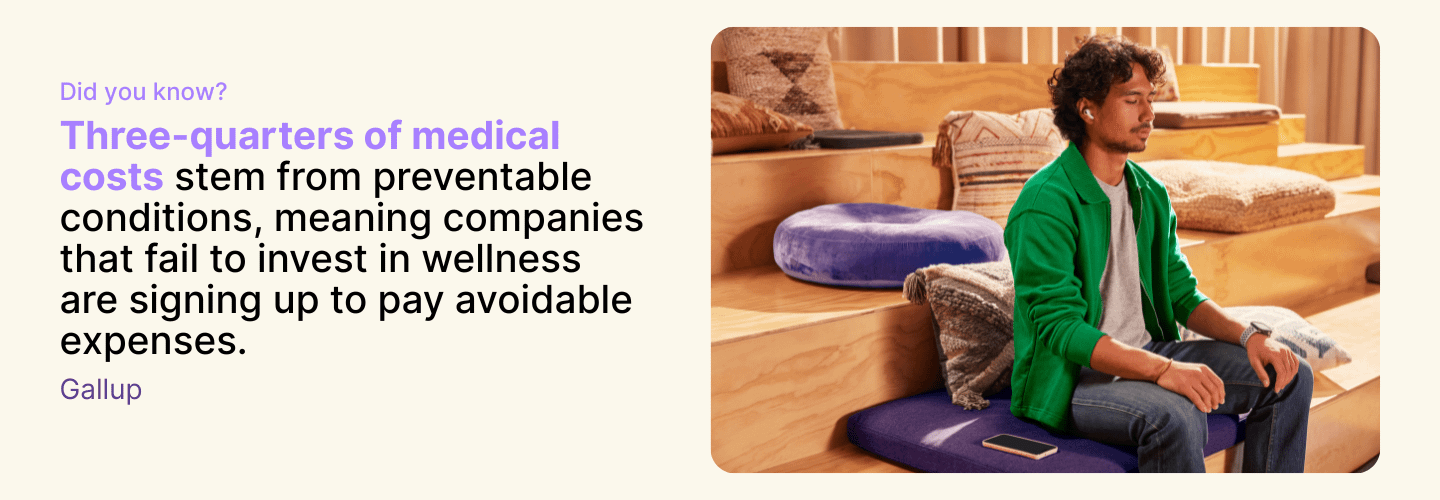
Also, it costs less to prevent problems and offer early support than to treat issues later. Supporting employees with fitness, stress, and long-term health keeps more people out of high-risk groups and reduces costly claims. For example, a six-month exercise and cardiac rehab program cut the number of high-risk individuals by 57%. It also lowered annual medical claims by $1,421 per person and gave a 6:1 return. In another study, participants who joined a wellbeing initiative saved $157 per year compared with those who did not.
For HR and benefits leaders, the next step is to measure these results alongside other benefits. Track claims trends each year and focus on the cost areas your program aims to improve, working together with your providers.
Improves retention, reduces turnover and strengthens employer brand
Our data shows that 85% of employees would consider leaving a company that does not focus on wellbeing, up from 68% in 2022. The employer brand impact is straightforward: when wellbeing is strong, people stay and advocate. Reports show employees with high workplace wellbeing are three times more likely to stay and three times more likely to recommend their employer.
How can HR leaders improve employee wellbeing in their companies?
HR can improve employee wellbeing by treating it as a whole-person priority rather than a collection of separate benefits. After all, work and life are connected. What happens at work affects home life, and vice versa. When employees have a positive work-life balance, companies see more energy, focus, and resilience within their teams.
The wellness plans employees love to make resolutions last
Wellhub offers the best fitness, mindfulness, nutrition, and sleep options all in one affordable subscription to make 2026 your healthiest year yet.
Take ownership of the work environment, not employees’ personal choices
You can’t control every factor at work, but you can shape the daily conditions people experience. Even though genetics and personal situations matter, wellbeing isn’t fixed. Organisations can help by making healthy choices easier, reducing stress factors, and building a culture that supports people as individuals.
Use a holistic approach across all five dimensions
Wellbeing works best when all areas are supported together. The more areas an employee thrives in, the bigger the impact. Improvements build up across mental and emotional health, physical health, social connection, financial security, and professional fulfilment. That means focusing on physical wellness alone is unlikely to deliver the outcomes leaders want if stress, belonging, or work design are broken.
Build care and trust into leadership and culture
People do better work when they believe their organisation genuinely cares about their wellbeing. Teams with this belief tend to perform better on metrics leaders care about, including customer engagement, profitability, productivity, turnover, and safety incidents.
For HR leaders, these areas highlight practical steps like building manager skills, supporting psychological safety, setting clear workload expectations, offering flexibility, and encouraging healthy habits.
Move beyond isolated strategies to long-term work design
Short-term wellness strategies can help, but they won't fix the root causes on their own. To improve wellbeing on a larger scale, HR leaders need to shape daily work conditions, like workload, pace, autonomy, flexibility, recognition, growth, and health. This approach fosters lasting wellbeing, resulting in significant improvements in performance, retention, and engagement.
How can companies support employee wellbeing?
The most effective way to support wellbeing is to make it part of how work is planned, managed, and evaluated, rather than treating it as a set of extra perks. At the moment, only a quarter of UK workers say they are happy at work, so this issue needs to be addressed.
Start with measurements that leaders can act on
Treat wellbeing like any other business priority: define what “good” looks like, track it, and manage it. A practical way to do this is to separate:
- Wellbeing outcomes, such as happiness, stress levels, job satisfaction, and sense of accomplishment.
- Wellbeing drivers include compensation, flexibility, trust, belonging, autonomy, and whether people feel cared for as humans.
This split is important because it helps you invest in what really matters and gives leaders a clear way to measure how people are doing.
"Fix" the work, not just the worker
Resilience training and wellbeing apps can be very helpful on a daily basis, but they cannot compensate for unhealthy ways of working. When work design is the problem, adding extra wellbeing activities can make things worse. If people are overloaded, dealing with poor processes, or working in a stressful or toxic culture, adding more to their schedule can increase pressure. The main point is that structural problems need structural solutions.
Build belonging through line managers and culture
Salary and flexibility matter, but what often makes the biggest difference day to day is social connection and belonging. When organisations look at why wellbeing varies between teams and companies, belonging and feeling cared for are the top factors. Employees usually feel this care most from their line manager and immediate team.
For HR leaders, this makes manager capability a wellbeing strategy. It is not only leadership development. It is how you protect retention, engagement, and performance.
Strengthen the basics that employees notice first
Some of the highest impact levers are also the most straightforward:
- Recognise your employees constantly.
- Give people autonomy in how they do their work.
- Create a real employee voice, so people can speak up and be heard.
- Protect psychological safety, including the safety to talk about mental health without stigma.
These changes don’t always need big budgets, but they do need consistent leadership and clear expectations for managers.
Make wellbeing a leadership priority, not an HR project
Many leaders agree that wellbeing is important, but fewer take measurable action. Over 80% of managers say investing in people is good for business, but only 19% have actions linked to a strategic priority for investing in people. For UK HR leaders, this means focusing on governance. Wellbeing needs shared ownership across the leadership team, since culture is set from the top. HR can lead, but can’t do it alone.
Start a wellness programme for your employees
A wellness programme is most effective when it builds on solid work design instead of replacing it. There are three key elements you can manage:
Set clear goals and focus on what matters. Track outcomes like happiness at work, stress, job satisfaction, and sense of purpose. Find out what affects these areas so you can use your time and budget wisely. This approach also helps you show results in ways leaders value, such as retention and productivity.
Offer support that matches real-life needs instead of using a one-size-fits-all approach. Make it simple for employees to get help with mental health, movement, recovery, and healthy habits, giving them options and flexibility. People are more likely to use support when it is easy and clearly meets their daily needs, rather than feeling like extra work.
Focus on the basics that employees notice first. For example, wellness benefits show better results when people feel treated fairly and supported by their manager.

Roll out AI with HR at the table
AI can remove repetitive tasks and increase flexibility, but it can also reduce human interaction and belonging if implemented poorly. To prevent this, involve HR and employees early in the design and rollout of new tools. If AI makes work more efficient but reduces quality or the human experience, it can hurt wellbeing and cancel out the productivity gains you wanted.
Make wellbeing a priority for your company in 2026
Prioritising employee wellbeing is now essential for organisations that want to stay competitive. Supporting people’s mental, emotional, and physical health builds the capacity, consistency, and motivation your business needs. A holistic approach is more than just standalone initiatives. It creates daily conditions that help people do their best work, like manageable workloads, flexibility, growth opportunities, and a culture of trust and belonging. When done well, investing in wellbeing boosts engagement, productivity, leadership, and retention, supporting long-term success.
Speak with our Wellbeing Sales Team to build a program that supports your employees across every dimension of their wellbeing.
Employee wellbeing FAQs
How can managers support employee wellbeing?
Managers improve employee wellbeing by setting realistic workloads, giving people autonomy, checking in regularly, and building psychological safety so employees can speak up early.
This matters because almost 90% of employees say they perform better when they prioritise wellbeing.
How to measure employee wellbeing?
Measure employee wellbeing with a mix of outcomes and drivers. Track outcomes like stress, happiness, satisfaction, and purpose. Then, monitor drivers such as workload, flexibility, manager support, and programme access, since employees with structured support report better wellbeing.
How can CFOs improve employee financial wellbeing?
CFOs can improve employee financial wellbeing through fair, transparent compensation, stronger benefits value, and budgeting and financial literacy tools. This is urgent because financial pressure is the top external stressor for 41% of employees, and work-related mental health issues are estimated to cost the UK economy £57.4 billion per year.
What is an employee wellbeing strategy?
An employee wellbeing strategy is a joined-up plan that improves wellbeing across key dimensions and fixes workplace conditions that drive stress and burnout.
It matters because only 14% of companies offer structured wellness programmes, while 95% of employees say wellbeing areas are interconnected.
Why invest in employee wellbeing?
Investing in employee wellbeing improves retention, performance, and business resilience. The need is clear in the UK, where 53% of employees say job demands cause excessive stress, and only 29% of workers are thriving at work.
The business case is also backed by ROI data: 76% of UK CEOs report a positive ROI from wellness programmes, and the WEF estimates improving workplace wellbeing could unlock $11.7 trillion in global economic value.
Category
Share

The Wellhub Editorial Team empowers HR leaders to support worker wellbeing. Our original research, trend analyses, and helpful how-tos provide the tools they need to improve workforce wellness in today's fast-shifting professional landscape.
You May Also Like

Wellness Incentives: Guide and 30 ideas for all budgets
Discover 30 wellness incentive ideas for every budget, plus a practical action plan to launch a successful programme in 2026.

Workplace Wellbeing: 15 initiative ideas for UK companies
Discover useful workplace wellbeing initiatives for UK organisations with this guide, including practical ideas to support employee health, engagement, and productivity.

Employee Wellness Programme: Guide for UK HR Leaders
Build a wellness programme your employees actually use. Get 30+ ideas, a simple launch plan, and ROI metrics to prove impact.